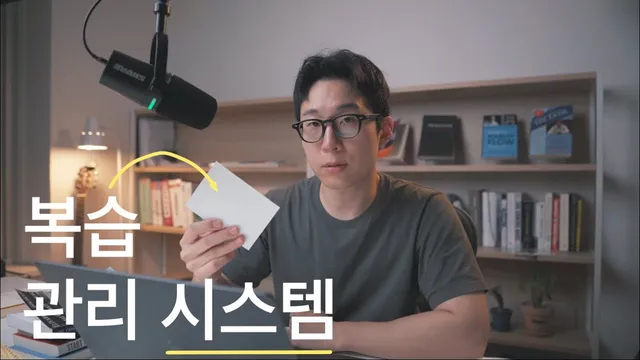
한번 배운 지식을 평생 기억하는 방법
Based on 코리안키's video on YouTube. If you like this content, support the original creators by watching, liking and subscribing to their content.
Store knowledge as question-and-answer prompts rather than as plain notes so recall can be tested later.
Briefing
Forget “saving notes and hoping you remember later.” The core idea here is a review-management system that turns newly learned information into scheduled flash-card questions, so the knowledge reappears at the exact moments it’s most likely to be forgotten—making long-term recall far more reliable.
The workflow starts with capturing facts in a note app (RokSik/록식) as question-and-answer pairs. Instead of writing a summary to reread later, the information is stored in a prompt format—e.g., “Final Cut에서 영상 클립의 속성이나 설정값을 다른 클립에 붙여 넣는 방법은?”—with the correct answer next to it. A special symbol converts these entries into flashcards, which are then sent to Anki, a mobile flashcard app.
Once in Anki, the cards are reviewed “whenever there’s a gap”: commuting on the subway, waiting for someone, or stretching at the gym. The key mechanism is adaptive scheduling. If the learner recalls the answer correctly when the question appears, the card’s next review is pushed far into the future (the example given is about three months). If recall fails, the card returns much sooner (days rather than months—such as one week or three days). This creates a pipeline where information keeps cycling back until it’s truly learned, even if it won’t be used immediately.
A concrete example is a Final Cut shortcut. The shortcut is learned during a lecture, but it may only be needed days or weeks later. By converting the shortcut into a question card and reviewing it through Anki, the learner is guaranteed to see the prompt again before the likely usage moment. The same approach is applied to language learning: while reading English originals, unfamiliar phrases like “푸딩의 증명은 먹는 것에 있다” are turned into flashcards with meanings written as answers. Repeated retrieval practice trains understanding over time.
The transcript contrasts this system with two common alternatives. First, simply keeping notes creates a “where did I save it?” problem and often requires searching—sometimes impossible when you need the information. Second, traditional “wrong answer notes” don’t scale well for managing many different knowledge types in one place. The advantage claimed here is centralized storage and retrieval: once the cards flow from RokSik into Anki, the learner doesn’t need to remember where the information lives—only to review.
The broader payoff is that knowledge isn’t just archived; it’s actively prompted and reinforced through spaced repetition. The system is presented as something that can support both exam preparation (the speaker credits it with passing the tax accountant exam) and everyday learning—shortcuts, book knowledge, and vocabulary—so that forgetting becomes manageable through consistent, even if not daily, review. The only stated requirement is maintaining regular Anki practice so the scheduling loop can do its job.
Cornell Notes
The transcript describes a “review management system” designed to prevent learned information from disappearing after the moment of learning. New knowledge is captured in a note app (RokSik/록식) as question-and-answer entries, converted into flashcards, and sent to Anki. Anki then schedules each card’s next appearance based on recall: correct answers push reviews far out (e.g., ~3 months), while failures bring them back quickly (e.g., ~1 week or 3 days). Because cards keep resurfacing as prompts, the learner doesn’t need to remember where notes are stored or search for them later. The system is presented as effective for both exam study and everyday learning, with the main requirement being consistent Anki review.
Why is storing notes alone unreliable for long-term memory?
How does the system convert raw learning into something Anki can schedule?
What does “adaptive scheduling” mean in this context, and how is it illustrated?
How is the method applied to different kinds of knowledge (not just exam facts)?
What advantages are claimed over “wrong answer notes” or a traditional second-brain approach?
Review Questions
- What specific steps turn a newly learned fact into a flashcard that Anki can schedule?
- How does the system decide whether a card should be reviewed again in days versus months?
- Give one example from the transcript of how the system handles (1) a skill and (2) a language phrase.
Key Points
- 1
Store knowledge as question-and-answer prompts rather than as plain notes so recall can be tested later.
- 2
Use RokSik/록식 to capture Q&A entries and convert them into flashcards with a designated symbol.
- 3
Send the generated flashcards to Anki so reviews happen on a phone during small daily gaps.
- 4
Rely on Anki’s adaptive scheduling: correct recall pushes the next review far out (about three months), while failures bring it back quickly (about one week or three days).
- 5
Centralize retrieval through Anki so there’s no need to remember where information was saved or to search for it later.
- 6
Apply the same pipeline to both exam preparation and everyday learning, including software shortcuts and unfamiliar book phrases.
- 7
Maintain consistent Anki practice (not necessarily daily) so the spaced repetition loop can keep knowledge from fading.