10 Books to Sharpen Your Systems Thinking (from a Professor)
Based on Readwise's video on YouTube. If you like this content, support the original creators by watching, liking and subscribing to their content.
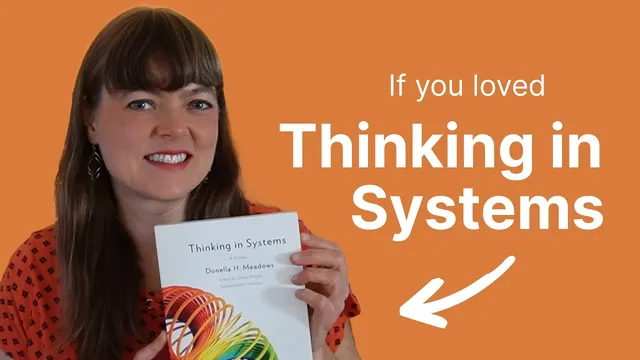
Thinking in Systems is presented as a foundational lens that makes diverse problems legible as interconnected systems with feedback and failure modes.
Briefing
Donella Meadows’ Thinking in Systems is treated as a foundational “lens” that makes everyday problems—rivalries, collapsing ecosystems, and bureaucratic decline—read like interconnected systems with feedback, incentives, and failure modes. After that shift in perspective, the natural next step is to read widely across politics, biology, game theory, science, climate risk, data ethics, and even the mathematics of sudden change—because systems thinking keeps reappearing in different forms.
The recommendations begin with Seeing Like a State by James C. Scott, which applies systems thinking to political science and anthropology. Its core focus is how centralized planners impose a simplified vision on complex societies—often through tools like maps, unified naming systems, and standardized metrics. Scott’s case studies include forced villagization, where populations are moved from countryside to cities without meaningful consent. The book’s central warning is that “good systems thinking” requires evolutionary adaptation rather than top-down engineering, and that on-the-ground knowledge—local culture, habits, and lived realities—often empowers people while also making systems work.
Nasim Taleb’s Antifragile extends the systems mindset into a counterintuitive design principle: resilience isn’t the ceiling. Systems can become stronger through stress via feedback loops. Taleb contrasts fragile systems that shatter under pressure with resilient ones that bounce back, arguing that the best outcome is antifragility—strengthening because of stress. Examples range from exercise, where muscle fibers recover stronger after breakdown, to ecosystems where trees grown without wind stress develop weaker roots and are more likely to fall. The practical challenge is calibrating “just enough” stress—too little yields weakness, too much collapses the system.
From there, The Evolution of Cooperation by Robert Axelrod brings systems thinking into game theory through the repeated Prisoner’s Dilemma. Axelrod’s tournament of strategies finds that tit for tat—cooperate first, retaliate once after defection, then forgive—wins by balancing firmness with a willingness to return to cooperation. The takeaway is behavioral and strategic: don’t defect first, retaliate briefly when trust is broken, and avoid endless punishment.
Thomas Samuel Kuhn’s The Structure of Scientific Revolutions shifts the systems lens to academia and paradigm change. A discipline’s “paradigm” sets what counts as legitimate knowledge and methods; progress accelerates when a “heretic” challenges foundational assumptions. Institutional “immune systems” resist, but change eventually arrives as old authorities fade and new voices gain traction.
Other picks focus on escalation and collapse dynamics. Crash Course by Chris Martenson uses systems escalation—like escalating fights or gerbil population booms followed by food-driven crashes—to frame planetary limits such as peak oil. Reality Blind by N.J. Hagens adds future-oriented system diagrams and emphasizes behavioral economics: human psychology and incentives shape economic and ecological outcomes.
For history and politics, End Times by Peter Turchin argues that violent revolutions follow conditions rather than fixed time intervals, highlighting mass immiseration and overproduction of elites. Governing the Commons by Elinor Ostrom then tackles collective-action problems through common-pool resources—water, forests, fisheries—showing how communities build institutions and rules that can prevent overuse.
Finally, Weapons of Math Destruction by Cathy O’Neil warns that algorithmic systems can reproduce inequality and threaten democracy when models operate beyond human visibility—illustrated by proxies like zip codes that can encode race and group-level risk. Chaos: Making a New Science by James Gleick rounds out the list by emphasizing that systems can undergo sudden phase-like transitions, such as water freezing at 32°, and that recognizing change points is crucial for understanding complex systems.
Cornell Notes
After Thinking in Systems, the reading path recommended here expands the lens across domains: politics, biology, cooperation, scientific change, escalation, future risk, governance, algorithms, and chaos. James C. Scott shows how centralized planners impose simplified models that often fail because they suppress local knowledge and evolutionary adaptation. Nasim Taleb argues for antifragility—systems can strengthen through calibrated stress via feedback loops. Robert Axelrod’s repeated Prisoner’s Dilemma highlights tit for tat as a practical strategy that combines cooperation, one-step retaliation, and quick forgiveness. The list then connects paradigm shifts, common-pool resource governance, algorithmic injustice, and sudden change points to the same underlying systems logic: outcomes emerge from interactions, incentives, and feedback over time.
Why does Seeing Like a State treat standardization (maps, naming, metrics) as both powerful and dangerous?
What does Antifragile mean by “becoming stronger because of stress,” and how is that different from resilience?
How does tit for tat outperform endless retaliation in The Evolution of Cooperation?
What mechanism drives paradigm shifts in The Structure of Scientific Revolutions?
How do Governing the Commons and Weapons of Math Destruction connect systems thinking to real-world governance and harm?
What does Chaos: Making a New Science add to systems thinking?
Review Questions
- Which recommended book most directly challenges top-down planning, and what role does local knowledge play in its argument?
- How do tit for tat and antifragility each use feedback loops, but toward different goals (cooperation vs. strengthening under stress)?
- Pick one escalation/collapse example (gerbils, oil use, violent revolutions). What system condition makes the crash likely?
Key Points
- 1
Thinking in Systems is presented as a foundational lens that makes diverse problems legible as interconnected systems with feedback and failure modes.
- 2
Seeing Like a State warns that centralized planning often fails when it replaces local, evolving knowledge with simplified standardized models.
- 3
Antifragile reframes stress as potentially beneficial when feedback loops let systems learn and strengthen—if stress is calibrated correctly.
- 4
The repeated Prisoner’s Dilemma in The Evolution of Cooperation favors tit for tat: cooperate first, retaliate once after defection, then forgive.
- 5
The Structure of Scientific Revolutions explains paradigm shifts as system-level changes in legitimacy and authority, not just new evidence.
- 6
Governing the Commons shows how communities can manage common-pool resources through institutions and enforcement rules that adapt over time.
- 7
Weapons of Math Destruction argues that algorithmic systems can encode inequality through hidden proxies and group-level correlations, even without explicit “racism” in the code.