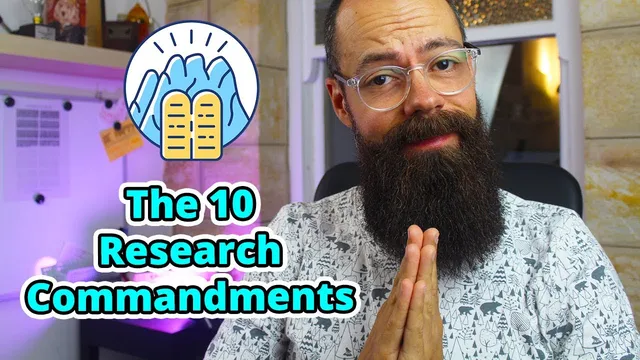
10 commandments for a successful PhD and research
Based on Andy Stapleton's video on YouTube. If you like this content, support the original creators by watching, liking and subscribing to their content.
Explore widely early by talking with researchers outside your niche and sampling unfamiliar conference sessions to gather new methods and perspectives.
Briefing
A successful PhD and research career depends less on clinging to a single “right” idea and more on actively seeking input, testing hypotheses early, and quickly abandoning what doesn’t work. The core message is to stay creatively mobile—talk to people outside one’s immediate niche, explore unfamiliar methods at conferences, and treat research like an evolving set of possibilities rather than a marriage to a topic. That openness, the advice goes, feeds the mind with new information and helps researchers find overlap and “secret elements” others may miss.
Once experiments and lines of inquiry start producing evidence, the strategy shifts from exploration to ruthless prioritization. Bad ideas should be killed quickly because time is limited; many researchers waste momentum by doubling down on approaches that fail. The recommended rhythm is to expect failure early—especially in the first year—then, after that initial hump, double down on what’s working. This includes periodic reviews of lab notebooks and notes, conversations with supervisors about what is succeeding versus stalling, and then redirecting effort toward the most productive paths while still branching into new inquiries away from the current winners.
Professional relationships and institutional navigation also matter. Researchers are urged to “honor” supervisors by taking their guidance seriously while filtering it through independent judgment; the goal is respect and a constructive working relationship, not blind agreement. A sour supervisor-student dynamic can delay progress, so maintaining professionalism is framed as a practical research accelerant. Similarly, universities are portrayed as protective of their brand, so public displays of dissatisfaction are discouraged—especially for early-career researchers who lack the leverage of senior professors.
Sustaining output requires recovery. The advice includes setting aside at least one day a week that is genuinely research-free, using activities that restore energy and improve lab focus—whether that’s time with friends and family, nature, reading, or music. The point is not just rest, but efficiency and mental stability so work stays sustainable.
The remaining “commandments” focus on research integrity and mindset. Researchers should be coachable: accept criticism without defensiveness, treat feedback as an ideas-improvement process, and admit when they’re wrong. They should also keep research open and accessible to different audiences—academic talks for specialists, more casual formats for the public—while building communication skills such as three-minute thesis presentations. Proper citation is non-negotiable, and limitations must be stated clearly to avoid overstating what data supports. Finally, early-career researchers are warned against coveting others’ careers or obsessing over metrics like Google Scholar profiles and H-index comparisons; progress is measured against one’s own trajectory, not someone else’s publishing cycle. The practical takeaway is to focus on controllables: steady work toward finishing the thesis and publishing the next paper.
Cornell Notes
The guidance for a successful PhD centers on staying intellectually flexible early, then committing resources to what works. Researchers should “explore widely” by talking to people outside their niche and sampling methods at conferences, because new perspectives often reveal useful overlaps. When evidence shows a line of inquiry isn’t working, it should be dropped quickly—failure is expected in the first year, but effort should shift toward productive approaches afterward. Success also depends on professional habits: respect supervisors while applying independent judgment, maintain a healthy weekly break to preserve focus, and respond to criticism without defensiveness. Finally, integrity matters—cite properly, acknowledge limitations, avoid metric-based comparison, and keep research communication accessible to different audiences.
Why does the advice emphasize exploring ideas and people outside one’s immediate field?
What does “kill bad ideas quickly” look like in practice during a PhD?
How should researchers balance loyalty to supervisors with independent thinking?
Why is weekly time away from research treated as a productivity strategy?
What does “be coachable” mean when receiving criticism?
How do citation and limitations protect a researcher’s career and credibility?
Review Questions
- What specific behaviors help a researcher explore enough early on to later identify the most promising lines of inquiry?
- How can a student respond to criticism in a way that improves ideas rather than escalating conflict?
- Why does the advice warn against comparing one’s metrics (like H-index) to others, and what should replace that habit?
Key Points
- 1
Explore widely early by talking with researchers outside your niche and sampling unfamiliar conference sessions to gather new methods and perspectives.
- 2
Treat the first year as a failure-tolerant phase, but once a line of inquiry is clearly failing, drop it quickly and move on.
- 3
Double down on what’s working by reviewing lab notes and discussing progress with supervisors on a regular cadence.
- 4
Maintain a constructive, respectful supervisor relationship by taking guidance seriously while filtering it through independent judgment.
- 5
Protect weekly recovery time with at least one research-free day to sustain focus and efficiency.
- 6
Respond to criticism with coachability—listen, consider the possibility you’re wrong, and aim to improve the ideas.
- 7
Avoid integrity and reputation risks by citing properly, acknowledging limitations, and resisting metric-based comparison to others’ careers.