13 Misconceptions About Global Warming
Based on Veritasium's video on YouTube. If you like this content, support the original creators by watching, liking and subscribing to their content.
“Climate change” better reflects real-world impacts—stronger extremes, sea-level rise, and ocean acidification—than “global warming” alone.
Briefing
The central takeaway is that “global warming” is only part of the story: the planet’s rising average temperature is driving a broader shift in climate patterns—stronger extremes, sea-level rise, ocean acidification, and feedbacks that amplify warming—while the evidence for a continuing upward trend and for human-caused CO2 is supported by multiple independent lines of data.
The discussion starts with a naming dispute that quickly becomes a scientific one. “Global warming” can be technically accurate because the planet’s overall average temperature is increasing, but “climate change” better captures what matters for impacts: more intense storms, droughts, floods, and ocean acidification. That framing also addresses a common tactic—pointing to cold weather or short-term fluctuations to claim the trend has stopped. The transcript counters by emphasizing that climate trends are determined by how data behave over time, not by isolated years or outdated graphs; it also notes that incorporating satellite data strengthens the case that warming continues.
Another misconception targets claims that scientists “used to say cooling.” While some 1970s papers predicted cooling, the transcript highlights that, over the same period, far more papers predicted warming. It also argues that temperature is not the only metric: sea levels rise (about three millimeters per year), ice dynamics show melting in Greenland and Antarctica, and Arctic sea ice trends are interpreted in context rather than cherry-picked.
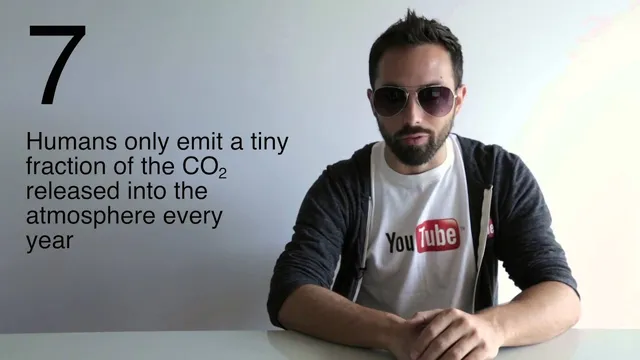
The conversation then turns to causes. The Sun is raised as an alternative driver, but the transcript notes that solar brightness has been dimmer since the 1950s even as temperatures rise. It also tackles the idea that humans emit too little CO2 to matter by comparing human emissions (about 30 gigatons per year) with natural fluxes from land and oceans (about 780 gigatons per year). The key point is that the atmosphere’s CO2 concentration has climbed from roughly 180–280 parts per million over hundreds of thousands of years to about 400 ppm today, and the annual increase is on the order of 15 gigatons (around 2 ppm). To connect that rise to human activity, the transcript cites carbon isotope evidence: carbon 13 is less common in fossil fuels than in the atmosphere, and its concentration has been decreasing.
From there, the greenhouse-gas argument expands beyond CO2. Water vapor is described as the most potent greenhouse gas, but the transcript links its increase to warming: a warmer atmosphere holds more water vapor, which boosts the greenhouse effect. It also describes a feedback chain—warming reduces ice reflectivity, further increasing absorption—and claims that multiple evidence streams converge on an overall warming of roughly 3°C for a CO2 doubling.
Finally, the transcript addresses why past climate changes don’t disprove the current one. Milankovitch cycles can trigger warming, but the transcript argues that in those records CO2 rises after temperature begins, meaning orbital changes initiate warming while CO2 amplifies it. It concludes by reframing the stakes: even if the outcome isn’t immediate catastrophe, delaying emission cuts makes future impacts—more intense extremes, sea-level rise, and ocean chemistry changes—harder and more expensive to manage.
Cornell Notes
The transcript argues that climate change is more than a warmer planet: it includes stronger extremes, sea-level rise, and ocean acidification, driven by greenhouse-gas feedbacks. It counters “global warming” skepticism by emphasizing that trends are determined over time and that multiple indicators—sea level, ice loss, and satellite-era temperature records—point upward. It also addresses causation: solar changes don’t match the timing, and human CO2 is linked to the atmospheric rise using isotope evidence (carbon 13 depletion in fossil-fuel CO2). The greenhouse effect is portrayed as a system where CO2 warming increases water vapor and reduces ice reflectivity, amplifying temperature change. Past climate cycles (Milankovitch) are used to show CO2 can amplify warming rather than being the sole initial trigger.
Why does “climate change” matter more than “global warming” for understanding impacts?
How does the transcript rebut claims that warming has stopped or that the trendline is misleading?
What evidence is used to argue that the Sun is not the main driver of recent warming?
How does the transcript connect rising atmospheric CO2 to human emissions?
Why does the transcript treat water vapor as a key greenhouse factor even though humans don’t directly emit it?
How are Milankovitch cycles used to argue that CO2 amplifies warming rather than solely causing it?
Review Questions
- Which indicators besides global average temperature are cited as evidence for ongoing warming, and what do they measure?
- What role does carbon-13 isotope evidence play in linking atmospheric CO2 changes to fossil-fuel emissions?
- How do water vapor and ice-albedo feedbacks interact with CO2-driven warming in the transcript’s causal chain?
Key Points
- 1
“Climate change” better reflects real-world impacts—stronger extremes, sea-level rise, and ocean acidification—than “global warming” alone.
- 2
Short-term weather swings (like cold winters) don’t overturn long-term climate trends; trend analysis depends on correct datasets and time windows.
- 3
Solar brightness changes don’t match the recent warming pattern because the Sun has been dimmer since the 1950s while temperatures rise.
- 4
Human CO2 matters because atmospheric CO2 has risen from long-term historical ranges to about 400 ppm, with an ongoing annual increase of roughly 2 ppm.
- 5
Carbon-13 isotope shifts provide evidence that the added CO2 is linked to fossil fuels rather than natural sources alone.
- 6
CO2 warming is amplified by feedbacks: increased water vapor and reduced ice reflectivity increase the greenhouse effect.
- 7
Past orbital-driven warmings show CO2 often rises after temperature, supporting a feedback-amplifier role for CO2 rather than CO2 being the sole initial cause.