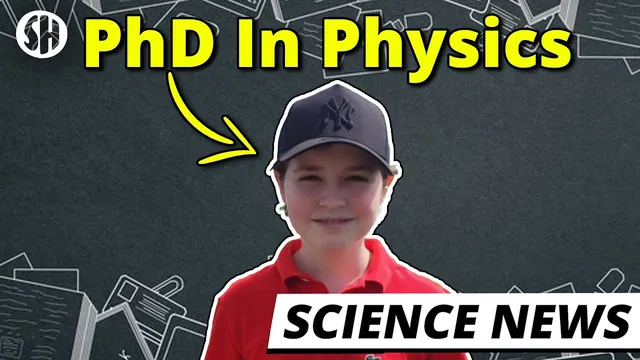
15 Year-Old Just Finished his PhD in Quantum Physics. I had a look at his thesis.
Based on Sabine Hossenfelder's video on YouTube. If you like this content, support the original creators by watching, liking and subscribing to their content.
Laurent Simons’ PhD builds on earlier work using Bose-Einstein condensates as a platform for analog quantum physics.
Briefing
A Belgian teenager, Laurent Simons, has completed a PhD in quantum physics—an achievement that spotlights both the science of quantum matter and the broader question of when advanced research should be pursued. The thesis work builds on Simons’ earlier bachelor research into “Analog physics with excitations in Bose-Einstein Condensates,” using ultra-cold atomic systems as stand-ins for harder-to-study physical scenarios.
Bose-Einstein condensates are clouds of atoms cooled to near absolute zero, where quantum behavior becomes collective and spans the entire cloud. In this regime, the condensate can act like a near-frictionless fluid, and it supports “quasiparticles”—collective excitations that behave like particles. Over the past decade, these systems have also become popular as “quantum simulation” platforms: researchers use them to probe quantum effects in other contexts, including analogs of black-hole physics and even cosmological expansion. The appeal is practical—building a controllable “laboratory universe” is far easier than constructing the real thing.
Simons’ bachelor thesis focused on Bose-Einstein condensates in the context of black-hole analogies. His PhD thesis then broadened the scope to quantum states of matter realized in atomic condensates, specifically superfluids and supersolids. The work centers on the properties of a particular type of quasiparticle within these systems. While the scientific payoff is framed as modest—more incremental than world-changing—the research is presented as a solid contribution and a meaningful step in a coherent research trajectory.
Beyond the technical content, the discussion turns to what the early PhD signals about education and ambition. The case challenges the common assumption that PhDs must happen only in one narrow life window. It also argues that many children may be more capable than society expects, especially if advanced tools like differential equations are introduced earlier. The message is not purely celebratory, though: the time spent on a PhD is also time that cannot be reclaimed, raising the tradeoff between long-term career credentials and the value of a full childhood.
The practical bottom line is that a PhD title matters most when it aligns with actual plans to conduct independent research. In many hiring contexts, the credential is less important than whether someone can deliver results quickly—start on Monday and solve problems by Tuesday. Simons’ path, paired with the broader critique of credential inflation, suggests a future where education and specialization may become more flexible, with fewer rigid assumptions about age, timing, and what a degree is “for.”
Cornell Notes
Laurent Simons completed a PhD in quantum physics at age 15, building on earlier work using Bose-Einstein condensates as quantum simulators. These near-absolute-zero atomic clouds exhibit collective quantum behavior and support quasiparticles—collective excitations that act like particles. His bachelor thesis addressed analog physics with excitations in Bose-Einstein condensates, including black-hole analogies, while the PhD focused more generally on quantum states such as superfluids and supersolids and the properties of a specific quasiparticle type. The discussion uses the thesis as a springboard to question when advanced research should happen and whether a PhD credential is worth the time for someone’s goals. The takeaway: advanced capability can appear earlier than expected, but the value of a PhD depends on whether independent research is the intended path.
What makes Bose-Einstein condensates useful for quantum simulation?
What are quasiparticles in this context?
How do superfluids and supersolids relate to the thesis topic?
Why do analog black-hole and cosmology simulations show up in headlines?
When does a PhD title actually help, according to the discussion?
What tradeoff is raised about doing a PhD at a very young age?
Review Questions
- How do Bose-Einstein condensates enable quantum simulation, and what role do quasiparticles play in that approach?
- What distinguishes superfluids and supersolids in the context of quantum states of matter, and why does that matter for excitations?
- What criteria determine whether a PhD credential is valuable for an individual’s goals, beyond the prestige of the degree?
Key Points
- 1
Laurent Simons’ PhD builds on earlier work using Bose-Einstein condensates as a platform for analog quantum physics.
- 2
Bose-Einstein condensates are ultra-cold atomic clouds near absolute zero, where quantum behavior becomes collective across the whole system.
- 3
The thesis focuses on quasiparticles—collective excitations that act like particles—within superfluids and supersolids.
- 4
Quantum simulation with condensates can model analogs of black-hole and cosmological phenomena, though it does not settle whether real geometry behaves the same way.
- 5
The discussion argues that advanced research can happen earlier than typical timelines, especially if foundational math like differential equations is introduced sooner.
- 6
A PhD title is most useful when it aligns with plans for independent research; many jobs value practical problem-solving more than credentials.
- 7
Doing a PhD young involves an opportunity cost: time that cannot be recovered from childhood.