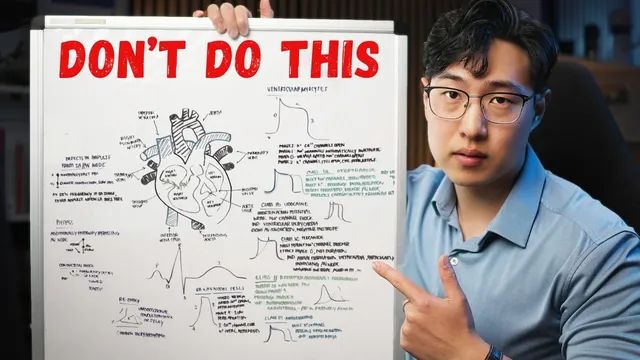
16 Note-Taking Secrets of the Top 1% of Learners
Based on Justin Sung's video on YouTube. If you like this content, support the original creators by watching, liking and subscribing to their content.
Treat note-taking as active cognition: if the brain isn’t evaluating and connecting ideas while writing, the notes won’t translate into learning.
Briefing
Top learners don’t spend more time writing—they spend more time thinking. The core rule behind the “top 1%” note-taking approach is that writing notes only helps when the brain is actively evaluating, organizing, and connecting ideas. If someone’s attention goes numb while the pen keeps moving, the overlap between “time spent writing” and “time spent learning” stays tiny, and memory won’t stick. The practical goal becomes simple: progressively reduce note volume and shift effort toward processing—then use notes as a record of that thinking, not as a substitute for it.
That mindset drives a set of concrete habits. First, write less and think more: replace full sentences with keywords, shorthand, and symbols, and aim to reduce “finger time” so cognition does the work. Second, use AI to avoid transcription as a default. When lectures can be recorded, the advice is to capture audio, then run it through AI to generate a short summary (even a single paragraph) so later study starts from meaning rather than raw detail. Third, ditch the highlighter. Highlighting can create an illusion of studying while doing little to build understanding; instead, spend the extra minutes reading actively, adding notes, and forming connections that create a memory network.
Fourth, stop copy-pasting—especially other people’s notes and diagrams. Copying feels productive because it increases the amount of material on the page, but it doesn’t force the mental “workout” of extracting meaning, paraphrasing, and linking to prior knowledge. Even diagrams should be recreated when possible, because drawing and testing your ability to reproduce them builds active recall rather than passive recognition. Fifth, stop relying on color coding as a memory engine. Colors are hard to remember; the real value comes from the decisions made while categorizing and placing information.
Sixth, use nonlinear notes to match how memory is organized: knowledge lives in networks and schemas, and the brain prunes what doesn’t fit. Nonlinear structures—mind maps, arrows, and grouped relationships—reduce the mental reconstruction needed during review and can be far easier to process than linear text. Seventh, use Cornell notes as a transition tool: cues and bottom-page summaries force questions and synthesis, but the end goal is spending more time on connecting and summarizing than on writing.
The remaining rules focus on review and structure. Zoom out often to connect new details to the bigger picture. Emphasize the important points by exaggerating “high-risk” elements in diagrams as memory cues (not as factual truth). When lectures move fast, write questions that prompt later network-building rather than isolated fact definitions. Avoid flow charts that create fragile dependency chains; build lateral groupings instead. Review within 24 hours to counter rapid memory decay, and write notes by topics rather than by lectures so meaningful cross-lecture links aren’t artificially separated. Create a template via brief pre-study to prime how concepts might connect, then convert weak, peripheral areas into flashcards.
Taken together, the system treats note-taking as an active learning design problem: reduce transcription, increase decision-making, build networks, and review quickly—so notes become a map of understanding rather than a log of everything heard.
Cornell Notes
The central insight is that note-taking only improves learning when the brain stays engaged in effortful processing—evaluating, organizing, and connecting ideas. High performers therefore write less (using shorthand and symbols), avoid “illusion of study” behaviors like highlighting, copy-pasting, and over-relying on color. They also switch from linear notes to nonlinear, network-based structures (mind maps, arrows, grouped relationships) that match how memory is stored and pruned. Review is treated as part of learning: use the 24-hour rule, zoom out to connect to the big picture, and turn weak peripheral details into flashcards. The result is notes that reflect understanding and become easier to recall and apply.
How can someone tell whether note-taking is actually helping memory?
Why does “write less” improve learning instead of reducing it?
What’s the practical alternative to writing lots of lecture notes?
Why avoid highlighting and copy-pasting?
What makes nonlinear notes more effective than linear notes?
How should review be scheduled and structured for retention?
Review Questions
- Which specific note-taking behaviors create an “illusion of study,” and what replacement actions build real understanding?
- How do nonlinear notes reduce the mental work required during review, and what visual elements (arrows, grouping, spatial layout) support that?
- What does the 24-hour rule change about the time cost of studying, and why does it matter even when notes are already written?
Key Points
- 1
Treat note-taking as active cognition: if the brain isn’t evaluating and connecting ideas while writing, the notes won’t translate into learning.
- 2
Progressively reduce note volume by using keywords, shorthand, and symbols so thinking—not transcription—drives comprehension.
- 3
Use recordings plus AI summaries when possible to avoid documenting everything and to start later study from meaning.
- 4
Avoid highlighting and copy-pasting as default strategies; instead, add notes that create connections and paraphrase information into your own understanding.
- 5
Switch from linear to nonlinear notes to mirror how memory stores knowledge in networks and schemas.
- 6
Review within 24 hours to counter memory decay, and zoom out to repeatedly connect details to the bigger picture.
- 7
Build topic-wide templates and convert weak, peripheral details into flashcards to strengthen the parts most likely to be pruned.