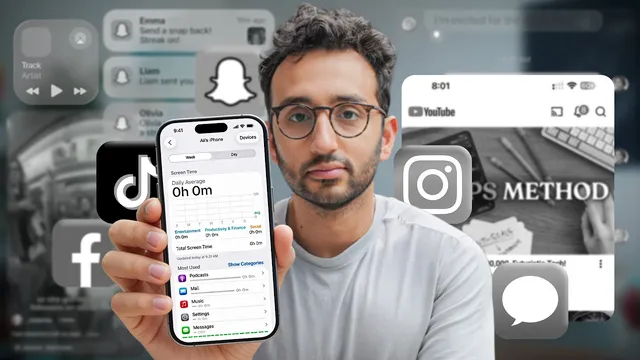
17 Micro-Habits to Improve Your Focus
Based on Ali Abdaal's video on YouTube. If you like this content, support the original creators by watching, liking and subscribing to their content.
Distraction often peaks right before starting a task, then improves after about five minutes—use that window with the “5-minute rule.”
Briefing
Improving focus often comes down to managing the first few minutes of a task and reducing the forces that pull attention away—especially the phone. A key pattern appears repeatedly: distraction peaks right before starting, then eases about five minutes in. That timing underpins the “5-minute rule,” a simple commitment tactic—tell yourself you’ll work for just five minutes, or extend a focus session by another five minutes. The discomfort of beginning is treated as a hurdle that can be outlasted, after which staying on task becomes noticeably easier.
From there, the habits focus on training attention through what people consume and how they structure their environment. Longer-form input—books, audiobooks, and movies—builds the ability to stay with a single stream of information, contrasted with the rapid switching encouraged by TikTok, Instagram Reels, and YouTube Shorts. Phone placement and usage rules aim to remove the most common distraction channel: keep the phone out of the bedroom (or at least charge it across the bed), automatically block “offending” apps at night, set screen time limits, and keep the device out of reach during work—ideally in another room, or at minimum in focus mode with notifications disabled and the screen facing down.
A deeper layer targets why distraction happens in the first place. Research summarized through Near Eel’s book Indistractible frames most distraction triggers as internal emotional states rather than external alerts—boredom, anxiety, fear, insecurity, or perfectionism. When discomfort shows up during challenging work, reaching for a phone becomes an escape from unpleasant internal sensations. The counter-practice is to name the emotion (“fear,” “uncertainty,” “perfectionism,” etc.) and then close the eyes to fully feel it instead of fleeing it. Repeatedly leaning into discomfort trains the brain and body not to treat these feelings as threats, reducing the urge to distract and making longer focus more likely.
Other micro-habits reduce friction and make deep work easier to sustain. Changing environments—moving between libraries and coffee shops—can turn focus into a skill that transfers across settings, especially with noise-cancelling headphones. Tracking progress (like word counts or experience bars in games) adds a feedback loop that makes grinding tasks feel like advancement. Breaks should recharge rather than stimulate: checking email, Slack, or social media during downtime adds new mental “open loops” instead of restoring energy.
The practical checklist also includes “hardware” basics—sleep, nutrition, exercise, and social connection—because bodily constraints can masquerade as attention problems. Notifications are narrowed to only friends and family, with other app alerts muted. Finally, tasks should be made slightly more enjoyable; even a 10% boost in enjoyment can reduce distraction and increase creativity and energy. A sponsored tool, Whisper Flow, is offered as one way to lower the effort of capturing ideas by speaking to transcribe and format text automatically, aiming to keep attention on thinking rather than typing.
Cornell Notes
Focus improves when people manage the start of work, reduce phone-driven interruptions, and train attention against internal discomfort. Distraction tends to peak just before starting and often becomes easier after about five minutes, which supports the “5-minute rule” for getting through the initial urge to quit. Many distractions come from emotional escape—boredom, anxiety, fear, insecurity, or perfectionism—so the counter is to name the emotion and fully feel it rather than reach for a device. Additional micro-habits reduce friction (change environments, track progress, recharge with real rest) and fix “hardware” issues like sleep, nutrition, exercise, and social connection. Together, these habits make sustained focus more likely and less dependent on willpower.
Why does the “5-minute rule” work for focus, and what timing does it rely on?
How do phone habits specifically undermine attention, and what concrete changes are recommended?
What does Indistractible claim about the real triggers behind distraction?
What practice is suggested to reduce distraction caused by internal discomfort?
Which habits are meant to make deep work easier to sustain without relying on willpower?
How do “hardware” factors and task enjoyment affect attention?
Review Questions
- What does the “5-minute rule” assume about when distraction peaks, and how does that shape the action step?
- How can naming an internal emotion and leaning into it reduce the urge to reach for a phone?
- Which habits target friction and feedback (progress tracking, environment changes, recharge breaks), and why do those matter for sustained focus?
Key Points
- 1
Distraction often peaks right before starting a task, then improves after about five minutes—use that window with the “5-minute rule.”
- 2
Train attention by consuming more long-form material (books, audiobooks, movies) instead of constant short-form switching.
- 3
Reduce phone-driven interruptions by moving the phone away from the bed and desk, using app-blocking and screen time limits, and disabling notifications during work.
- 4
Treat many distractions as emotional escape: name the feeling (e.g., anxiety or perfectionism) and practice fully feeling it to weaken the reflex to distract.
- 5
Make deep work easier by minimizing friction: change environments, track progress, and take breaks that recharge rather than stimulate.
- 6
Check “hardware” basics—sleep, nutrition, exercise, and social connection—because they can determine whether focus is even possible.
- 7
Increase task enjoyment by making the work slightly more fun (even ~10%), which can reduce boredom-driven distraction and boost energy.