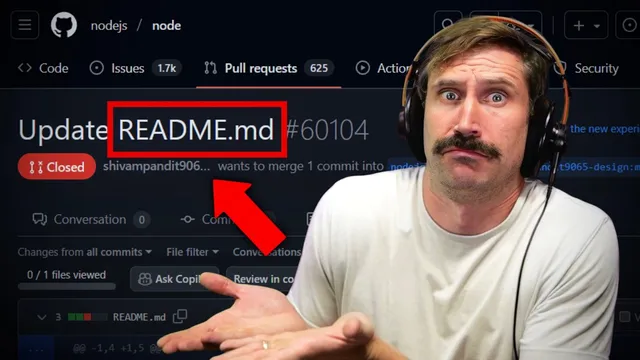
2 years later its still happening
Based on The PrimeTime's video on YouTube. If you like this content, support the original creators by watching, liking and subscribing to their content.
A beginner Git/GitHub tutorial segment is portrayed as encouraging trivial README edits (adding a name) and opening pull requests on major projects.
Briefing
A years-old YouTube tutorial is still driving waves of low-effort “name-in-the-readme” pull requests into major open-source repositories—creating recurring spam and extra workload for maintainers long after the original advice should have been retired.
The problem is traced to a Git/GitHub beginner course segment where an instructor demonstrates forking a popular project (the transcript cites ExpressJS) and then making a trivial change: adding their own name to a documentation file and opening a pull request. The transcript claims this exact behavior has been repeated at massive scale because the tutorial segment has millions of views, meaning hundreds of thousands to potentially millions of people may have followed along.
To show how widespread the fallout is, the transcript points to ongoing pull requests in ExpressJS repositories that appear to be automated or copy-pasted documentation updates. It references an existing mechanism aimed at reducing “spammy PR noise,” including a rule tied to “max docs changes” and a threshold (less than 20) that flags likely spam. Even with such safeguards, the transcript describes finding many PRs that are essentially readme edits with a person’s name, sometimes repeating the same phrasing across multiple submissions.
The scale is framed as both persistent and measurable: a quick scan is said to find that roughly 22.8% of currently opened ExpressJS pull requests are readme updates containing names. The transcript also compares this to Hacktoberfest, a recurring event that previously amplified similar spam behavior. Even though the Hacktoberfest issue is described as originating around 2020, the transcript claims the same pattern kept resurfacing in 2021, 2022, 2023, and 2024—suggesting that incentives and bad guidance can outlive their original context.
A key grievance is that the tutorial’s guidance was allegedly recognized as inappropriate in comments—warning not to create test PRs on official repositories. Yet the transcript argues the tutorial remained online and unedited, continuing to generate maintainers’ notifications and repeated triage.
The takeaway shifts from technical critique to accountability. While the transcript acknowledges that newcomers may be trying to learn and contribute, it insists that adding a name to a major repo provides no real value and wastes community time. It urges would-be contributors to choose a real issue, follow documentation, debug, and submit findings that help the project—so contributions reflect learning and substance rather than performative participation.
In short: a widely viewed beginner tutorial is portrayed as a durable source of open-source spam, and the lasting harm is measured in repeated maintainer effort—making the case that “low-effort PRs” are not harmless when they scale and persist.
Cornell Notes
The transcript links a long-running wave of low-quality open-source pull requests to a beginner Git/GitHub tutorial segment that encourages forking a major project and submitting trivial documentation changes—specifically adding a person’s name to a README. Because the tutorial segment reportedly has millions of views, the behavior is said to have spread widely and continued for years. A scan of ExpressJS pull requests is described as finding that about 22.8% of currently open PRs are essentially name-based README updates. Even with automated spam-reduction rules (like thresholds for “max docs changes”), the pattern persists, creating repeated notification and triage work for maintainers. The transcript’s core message is that newcomers should contribute by tackling real issues and submitting useful findings, not by making symbolic PRs.
What specific kind of pull request behavior is being criticized as spam?
Why does the transcript claim this behavior kept happening for years?
How is the problem quantified for ExpressJS in the transcript?
What role do automated spam filters play, and why aren’t they enough?
What alternative contribution path does the transcript recommend for newcomers?
How does the transcript balance blame between bad guidance and contributor responsibility?
Review Questions
- What makes a README-with-name pull request “low-effort” in the transcript’s framing, and why is that harmful at scale?
- How do spam-detection rules (like thresholds on documentation changes) relate to the persistence of the name-based PR pattern?
- What steps does the transcript suggest for turning a desire to contribute into a PR that maintainers are more likely to accept?
Key Points
- 1
A beginner Git/GitHub tutorial segment is portrayed as encouraging trivial README edits (adding a name) and opening pull requests on major projects.
- 2
The transcript claims the tutorial’s large view count helped spread the behavior to a massive number of people.
- 3
Ongoing ExpressJS pull requests are described as frequently matching the same template: name-based README updates.
- 4
Automated spam-reduction logic (including a “max docs changes” threshold) can flag likely spam but doesn’t eliminate the problem.
- 5
The pattern is framed as persistent because the tutorial allegedly remained online even after community warnings appeared in comments.
- 6
The transcript argues that symbolic PRs waste maintainer time and provide no real value to the project.
- 7
A better contribution route is to pick a real issue, debug or investigate, and submit findings that improve the codebase or documentation meaningfully.