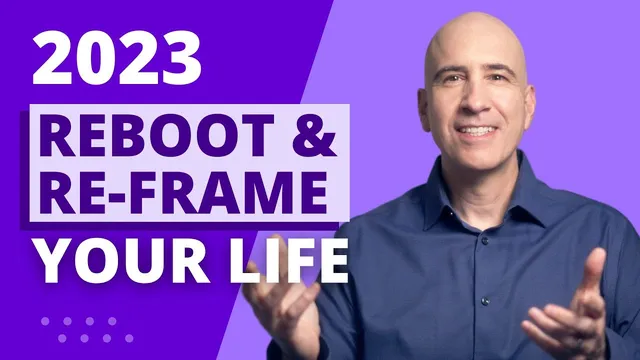
2023 Annual Reboot & Re-Frame – 4 Steps to Your Best Year Ever
Based on August Bradley's video on YouTube. If you like this content, support the original creators by watching, liking and subscribing to their content.
Identify recurring patterns and feedback loops by reviewing calendars, journals, and past tracking—not just one-off events.
Briefing
A reset that actually changes outcomes hinges on four concrete moves: spot the patterns running your life, raise the floor you refuse to slip below, define what you explicitly don’t want to become, and reverse-engineer the routines of people already living the future you want. The payoff is practical—turning “reflection” into a system for rewiring behavior over the next six or 12 months, whether the calendar says New Year or not.
The first step is pattern identification. The approach draws a sharp line between one-off events and the recurring loops that shape identity. Instead of focusing on isolated mistakes or occasional wins, it urges people to make two lists—good patterns and bad patterns—and then dig for the feedback loops behind them. That includes scanning calendars, journals, and any prior tracking to find what repeats, what escalates, and what quietly drains momentum. From there, the work becomes twofold: strengthen the positive loops and deliberately break the negative ones, then design new desired patterns that can take over once the old cycles lose their grip.
Next comes raising minimum standards. Motivation, it argues, tends to spike more reliably when people prevent themselves from falling below a baseline that feels unacceptable—whether that’s physical condition, finances, or the level of disorder in daily life. The strategy isn’t to chase bigger dreams through sheer willpower; it’s to lift the “not acceptable” threshold so consistently solid behavior becomes the default. Exceptional performance, in this framing, is less about constant peak output and more about showing up and staying solid—especially when things dip.
The third move is negative visualization: identify what you do not want to end up as. The method pairs value goals and outcome goals with an equally explicit “not-to-be” list for the end of the reset window. It recommends writing those criteria down clearly—keeping them visible in a digital planner or in Notion—because avoiding an unwanted future can create sharper, more visceral motivation than chasing a positive target alone. This “I don’t want to end up here again” stance is positioned as a practical lever for action.
Finally, the reset gets grounded by studying specific people. Rather than vague inspiration, it calls for naming individuals who already occupy the desired end state—ideally in the same field—and reverse-engineering their success. That means looking at how long they’ve been doing it, what routines and habits they follow, how they set goals, and what tactics they used earlier to reach their current level. Outcomes are treated as lagging indicators; the real path is the tactics, patterns, and actions that produce those outcomes.
The guidance also ties these four steps to an annual review and annual planning process, described as more tactile and actionable than abstract, “new agey” approaches. Those review/planning workflows are presented as complementary: high-level reflection paired with specific next actions, potentially implemented in a Notion-based PPV system. The overall message is that the reset is not a one-time burst of motivation—it’s a structured reframe designed to carry forward into the next stage of life.
Cornell Notes
The reset framework focuses on four levers that can change behavior over the next six to 12 months: identify recurring patterns (not one-off events), raise minimum standards so slipping feels unacceptable, define a clear “not-to-be” future using negative visualization, and study specific people who already achieved the desired outcome to reverse-engineer their routines. The approach treats outcomes as lagging results of tactics, habits, and feedback loops. It also recommends pairing the reset with an annual review and annual planning process to translate reflection into concrete actions. The goal is a practical reframe that works at any point in the year, not just at New Year.
Why does the framework emphasize patterns over one-time events?
What does “raising minimum standards” mean in practice?
How does negative visualization strengthen goal-setting?
What does reverse-engineering success involve?
How do annual review and annual planning fit into the reset?
Review Questions
- Which recurring feedback loops in your life are strengthening or weakening over time, and how can you identify them using your calendar, journals, or tracking?
- What minimum standard would you raise so that slipping below it feels unacceptable—and what concrete behaviors would enforce that baseline?
- Who is one specific person already living the outcome you want, and what routines or tactics from their process can you adopt during your next six- or 12-month reset?
Key Points
- 1
Identify recurring patterns and feedback loops by reviewing calendars, journals, and past tracking—not just one-off events.
- 2
Create two lists: good patterns to reinforce and bad patterns to break, then design new desired loops to replace them.
- 3
Raise minimum standards so consistent “solid work” becomes the default and dips trigger a fast return to the baseline.
- 4
Use negative visualization by writing a clear “not-to-be” list for the end of the reset window to prevent drifting into the default path.
- 5
Reverse-engineer success by studying specific people who already achieved the target outcome, focusing on routines, habits, and tactics—not just results.
- 6
Pair the reset with an annual review and annual planning process to translate reflection into a concrete game plan for the next stage of life.