3 Best Paths To Learn AI In 2026
Based on Krish Naik's video on YouTube. If you like this content, support the original creators by watching, liking and subscribing to their content.
Match the AI learning sequence to experience level and urgency: foundation-first for freshers, application-first for developers, and no-code building for leadership.
Briefing
Learning AI in 2026, according to this roadmap, comes down to picking the right sequence based on experience level and urgency—then proving skills through end-to-end projects with deployment and MLOps/LLMOps. The core message is that a dedicated learner can make a transition in roughly 7–8 months, but only if the learning path matches real constraints: whether someone is starting from fundamentals, building applications immediately, or operating in a leadership role where coding can be minimized.
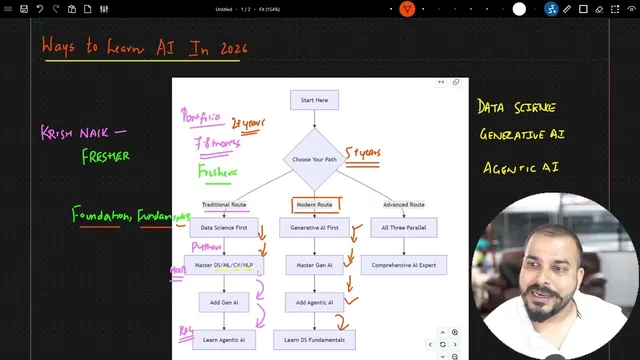
For “freshers” (students or job-seekers with little to no industry background), the recommended route is a traditional foundation-first path. The sequence starts with Python programming, then builds core data science competencies: machine learning, deep learning, computer vision, and NLP. From there, learners add generative AI and agentic AI—explicitly including RAG as part of agentic workflows. The rationale is straightforward: strong fundamentals make it easier to absorb the fast-moving generative and agentic layer later. The roadmap also emphasizes practice through end-to-end projects and modular coding, backed by MLOps tooling. With 3–4 hours of study daily for 7–8 months—and a portfolio that demonstrates problem-solving—many companies can be persuaded to take a chance.
For experienced developers (roughly 5+ years) whose day-to-day work is building products, the path shifts to a modern, application-first order. Here, the priority is learning generative AI and agentic AI so they can deliver what the workplace needs quickly. The suggested sequence is to master generative AI first, then agentic AI, and only afterward fill in data science fundamentals if time allows. The choice becomes practical: if a company has an urgent requirement to ship generative/agent features, the modern route is favored; if there’s no immediate pressure and time exists to strengthen foundations, the traditional route remains viable.
Leadership and senior roles (10+ years, and especially 13+ years) get a different emphasis. The roadmap argues that leaders shouldn’t start by focusing on coding. Instead, they should learn to develop generative and agent applications using no-code or low-code tools such as LangFlow and LangChain. The goal is competency in building and overseeing AI systems rather than becoming a hands-on coder. Still, if leadership has ample time and wants deeper grounding, a traditional foundation-first approach can work.
A final “advanced route” is reserved for highly experienced practitioners who want breadth and depth simultaneously. In that model, all three tracks run in parallel to become a comprehensive AI expert.
Regardless of the chosen path, the endpoint is the same: build projects that include MLOps and LLM ops, plus deployment mechanics like CI/CD pipelines. Consistency is treated as the decisive factor—students and learners who stick with the plan can make the transition in 7–8 months. The roadmap also points to structured learning options, including a “2.0 ultimate data science genai boot camp,” and an end-to-end project subscription launching around 22nd Jan 2026 (with a possible earlier announcement if enough interest is shown).
Cornell Notes
The roadmap for learning AI in 2026 centers on choosing a learning sequence that matches experience level and how urgently someone needs to transition. Freshers should follow a traditional path: Python → data science fundamentals (ML, deep learning, computer vision, NLP) → generative AI and agentic AI (including RAG), then build end-to-end projects using MLOps. Experienced developers should often take a modern, application-first route: generative AI → agentic AI → data science fundamentals if time allows, especially when workplace requirements are urgent. Leadership roles should prioritize building generative/agent applications with no-code tools like LangFlow and LangChain rather than starting with coding. Across all paths, success depends on consistent project work with deployment, CI/CD, and LLM ops.
Why does the roadmap insist that “freshers” should start with fundamentals before generative and agentic AI?
What changes for someone with 5+ years of experience who needs to build AI features at work?
How should leadership (10+ or 13+ years) approach learning AI differently from developers?
What does the roadmap mean by “advanced route,” and who is it for?
What project requirements are treated as non-negotiable for making the transition?
What timeline and study intensity does the roadmap recommend?
Review Questions
- If a learner has 5+ years of experience and an urgent generative/agent requirement at work, which learning sequence should they prioritize first—and why?
- What specific project components (beyond model building) does the roadmap require to demonstrate readiness for AI roles?
- How does the roadmap justify using no-code tools like LangFlow and LangChain for leadership-level learners?
Key Points
- 1
Match the AI learning sequence to experience level and urgency: foundation-first for freshers, application-first for developers, and no-code building for leadership.
- 2
For freshers, start with Python and data science fundamentals (ML, deep learning, computer vision, NLP) before moving into generative AI and agentic AI (including RAG).
- 3
For experienced developers, prioritize generative AI then agentic AI to support shipping product features, and add data science fundamentals afterward if time allows.
- 4
For leadership roles, reduce emphasis on coding at the start and build generative/agent applications using no-code tools like LangFlow and LangChain.
- 5
Treat end-to-end projects as the proof of skill, requiring MLOps/LLMOps and deployment practices.
- 6
Include CI/CD pipelines in projects to demonstrate real-world readiness rather than isolated experiments.
- 7
Aim for consistency over shortcuts; the roadmap targets a 7–8 month transition with dedicated daily study and a strong portfolio.