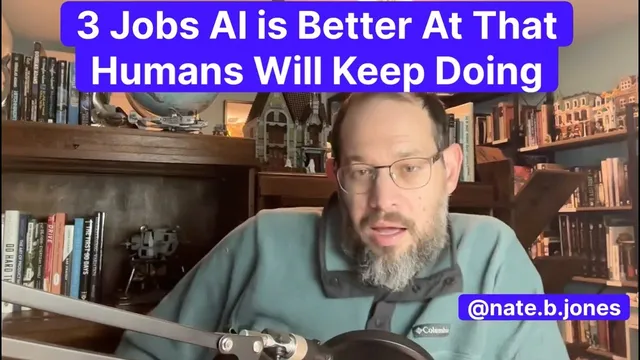
3 Jobs AI is Better At That Humans Will Keep Doing Anyway LOL
Based on AI News & Strategy Daily | Nate B Jones's video on YouTube. If you like this content, support the original creators by watching, liking and subscribing to their content.
AI systems have shown higher performance than doctors in diagnosis accuracy and in medical Q&A quality, including empathy ratings and correctness.
Briefing
Three “nostalgic” jobs—doctors, poets, and artists—are already showing measurable performance gaps in favor of AI, yet the demand for human involvement is expected to persist because people value something beyond raw accuracy. The IMF framing of “nostalgic jobs” fits the pattern: even when AI is provably better, humans often keep wanting humans to do the work.
In medicine, AI’s edge shows up in both diagnosis and patient-facing communication. In one diagnosis test, GP4 was given case histories alongside doctors and produced correct diagnoses 90% of the time, while doctors landed at 74%. A second analysis of medical Q&A—such as drug interactions and whether a patient can take a specific medication—found that doctors struggled on both length and empathy. ChatGPT-4’s answers were far longer (about 200 words versus roughly 50 from doctors), and medical professionals rated ChatGPT-4’s responses as more empathetic: 45% of ChatGPT-4 answers were judged empathetic compared with 4% for doctors. On correctness, ChatGPT-4 also scored higher, answering 80% of questions correctly versus doctors’ lower performance. Still, the conclusion isn’t “replace doctors immediately.” The argument is that patients want a human who has suffered and been sick—someone who can embody trust and shared experience—so doctors will likely shift toward working with AI rather than disappearing.
Poetry is treated as a second nostalgic job where AI can outperform on detectability and audience preference, even if it may produce “less” of what readers romanticize. A study paired works by established poets—such as Chaucer, Emily Dickinson, and T. S. Eliot—with poems generated by ChatGPT 3.5 in the same style. Humans struggled to tell the difference, and they even preferred the AI-written poems. The study’s hypothesis is that the AI poems are less complex: more direct, with less subtext and fewer layers of meaning. The analogy offered is fast, easy consumption—like a Happy Meal—versus the harder pleasure of wrestling with ambiguity. Even so, the forecast is not the end of human poetry publishing; instead, human-authored work may become more associated with live readings and clear provenance.
Art rounds out the trio with a similar split between measurable similarity and human preference for “human-ness.” In a study with about 11,000 participants, researchers filtered out obviously flawed AI images and then tested whether people could distinguish AI from human art in comparable styles (including Impressionist and Dutch masters). Participants guessed correctly about 60% of the time—only slightly above chance. Yet the most liked pieces overall were AI-generated. The takeaway is a likely stratification: AI will rapidly commoditize “industrial art” used everywhere (wallpaper, bedspreads, everyday design), while human art retains premium value in contexts where live presence and personal “soul” matter.
Across all three categories, the core claim is consistent: AI can already do the tasks better by common metrics, but human demand will keep those jobs alive—just reshaped around what people emotionally and culturally want from other people.
Cornell Notes
AI is outperforming humans in three “nostalgic” jobs—medicine, poetry, and visual art—on measurable tasks like diagnosis accuracy, answer quality, style imitation, and audience preference. In medical tests, GP4 diagnosed cases correctly more often than doctors, and ChatGPT-4 delivered more empathetic and longer responses while also scoring higher on correctness. For poetry, humans struggled to distinguish AI-written poems from works by major poets and often preferred the AI versions, likely because they’re more direct and less subtext-heavy. In art, people could only slightly better than chance tell AI from human images, and top-rated works were AI-generated. The forecast is not job extinction; it’s a shift toward human roles that emphasize trust, live experience, and human provenance.
What evidence suggests AI can outperform doctors on diagnosis and patient-facing responses?
Why might patients still want human doctors even if AI is more accurate and empathetic in tests?
How did the poetry study test “style imitation,” and what did it find about human preference?
What does the art study imply about humans’ ability to detect AI art and what they liked most?
What future division of labor is proposed for art and why?
Review Questions
- Which specific metrics in the medical tests favored AI over doctors, and how did empathy ratings factor into the comparison?
- What explanation is offered for why readers may prefer AI-written poems even when they can’t reliably detect AI style imitation?
- How do the art study’s detection rate (around 60% correct) and the popularity results (top pieces were AI) point to different aspects of human judgment?
Key Points
- 1
AI systems have shown higher performance than doctors in diagnosis accuracy and in medical Q&A quality, including empathy ratings and correctness.
- 2
Even when AI outperforms on measurable tasks, patient demand for human trust and shared experience is expected to keep doctors relevant through AI-assisted practice.
- 3
AI-written poetry can be hard for humans to distinguish from established poets’ work and may be preferred, likely because it is more direct and less subtext-heavy.
- 4
Human poetry is predicted to shift toward higher-value formats such as live readings where provenance is clear.
- 5
AI art can be difficult to detect in similar styles and can win on popularity, but human-created art is expected to retain premium status in live and exhibition contexts.
- 6
Art is likely to split into commoditized “industrial” AI design for everyday goods and higher-tier human art valued for presence and personal meaning.