3 Levels of Mind Maps Every Student MUST Master
Based on Justin Sung's video on YouTube. If you like this content, support the original creators by watching, liking and subscribing to their content.
Treat mind mapping as a skill with levels; learning gains depend on reaching level three, not merely drawing a diagram.
Briefing
Mind maps only deliver their biggest learning gains when they reach “level three” skill—where structure becomes clearer, key relationships are weighted, and the grouping is deliberately chosen as the most intuitive fit. At lower levels, mind mapping can feel messy or even pointless, because the brain isn’t being forced into the higher-order thinking that drives retention, faster processing, and deeper understanding.
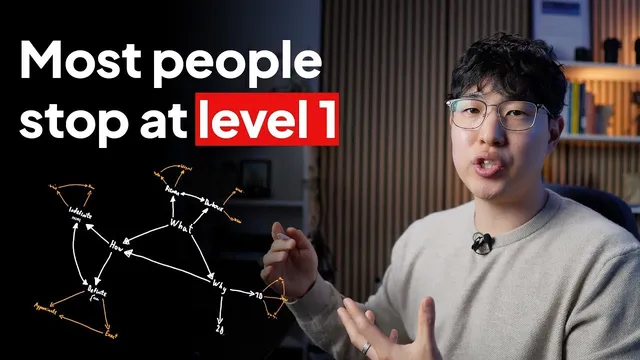
The path begins with diagnosing what level a mind map is at. Level zero is conventional linear note taking: it’s typically linear, wordy, and superficial, often filled with transcription, highlighting, and annotations that consume time without building strong memory or understanding. Level one is the first break from that mold. It keeps two core traits: nonlinearity of ideas (spreading concepts spatially rather than left-to-right) and explicit connections (using arrows and lines to show relationships). But level one still relies on basic representation skills—swapping full sentences for fragments, reducing wordiness, and getting comfortable placing ideas around the page.
Level two is where real benefits start to show. A level two mind map has groups of information that relate to each other, producing a cleaner flow and structure. The key shift is cognitive: instead of merely arranging ideas nonlinearly, the learner spends more time deciding how to organize them—by identifying similarities and differences to form groups, mapping how ideas influence one another, and intentionally building structure rather than scattering arrows. In a demonstration using a metacognition article excerpt, level zero and level one involve constant writing with minimal mental pause, while level two forces longer stretches of thinking (20–30 seconds or more) before anything is written. That extra decision-making is presented as the mechanism behind a noticeable improvement in recall and comprehension.
Level three is framed as the differentiator between top performers. The map’s structure and flow become even clearer, and not all connections are treated equally: some groups and arrows are emphasized (for example, thicker arrows) to signal importance. Groups also become more intuitive—sometimes relabeled in the learner’s own terminology so the categories “click” faster. The defining process at this stage is quality control: generating alternative ways to structure the same information and then making a judgment about which arrangement is most intuitive and therefore stickier in memory. The result is cleaner, more deliberate maps where relationships are chosen, not merely drawn.
The transcript also argues that the mental work behind level three can happen even without mind maps. Linear notes can still produce level three outcomes if the learner synthesizes and organizes relationships mentally, effectively writing a structured mini-essay. But doing that is described as harder and slower because the learner can’t externalize and track connections as easily, and later review becomes more time-consuming than glancing at a mind map’s structure. Overall, the three-level framework turns mind mapping from a drawing exercise into a measurable progression of thinking depth—one that most learners only reach consistently at the top end of performance.
Cornell Notes
Mind mapping becomes a high-impact learning tool only when it reaches level three. Level zero is linear, wordy note taking that tends to be superficial and time-consuming. Level one introduces nonlinearity and connections using arrows and lines, but it mainly trains representation skills. Level two adds grouped structure by comparing similarities/differences and deciding how ideas flow together, which forces deeper thinking and improves retention. Level three raises the quality of relationships: it emphasizes the most important links, uses intuitive group labels, and requires generating alternatives and choosing the best structure—often associated with top 1–2% learning performance.
What distinguishes level zero note taking from level one mind maps?
Why does level one sometimes feel like “it didn’t work,” even when someone is using mind maps?
What cognitive shift happens at level two?
What makes a level three mind map different from level two?
How can linear notes still achieve “level three results,” and why is it harder?
Review Questions
- Describe the three key characteristics of level one and the three processes that move someone from level zero to level one.
- What three changes define level two mind maps, and how does the transcript’s metacognition example illustrate the difference in thinking time?
- At level three, what does “quality of connections” mean in practice, and how does the process of choosing among alternatives affect memory?
Key Points
- 1
Treat mind mapping as a skill with levels; learning gains depend on reaching level three, not merely drawing a diagram.
- 2
Use level diagnosis as a first step: identify whether a map is level zero (linear), level one (nonlinear + connected but ungrouped), level two (grouped + structured), or level three (quality-weighted + intuitive + judged).
- 3
Move from level zero to level one by replacing full sentences with fragments, reducing wordiness, and representing ideas spatially with arrows/lines.
- 4
Build level two by grouping related ideas through similarity/difference, mapping coherent influence/flow, and intentionally organizing structure rather than scattering connections.
- 5
Reach level three by improving the quality of relationships: emphasize the most important links, relabel groups for intuition, and generate alternative structures before choosing the best.
- 6
If using linear notes, replicate level three mentally by synthesizing relationships into a structured output; expect it to be slower and harder than using mind maps for later review.