3 Principles for Business Growth: 8-Figure CEO Coaches Tiago
Based on Tiago Forte's video on YouTube. If you like this content, support the original creators by watching, liking and subscribing to their content.
Creators need to convert attention into owned, sellable products—not monetize fame as a series of one-off transactions.
Briefing
The core idea driving the conversation is the “billion-dollar Creator” framework: creators are unusually strong at getting attention, but they often fail to convert that attention into a scalable, sellable business. The practical question becomes where to point that attention for the highest return on investment—then build a company that can grow through recurring revenue and repeat purchases rather than relying on one-off launches or ad-like monetization.
Nathan Barry, founder of ConvertKit, frames the shift as a transfer of power to talent—first in Hollywood, now across the internet—because creators increasingly control both the audience and the distribution channels. He contrasts early “talent” economics (actors paid for appearances) with the modern creator advantage: once distribution sits with the creator, attention can be redirected into owned products and businesses. He illustrates this with examples like Dr. Dre’s wealth coming largely from Beats by Dre (and its sale to Apple) rather than purely from music, and Ryan Reynolds using brand attention to build companies such as Aviation Gin and Mint Mobile.
A key tension emerges when the discussion turns from inspiring case studies to real operating constraints. Tiago Forte describes a creator business that spiked during the pandemic—about $3M revenue in 2021—then flattened around $2M revenue after 2022, while profit collapsed by roughly 90% because labor costs rose to 80–90% of expenses. Even with strong engagement metrics (130,000 subscribers and ~50% open rates), the business lacks “doorway” leverage: hiring feels impossible without profit, and recurring growth feels out of reach.
Barry’s response centers on three principles. First, build more than a personal brand: the asset must be sellable, like a real company rather than a reputation. Second, sell products—not attention—because attention monetization (e.g., high-priced sponsored posts) usually caps out at the creator’s personal reach. Third, engineer recurring or repeat purchases across the business. He uses the “skyscraper vs. strip mall” metaphor to argue for concentration: stop scattering effort across many small offerings and instead pour resources into the biggest compounding structure.
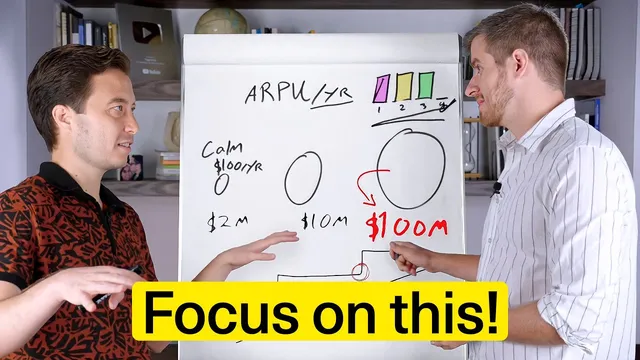
The conversation then gets concrete with revenue math. Barry distinguishes short-term cash flow from long-term enterprise value, and he emphasizes that recurring revenue changes the shape of growth: revenue builds over time, but churn becomes the central enemy. He benchmarks average revenue per customer (ARPU) and argues that Tiago’s current ~$25 per subscriber per year is “pretty good,” but the business model needs more recurring/repeat mechanisms to stabilize and scale.
Barry pushes back on the idea that community alone can solve recurring revenue. Community can work, but scaling to $10M–$100M typically requires multiple product lines and “step function” changes—often a recurring membership plus higher-ticket layers like certification and ongoing services. He offers a possible blueprint: a paid community for predictable cash flow, a certification that produces trained “implementers” (not just one-time credentials), and a recurring coaching/service layer where businesses pay for setup and guided execution. The aim is a flywheel where each layer reinforces the others, while every component has a strong reason to be recurring by default.
By the end, the framework is less about chasing more content and more about redesigning monetization so the business can grow exponentially without requiring the CEO’s constant involvement—turning stress and labor into systems that keep compounding.
Cornell Notes
Creators excel at attention, but attention alone rarely produces a scalable, sellable company. The “billion-dollar Creator” framework asks where attention should be directed for the highest return, then builds a business that goes beyond a personal brand. The three principles emphasized are: build something sellable, sell products (not attention), and create recurring or repeat purchases throughout the business. Recurring revenue changes growth dynamics—revenue compounds over time, but churn becomes a key constraint—so scaling requires step-function shifts like memberships, certifications, and recurring services that reinforce one another. The result is a flywheel that can reach $10M and potentially $100M without relying on constant CEO effort.
Why does “attention” often fail as a long-term business strategy for creators?
What does it mean to build “more than a personal brand,” and why does it matter for enterprise value?
How do recurring revenue and churn change the growth problem?
Why is “community” not automatically enough to reach $10M–$100M revenue?
What does the “skyscraper vs. strip mall” metaphor add to the monetization strategy?
How can certification and services become recurring instead of one-time?
Review Questions
- What are the three principles in the “billion-dollar Creator” framework, and how does each one address a different failure mode of creator monetization?
- In a recurring revenue model, how do churn and customer acquisition interact, and what does that imply for scaling to $10M or $100M?
- Why does Barry argue that multiple product layers (e.g., community + certification + recurring services) are often necessary for step-function growth?
Key Points
- 1
Creators need to convert attention into owned, sellable products—not monetize fame as a series of one-off transactions.
- 2
A scalable business requires recurring or repeat purchases across the model, not just occasional launches or ad-like revenue.
- 3
Short-term cash flow and long-term enterprise value can conflict; recurring revenue usually improves enterprise value but increases churn pressure.
- 4
Scaling typically requires step-function changes in monetization (e.g., memberships, certification, and recurring services), not linear growth from more content.
- 5
Community can generate recurring revenue, but it often needs high engagement and additional product layers to reach $10M–$100M.
- 6
Revenue math (like ARPU and customer counts) helps clarify what business model changes are required to hit specific revenue targets.
- 7
The strongest systems reinforce each other through a flywheel, reducing CEO workload by turning expertise into repeatable processes and trained delivery capacity.