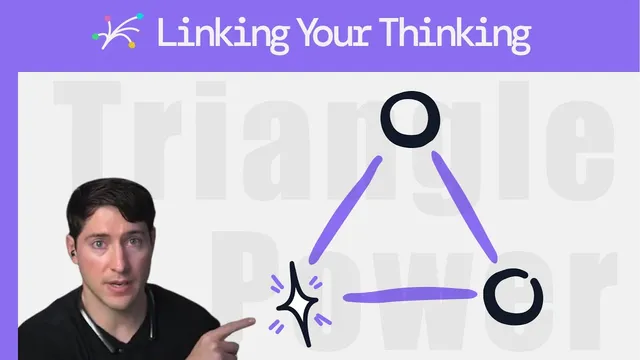
3 Ways to Think Better Using Triangles Δ
Based on Linking Your Thinking with Nick Milo's video on YouTube. If you like this content, support the original creators by watching, liking and subscribing to their content.
Triangulation is framed as a core cognitive mechanism that people use continuously to make sense of unknowns using known reference points.
Briefing
Triangulation—using two known points to infer a third—functions as a built-in “sense-making mechanism” that people rely on constantly, whether interpreting new information, retrieving memories, or generating ideas. The core claim is that this simple geometric move underlies everyday cognition: it turns partial knowledge into workable understanding by linking what’s familiar to what’s not yet clear.
The first “power” is using two points to understand a third. The transcript uses a metaphor: a newcomer sees two separate dots—“Nick” and the concept “paste layers”—and can’t form a coherent picture. As the newcomer learns more about Nick, the relationship between Nick’s perspective and paste layers becomes clearer, and a triangle of understanding forms. Over time, the learner gains clarity on both Nick (as a reference point) and paste layers (as the target concept). That matters because when a new concept X appears, prior knowledge of the reference point—what Nick is like, what he tends to think about paste layers—helps the learner approach X with a “balanced triangle,” using the known points to extrapolate what the third point likely is.
The second “power” is using two points to remember a third. A graphic attributed to Richard Feynman illustrates how separate cues can reconstruct a lost memory: two known points can be used to triangulate back into the past and recover knowledge that would be harder to access alone. The transcript also offers a real-life analogy: two people—like close friends or partners—can recall something together because each person holds part of the information, and together those points guide retrieval of the missing piece.
The third “power” is using two points to imagine a third. Here triangulation becomes an engine for insight creation. By externalizing an evolving body of thoughts into notes, a person can use existing ideas as anchors and let them intersect—creating “crossroads” where new understandings emerge. The transcript frames this as a practical workflow: the more effectively someone triangulates, the faster they can move in the world of ideas.
That speed, however, depends on avoiding cognitive overload. The transcript warns against over-collecting information that drowns the system in noise, over-structuring that turns thinking rigid, and over-highlighting that leaves no room for active mental work. When those failure modes are avoided, the notes and ideas can form an “emergent system” that supports continuous triangulation—understanding, remembering, and imagining—better than before.
Cornell Notes
Triangulation—inferring a third point from two known points—drives everyday thinking in three ways: understanding, remembering, and imagining. First, learning about a reference point (like a person’s perspective) helps someone make sense of a new concept by forming a triangle of related knowledge. Second, combining two cues can reconstruct a past memory that would be difficult to retrieve alone, a process illustrated with a Feynman graphic and everyday relationship examples. Third, externalized notes let ideas intersect, producing new insights at the “crossroads” between concepts. The transcript argues that better triangulation requires avoiding overload, excessive rigidity, and passive note-taking that crowds out active thought.
How does triangulation help someone understand a new concept when both the person and the concept are initially unclear?
Why does the transcript treat a “pivot point” as important when encountering a new concept X?
What does triangulation look like in memory retrieval?
How does triangulation support idea creation rather than just comprehension or recall?
What behaviors are said to block triangulation and slow insight emergence?
Review Questions
- What are the three distinct “powers” of triangulation, and how does each one change the role of the third point?
- In the Nick/paste layers metaphor, what specifically turns two separate dots into a triangle of understanding?
- Why does the transcript claim that note-making can speed up idea emergence, and what three note-related behaviors can undermine that process?
Key Points
- 1
Triangulation is framed as a core cognitive mechanism that people use continuously to make sense of unknowns using known reference points.
- 2
Understanding improves when a learner uses a stable pivot point to connect what they know about a person (or perspective) to what they know about a concept.
- 3
Memory retrieval can work like triangulation: combining two cues can reconstruct a missing past detail that would be harder to access alone.
- 4
Idea generation is treated as intersection-making: externalized notes allow ideas to cross and produce new insights.
- 5
Faster progress in thinking depends on avoiding overload, rigidity, and passive highlighting that crowds out active mental work.
- 6
A well-tuned system supports an emergent workflow where understanding, remembering, and imagining reinforce one another.