30 JANUARY 2026 14:30- 16:00 PHYSICAL SCIENCES GRADE 12
Based on PHAKAMA RESEARCH's video on YouTube. If you like this content, support the original creators by watching, liking and subscribing to their content.
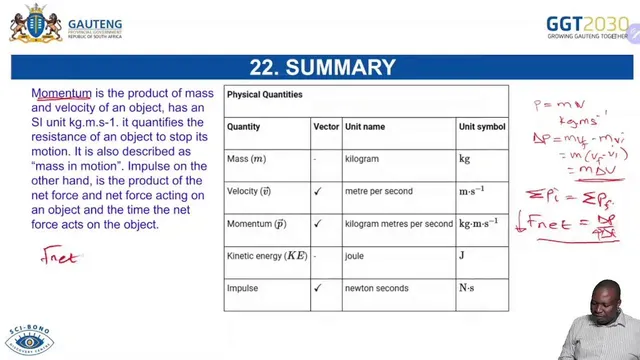
Momentum is defined as p = m v, and linear momentum is a vector because velocity has direction.
Briefing
Momentum in Grade 12 Physical Sciences is treated as the bridge between motion, forces, and collisions—then extended to impulse, safety design, and conservation laws. The lesson centers on the core definition that momentum (p) equals mass times velocity (p = m v). Because velocity includes both magnitude and direction, linear momentum is a vector quantity, meaning answers must include direction (often handled with a chosen positive direction in one-dimensional problems). Momentum only exists when an object is moving; if velocity is zero (object at rest), momentum is zero.
From there, the session drills the “change” idea that appears throughout exam questions. Change in momentum is always final minus initial, so Δp = p_f − p_i. With constant mass, this becomes m(v_f − v_i) = mΔv. The lesson then connects momentum to Newton’s Second Law in momentum form: the net force equals the rate of change of momentum, written as F_net = Δp/Δt. This relationship is used to interpret how velocity changes under a net force—velocity increasing in the direction of motion increases momentum, while braking or reversing direction decreases momentum or flips its sign depending on the chosen positive direction.
Impulse is introduced as the force–time counterpart to momentum change. Impulse is defined as the product of net force and the time interval over which it acts: J = F_net Δt. The impulse–momentum theorem links the two quantities directly: J = Δp. That means exam problems can ask for net force, time, velocity, or change in momentum using the same relationship. The lesson emphasizes that impulse and momentum change are the same “story” told in different units and forms.
A major application ties these physics ideas to real-world safety. Airbags, seat belts, and arrest beds reduce injury by increasing contact time during a collision. Since net force is tied to the rate of change of momentum, increasing the time interval lowers the average net force for the same momentum change—so the impact is less severe even though the collision still changes the vehicle occupant’s momentum.
The session also sets up collision modeling using isolated systems. An isolated system has no net external force (F_net = 0), so momentum conservation applies: the total linear momentum of an isolated system remains constant. Internal forces act during collisions, but external forces are excluded. Finally, the lesson distinguishes elastic versus inelastic collisions: elastic collisions conserve both momentum and total kinetic energy, while inelastic collisions conserve momentum but not kinetic energy.
To prepare for problem-solving, the lesson repeatedly stresses exam technique: write down given data and unknowns, use correct SI units (mass in kg, velocity in m/s), choose a consistent positive direction, and substitute into formulas without rearranging them incorrectly. Worked examples include calculating momentum of a cricket ball, solving for mass or velocity using p = m v, applying conservation of momentum to trolley collisions (including stationary objects and coupled motion), using velocity–time graphs to extract changes in velocity and compute net force, and multi-object momentum problems involving Peter, John, and a trolley. The takeaway is that momentum, impulse, and conservation laws form a single toolkit for both calculations and interpreting collisions and safety engineering.
Cornell Notes
The lesson builds a Grade 12 momentum toolkit: momentum is p = m v, a vector because velocity has direction. Change in momentum is always final minus initial (Δp = p_f − p_i), which becomes m(v_f − v_i) when mass stays constant. Newton’s Second Law is rewritten as F_net = Δp/Δt, linking force to how quickly momentum changes. Impulse is defined as J = F_net Δt and connected to momentum through the impulse–momentum theorem: J = Δp. These ideas explain collision behavior, support the conservation of linear momentum in isolated systems (F_net = 0), and justify safety designs like airbags that increase contact time to reduce average net force.
Why must linear momentum answers include direction, and how is that handled in one-dimensional problems?
How do you compute change in momentum, and what common mistake does the lesson warn against?
What is the relationship between net force, momentum change, and time?
How do impulse and the impulse–momentum theorem connect to collision problems?
What conditions make momentum conserved, and how do elastic and inelastic collisions differ?
Why do airbags and seat belts reduce injury according to the momentum/impulse framework?
Review Questions
- In a one-dimensional collision, if east is chosen as positive and the calculated final velocity is negative, what does that imply about the object’s direction of motion?
- A net force acts on an object for 0.10 s and changes its momentum by 12 kg·m/s. What is the average net force?
- State the conservation of linear momentum principle for an isolated system and explain what “isolated” means in terms of external forces.
Key Points
- 1
Momentum is defined as p = m v, and linear momentum is a vector because velocity has direction.
- 2
Change in momentum uses final minus initial: Δp = p_f − p_i = m(v_f − v_i) when mass is constant.
- 3
Newton’s Second Law in momentum form is F_net = Δp/Δt, linking force to the rate of momentum change.
- 4
Impulse is J = F_net Δt and equals change in momentum (impulse–momentum theorem): J = Δp.
- 5
Safety devices like airbags and seat belts reduce injury by increasing contact time, which lowers average net force for the same momentum change.
- 6
Conservation of linear momentum applies to isolated systems where net external force is zero (F_net = 0).
- 7
Elastic collisions conserve both momentum and total kinetic energy; inelastic collisions conserve momentum but not total kinetic energy.