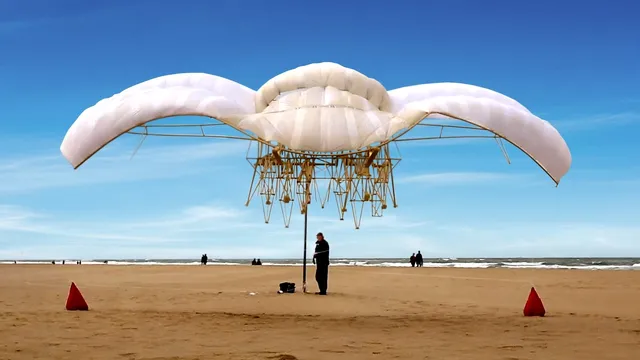
34 Years Of Strandbeest Evolution
Based on Veritasium's video on YouTube. If you like this content, support the original creators by watching, liking and subscribing to their content.
Strandbeests achieve motorless walking by selecting tube geometry that produces a mostly flat foot contact path, preserving balance.
Briefing
Wind-powered Strandbeests—Dutch artist Theo Jansen’s walking “skeletons”—have evolved for 34 years into machines that can survive on a beach without motors or electronics. The central achievement is a design method that turns trial-and-error into a repeatable “genetic code”: a fixed set of tube proportions that reliably produces the footpath needed for smooth, continuous walking. That matters because it shows how complex, life-like motion can emerge from mechanical constraints alone, and because Jansen’s long-term vision links those motions to real-world coastal resilience.
The build began with a basic problem: early prototypes couldn’t support their own weight. Jansen’s first attempts relied on fragile connections—tape that held tubes together only briefly—so the animals ended up lying on their backs and barely moving. Stronger, cleaner joints replaced that approach, with zip ties becoming the first major upgrade. But weight support wasn’t enough; the next hurdle was balance. The crucial insight was that each step’s traced path determines stability: a foot that swings through a mostly flat region along the ground keeps the structure from tipping, while a wonky trajectory causes loss of balance.
Finding the right geometry required computation and then a shortcut around brute force. Instead of testing trillions of tube configurations, Jansen used an evolutionary simulation. Starting from 1,500 combinations, the program generated 1,500 footpaths, then repeatedly selected and mutated the better ones for months of day-and-night runs. By the end, “13 holy numbers” emerged—proportions and placements that function like a genetic code. When assembled, those parameters produce a characteristic footpath; offsetting legs by 120 degrees ensures that some feet remain in contact with the ground, creating the smooth, marching gait seen across decades of Strandbeests.
Even with walking dialed in, beach survival demanded further adaptations. Sand is fluffy and sticky, so Strandbeests evolved large-surface feet that spread load and increase contact time, letting one foot take over as another lifts. When wind dies, many designs stall—an ongoing fatal flaw—so Jansen has been working on energy storage and “muscles” that can use stored power later. The system uses a wind-driven sail and crankshaft to pressurize air in bottles (with reported pressures high enough to be dangerous), then releases that energy through piston-based mechanisms that can push or pull.
Storms and exposure add another layer: individual Strandbeests can be blown over, but groups can hold each other steady, enabling a more collective strategy and even designs that can be pulled by companions. The machines also face the sea itself. A water “feeler” detects contact with water by sensing resistance, and experiments with a minimal nervous-system analogue aim to let the structure course-correct—turning sensory input into actuator output using logic-like switching.
The motivation behind the engineering is both environmental and personal. In the late 1980s, rising CO₂ and sea-level projections threatened parts of the Netherlands, and Jansen imagined wind-powered walkers that kick sand onto dunes to build natural defenses. Over time, the project became less about the original policy goal and more about legacy: he has described Strandbeests as a way to “die with peace of mind.” Today, thousands worldwide incorporate the “13 holy numbers” into new designs, spreading the mechanical “genetic code” far beyond Jansen’s workshop.
Cornell Notes
Wind-powered Strandbeests evolved over 34 years into motorless beach walkers by solving a chain of mechanical challenges: supporting their own weight, staying balanced, and surviving sand, storms, and the sea. The breakthrough was a computational evolutionary method that produced “13 holy numbers,” a fixed set of tube proportions that generates the footpath needed for smooth gait. Offsetting legs by 120 degrees keeps some feet in contact with the ground, stabilizing motion. Later hurdles pushed the designs toward animal-like behaviors—sand-adapted feet, group stability in storms, energy storage for calm periods, and experimental water-sensing “nervous system” logic to prevent drowning. The work matters because it demonstrates how life-like complexity can emerge from mechanical constraints and because Jansen’s original vision tied walking to dune-building and coastal protection.
What mechanical principle makes Strandbeests walk smoothly instead of wobbling or tipping?
Why didn’t brute-force computation work when searching for the best tube proportions?
What are the “13 holy numbers,” and how do they function like a genetic code?
How do Strandbeests adapt to fluffy beach sand beyond just having any foot shape?
What problem appears when wind stops, and what solution is being pursued?
How does the water-sensing system aim to prevent Strandbeests from ending up in the sea?
Review Questions
- How does changing tube proportions alter the footpath, and why does that affect balance?
- What role does the 120-degree leg offset play in maintaining continuous ground contact?
- Why is energy storage necessary for Strandbeests, and what mechanical components are used to store and release it?
Key Points
- 1
Strandbeests achieve motorless walking by selecting tube geometry that produces a mostly flat foot contact path, preserving balance.
- 2
Jansen used an evolutionary simulation (1,500 starting combinations) to avoid brute-force search and converge on “13 holy numbers.”
- 3
The “13 holy numbers” act like a genetic code: assembling them yields the characteristic footpath that underpins decades of smooth gait.
- 4
Beach survival depends on specialized feet with large surface area and increased contact time to prevent sinking and reduce structural stress.
- 5
Storm resilience can come from collective behavior: groups can hold each other steady, enabling designs that are harder to blow over.
- 6
A key ongoing failure mode is calm weather: when wind stops, many Strandbeests stall, so energy storage via pressurized air and piston “muscles” is being developed.
- 7
Preventing sea accidents is driving work on sensing and minimal decision-making systems, using a water feeler and logic-like control to trigger course corrections.