4 ADHD Techniques to Overcome Laziness
Based on Ali Alqaraghuli, PhD's video on YouTube. If you like this content, support the original creators by watching, liking and subscribing to their content.
Treat laziness as a starting blockage often driven by self-talk, not as a character flaw.
Briefing
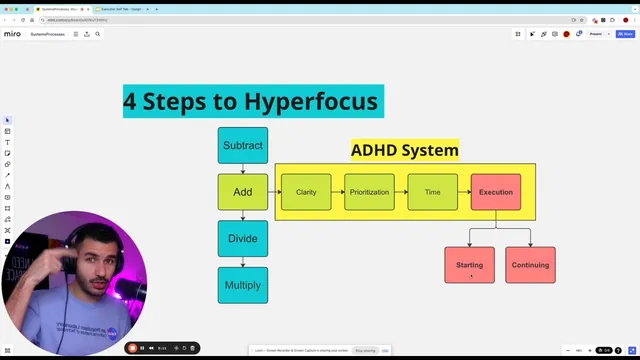
Laziness isn’t treated as a character flaw so much as a predictable mental loop—especially for people with ADHD—where overwhelm, loss of ownership, weak short-term motivation, and self-criticism block action. The core fix is execution: plans matter less than the ability to start and keep going, and the fastest leverage comes from changing the inner “self-talk” that determines whether tasks feel doable or impossible.
Execution splits into two parts: starting and continuing. Starting is usually the bigger bottleneck. Once someone begins, continuing often improves through environment design—removing distractions, keeping the phone out of reach, and leaning into focus when the task is engaging enough to trigger hyperfocus. But the starting problem often begins earlier, in the subconscious conversation that decides how a task is framed. When people feel forced (“I have to…”) or flooded (“I have to do the whole thing”), the brain treats the task as threat-like, which increases avoidance.
Technique one targets overwhelm by shrinking the first step until it feels almost silly in its simplicity. Instead of telling oneself to “make a YouTube video,” the instruction becomes “turn on the ring light and get the slides running.” The same idea applies to business work: rather than “create 10 new ads,” the goal becomes “write a hook or outline for one ad.” The point isn’t productivity theater; it’s reducing perceived complexity so the brain can move from resistance to relief. Even routine planning can be reframed: “open the tracking sheet” is easier than “do my evening routine,” and that micro-action often unlocks the next steps.
Technique two restores choice and ownership. The instruction shifts from obligation to agency: “I get to make a cool video” replaces “I have to sit down and make a video.” The speaker emphasizes that this reframing takes repetition because the default inner script often sounds like coercion. Over time, the reframing can build a motivational spiral—connecting the task to identity (“I’m helping people”) rather than punishment.
Technique three addresses the ADHD mismatch between long-term goals and short-term drive. Long-range “why” can make sense intellectually but fail to generate immediate dopamine. The workaround is to sell the next action with near-term rewards: write three tasks for tomorrow to feel better in the morning, or work out for 30 minutes to gain energy and confidence today. The emphasis stays on motivating action now, not just inspiring future outcomes.
Technique four rejects self-love as fluffy spa advice and reframes it as self-respect and self-compassion. Self-criticism is treated as fuel for avoidance: beating oneself up (“I’m dumb,” “I wasted the day”) lowers motivation and deepens the laziness cycle. Instead, the response becomes problem-solving—asking why the day stalled and diagnosing likely causes such as unclear next steps, a mismatched environment, loneliness, or social cues. The practical takeaway is to stop treating mistakes as evidence of personal worth and start treating them as signals about systems and behaviors that can be adjusted.
Together, the four self-talk techniques form a start-first execution strategy: reduce overwhelm, reclaim ownership, chase short-term rewards, and replace criticism with inquiry—so action becomes the default rather than the exception.
Cornell Notes
The approach treats “laziness” as a starting problem driven by self-talk loops rather than a lack of discipline. Execution depends on two phases—starting and continuing—but starting is usually the hardest, especially for ADHD. Four self-talk techniques target the mental blockers: (1) annihilate overwhelm by shrinking tasks to the smallest first step, (2) replace “I have to” with choice and ownership (“I get to”), (3) use short-term rewards instead of relying only on long-term “why,” and (4) swap self-criticism for self-respect and problem-solving. The payoff is practical: action becomes easier to initiate, and the cycle of avoidance loses momentum.
Why does the method treat laziness as something other than a moral failure?
How does “annihilate overwhelm” work in practice?
What does “choice and ownership” change about motivation?
Why are short-term rewards emphasized for ADHD?
How does the approach handle self-criticism after a low-productivity day?
Review Questions
- Which of the four self-talk techniques would you use first if a task feels too big to start, and what would your “tiny first step” sound like?
- How would you rewrite an obligation-based thought (“I have to…”) into a choice/ownership-based thought for a task you’ve been avoiding?
- After a day with little progress, what specific diagnostic questions would you ask to replace self-criticism with problem-solving?
Key Points
- 1
Treat laziness as a starting blockage often driven by self-talk, not as a character flaw.
- 2
Split execution into starting and continuing; starting is usually the harder phase and needs mental re-framing.
- 3
Use overwhelm-reduction by shrinking tasks to the smallest concrete first action (e.g., “turn on the ring light”).
- 4
Reclaim ownership by replacing “I have to” with “I get to,” and repeat the reframing until it sticks.
- 5
Motivate ADHD-prone brains with short-term rewards that create immediate dopamine hits, not only long-term “why.”
- 6
Replace self-criticism with self-respect and rapid problem diagnosis to prevent a deeper avoidance cycle.
- 7
Reinforce the system with reminders and visual cues (phone/computer reminders, wall prompts) so the new self-talk triggers automatically.