4 AI Labs Built the Same System Without Talking to Each Other (And Nobody's Discussing Why)
Based on AI News & Strategy Daily | Nate B Jones's video on YouTube. If you like this content, support the original creators by watching, liking and subscribing to their content.
AI’s “jagged” performance pattern is attributed mainly to one-shot, single-agent deployment that prevents retry, feedback, and incremental accumulation.
Briefing
AI’s “jagged” performance pattern—great at some tasks, weak at others—is increasingly an artifact of how systems are deployed, not a permanent feature of intelligence. As agentic workflows mature, work that can be decomposed, parallelized, verified, and iterated is getting smoother, meaning fewer abrupt failures and less whiplash between “it works” and “it doesn’t.” That shift matters because it changes what organizations should expect AI to handle in day-to-day roles like PRDs, codebases, and customer service—areas where iterative human-style processes already exist.
The core diagnosis is about single-turn, single-agent prompting. When a model must answer in one shot, errors propagate and there’s no built-in mechanism to detect mistakes, retry, or accumulate information beyond a context window. That setup forces “oneshot cognition” onto problems that professionals normally solve through drafts, feedback loops, intermediate checkpoints, and revision cycles. For years, AI was placed into that primitive interaction style, and the resulting uneven outcomes were treated as evidence of uneven intelligence.
Over the last year, multiple improvements have started to smooth that curve. Inference-time compute lets models spend more time thinking, try alternative tokens, and correct course—an approach associated in the transcript with “ChatGPT 5.2 thinking” and “5.2 Pro.” But the bigger change is organizational: better tooling, better prompting, and—most importantly—agentic “harnesses” that provide scaffolding around an agent so it can do long-running work. A harness can include task files, memory, and the operational environment that lets an agent operate like a team rather than a lone responder.
The strongest proof offered is a March 3 announcement from Cursor CEO Michael Trule: Cursor reportedly found a novel solution to “problem six” of the first proof, improving on an official human-written solution with stronger bounds and better coverage. The system reportedly ran for four days with zero hints, zero human nudges, and zero midcourse guidance, using the same coding harness that earlier built a web browser from scratch. The significance isn’t just that it solved a math problem; it did so using a system designed for coding, suggesting that the coordination-and-verification architecture generalizes beyond software.
Cursor’s earlier work on long-running autonomous coding points to the mechanism: flat coordination failed because agents became risk-averse and avoided difficult work. The breakthrough came from hierarchy and specialization—planners decompose tasks into subplans, workers execute in isolation, and a judge role decides whether to continue, restarting cleanly to avoid context-window collapse. The transcript also claims model choice matters for long-horizon tasks, with GPT 5.2 outperforming Claude Opus in this setup.
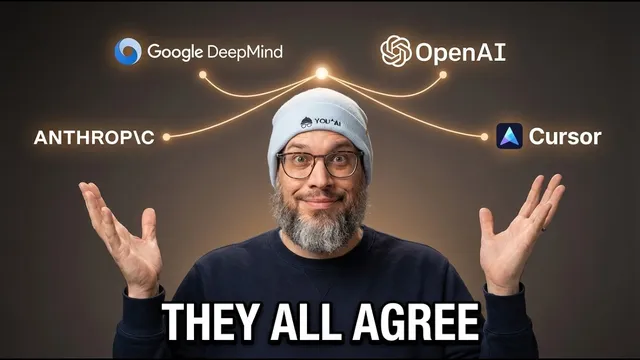
The broader claim is convergence across organizations: Anthropic, Google DeepMind, OpenAI, and Cursor independently built multi-agent coordination systems with similar structural patterns—decompose, parallelize, verify, and iterate. The “jaggedness” narrative, then, is replaced by a management narrative: organizational intelligence scales when roles, handoffs, and verification are built into the system. The practical takeaway is that AI will be most useful where answers are machine-checkable or expert-checkable, and where workers can shift from “doing” to “sniff-checking” correctness and maintainability. The transition is expensive in tokens and effort, but it’s positioned as the path to smoother AI performance for real workplace tasks.
Cornell Notes
The transcript argues that AI’s uneven (“jagged”) performance is largely caused by single-turn, single-agent deployment—where errors can’t be caught, work can’t be retried, and information can’t accumulate past context limits. As inference-time thinking improves and, more importantly, as agentic “harnesses” add structure (hierarchy, isolation, verification, and clean restarts), outcomes for workplace tasks become smoother. A key example is Cursor’s reported four-day, zero-hint solution to a hard math problem that improved on an official human solution, using a coding-oriented harness. The implication is that multi-agent coordination architectures generalize across domains where answers are verifiable, shifting knowledge work toward decomposition and “sniff-checking” correctness rather than relying on one-shot generation.
Why does “jaggedness” show up so strongly in early AI chat experiences?
What changes when AI is given inference-time compute and an agentic harness?
What specific Cursor example is used as evidence that performance is smoothing?
How did Cursor’s multi-agent system avoid the failure of “flat coordination”?
What structural pattern does the transcript claim is shared across multiple AI labs?
What workplace shift does the transcript recommend for people using AI?
Review Questions
- How does a single-turn, single-agent interaction cause errors to persist, and why does that differ from how professionals work?
- What roles (planner, worker, judge) and mechanisms (hierarchy, isolation, clean restarts) are described as essential for long-horizon agent performance?
- Why does the transcript claim that “smooth for work” depends more on harness design and verification than on raw model intelligence?
Key Points
- 1
AI’s “jagged” performance pattern is attributed mainly to one-shot, single-agent deployment that prevents retry, feedback, and incremental accumulation.
- 2
Inference-time compute improves outcomes by letting models spend more time and revise intermediate attempts, but harness design is presented as the bigger lever for workplace reliability.
- 3
Agentic harnesses enable long-running work by adding structure such as task decomposition, workspace scaffolding, and restartable iterations to avoid context-window collapse.
- 4
Cursor’s reported four-day, zero-hint math breakthrough is used to argue that coordination-and-verification architectures generalize beyond coding into other verifiable domains.
- 5
Multi-agent systems across Anthropic, Google DeepMind, OpenAI, and Cursor are described as converging on the same workflow: decompose, parallelize, verify, and iterate.
- 6
As execution becomes cheaper, the transcript predicts a shift from task execution to evaluation skills—especially “sniff-checking” correctness and maintainability.
- 7
The practical adoption challenge is organizational: building and managing agent infrastructure and evaluation processes, not just picking a model.