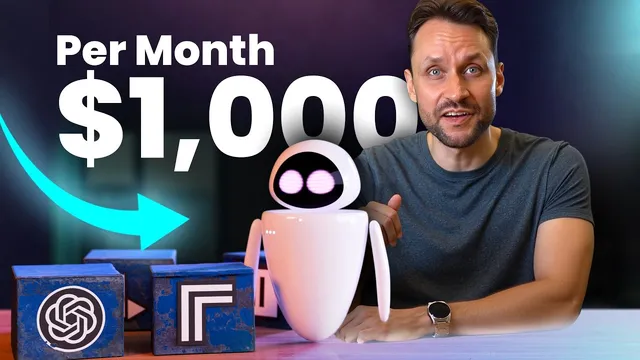
4 Fast Business Ideas To First $1,000 MRR
Based on Simon Høiberg's video on YouTube. If you like this content, support the original creators by watching, liking and subscribing to their content.
Build “rapper” AI tools by wrapping proven model APIs (OpenAI, Replicate, Luma, ElevenLabs) in a focused UI to reduce development time.
Briefing
Reaching the first $1,000 in monthly recurring revenue (MRR) doesn’t require a “million-dollar” idea—four business models can get early momentum faster by leaning on existing tech, repeatable products, and subscription-style delivery. The common thread is reducing complexity: either outsource the heavy lifting to proven AI infrastructure, package an offer so it can be sold repeatedly, or specialize an AI experience enough that customers pay for outcomes rather than generic access.
First up are “rapper” tools—small AI products built by wrapping existing AI services (like OpenAI, Replicate, Luma, and ElevenLabs) inside a new interface. Instead of building the underlying models, these businesses focus on the front end: a user-friendly UI plus a workflow that makes the underlying capabilities useful. The upside is speed and easier maintenance; the downside is margin pressure because API costs can be significant. Still, the model can work well when the product is marketed effectively on social media, and when it targets clear use cases such as text-based SaaS (chatbots and content writers), diffusion-based image generation, text-to-video via Luma, and speech/audio via ElevenLabs.
Second are boilerplates and starter kits sold as repeatable assets. While many templates already exist, the market stays open because tools become outdated, bloated, or missing features for today’s tech stack. The play is to build for a specific niche or trend—such as templates for startups integrating Stripe, Tailwind CSS, and other modern components—or for developers who want a foundation for AI-powered apps. Once the template is well documented and solves a real problem, it can be sold over and over with minimal upkeep. The same logic applies beyond developers: design systems, UI kits, and no-code templates can also capture demand from people who want to save time and avoid starting from scratch.
Third is a more “futuristic” angle: selling access to specialized AI agents rather than generic custom chatbots. Custom GPTs were positioned as an app-store-like marketplace, but the transcript argues that most custom GPTs underperform because they don’t differ enough from standard chat experiences. The alternative is to fine-tune models for domain expertise—using real training data and credentials—so the agent performs better for a specific job-to-be-done. Examples include a lawyer-trained assistant, a fitness coach agent tailored to dietary needs, or a financial adviser agent aligned to particular investment instruments. The catch: OpenAI custom GPTs are described as too weak for this purpose, pushing builders toward fine-tuning.
Finally, the transcript reframes MRR beyond SaaS by borrowing subscription mechanics from service businesses. Freelancers and agencies can capture recurring revenue by productizing their services—turning custom work into a packaged monthly offer with clear deliverables and boundaries (e.g., a set number of website updates, designs, or social media tasks). This reduces burnout, makes delivery predictable, and gives clients peace of mind and convenience. With a $500/month offer, two clients reach $1,000 MRR; four clients at $250/month also works. The models are presented as beginner-friendly paths to $1,000 MRR, with room to scale far higher by expanding the same repeatable systems.
Cornell Notes
The path to $1,000 MRR can be shorter when builders avoid reinventing core technology and instead package repeatable value. One approach is creating “rapper” AI tools that wrap existing model APIs (OpenAI, Replicate, Luma, ElevenLabs) in a new UI, trading lower build effort for API-driven margin costs. Another is selling boilerplates and starter kits tailored to specific niches or modern stacks, where strong documentation enables low-maintenance repeat sales. A third option is charging for specialized AI agents built via fine-tuning on domain expertise, since generic custom GPTs are described as underwhelming. Finally, service businesses can generate recurring revenue by productizing monthly deliverables into subscription-style offers that prevent scope creep and improve client convenience.
What makes “rapper” AI tools a fast route to early MRR, and what trade-off comes with it?
Why do boilerplates and starter kits still have room even though many already exist?
What’s the critique of selling access to custom GPTs, and what alternative is proposed?
How can a freelancer or agency generate MRR without turning into SaaS?
What simple math shows how $1,000 MRR can be reached with subscription services?
Review Questions
- Which AI providers mentioned in the transcript map to text, image, video, and speech in the “rapper” tool model?
- What differentiates a niche boilerplate from a generic template, and why does documentation matter for recurring sales?
- How does productizing a service change both client expectations and the provider’s workload?
Key Points
- 1
Build “rapper” AI tools by wrapping proven model APIs (OpenAI, Replicate, Luma, ElevenLabs) in a focused UI to reduce development time.
- 2
Expect API costs to pressure margins; pricing and usage control matter for profitability.
- 3
Sell boilerplates and starter kits by targeting a specific niche or modern tech trend and keeping them tightly documented so buyers can launch quickly.
- 4
Fine-tune models to create domain-specialized AI agents; generic custom GPT access is described as insufficient for charging.
- 5
Generate recurring revenue in service businesses by productizing work into monthly subscription deliverables with clear boundaries.
- 6
Use subscription pricing math to set a realistic client target for $1,000 MRR (e.g., two clients at $500 or four at $250).