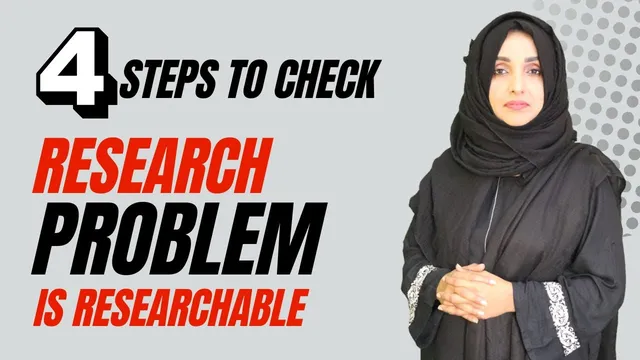
4 Steps to Check Either Your Research Problem is Researchable or Not | Dr Rizwana | Urdu/Hindi
Based on Dr Rizwana Mustafa's video on YouTube. If you like this content, support the original creators by watching, liking and subscribing to their content.
Confirm mentorship and senior guidance so obstacles can be handled during execution.
Briefing
A research problem is only worth pursuing if it’s realistically solvable with the resources at hand—and if the work adds genuine value to existing knowledge. Dr Rizwana Mustafa lays out a practical checklist for testing whether a proposed research problem is “researchable,” then tightening it into a strong research question and proposal that can survive real-world constraints.
The first step is feasibility through mentorship and access. Before committing, researchers should confirm they have a capable mentor/supervisor (and senior guidance) who can help when obstacles appear. Feasibility also depends on whether the planned research can actually generate answers: if surveys or other data-collection methods are part of the plan, the researcher must check whether the specific problem can be investigated through available cases, and whether the needed data can be compiled. Just as important is verifying availability—resources, equipment, and support systems—because a “good” idea can still fail if the lab, tools, or expertise aren’t there.
The second step is contribution: the research must produce something that matters to society and to the scholarly record. The work should address a gap against the backdrop of the existing body of literature on the issue. Contribution should match the level of study—minor for graduate-level work, broader for MPhil, and major for doctoral research—so the scope stays credible and achievable. The goal is not only to add information, but to develop research objectives that lead to usable “practice knowledge,” where others can perform the work and access the resulting data.
That contribution also depends on how the research will be shared. Making data accessible and publishing in reputable journals increases the work’s reach, supports evaluation by other researchers, and can enable younger researchers to build on it. In other words, the proposal’s worth rises when the research is designed for transparency, reproducibility, and public knowledge.
The feasibility and contribution tests are reinforced with concrete examples from lab research. If a proposed synthesis requires an instrument not available in the researcher’s lab—and there’s no collaboration or access pathway—then the project may fail due to time constraints or lack of equipment. The same caution applies when the proposed work doesn’t add value to the literature: if the same pathway produces multiple “syntheses” that are essentially useless, or if the resulting compounds have no meaningful biological activity or novelty, then the project risks becoming redundant. The prescription is to focus on what can be done with available resources and to ensure the planned addition is genuinely valuable compared with what already exists.
Overall, the checklist boils down to two gatekeepers: can the research be executed with real access to tools, data, and guidance—and will it add a credible, level-appropriate contribution that improves knowledge and benefits society? If both conditions hold, the research problem can be developed into a healthy, researchable question and a proposal strong enough to withstand scrutiny.
Cornell Notes
The core test for a research problem is whether it’s both feasible and valuable. Feasibility starts with having the right mentorship and practical access to resources, equipment, and data-collection pathways (including whether surveys/case studies can actually generate answers). Value comes from contributing to the existing literature by addressing a real gap and producing usable, practice-oriented knowledge that can be accessed and published. Scope should match degree level: smaller for graduate work, broader for MPhil, and major for doctoral research. Proposals should also avoid “redundant” plans—especially those requiring unavailable instruments or producing outputs with no meaningful novelty or activity.
What feasibility checks should come first before treating a research problem as “researchable”?
How should researchers decide whether their work will be a meaningful contribution to literature?
Why does degree level matter when defining the contribution and scope of a research proposal?
What does “access” and publication add to the value of a research project?
What are the warning signs that a research proposal may be unworkable or low-value?
Review Questions
- What specific feasibility elements (mentorship, data pathway, equipment access) must be verified before finalizing a research problem?
- How can a researcher ensure their contribution is appropriate for graduate, MPhil, and doctoral levels?
- Give two examples of how a proposal can become unworkable or low-value, and explain how to correct each issue.
Key Points
- 1
Confirm mentorship and senior guidance so obstacles can be handled during execution.
- 2
Test whether the research problem can generate answers using the planned data-collection method and available cases.
- 3
Verify that required resources and instruments are accessible within the project timeline.
- 4
Define contribution as a gap-filling addition to the existing literature, aligned with degree level (minor for graduate, broader for MPhil, major for PhD).
- 5
Design objectives that lead to usable, practice-oriented knowledge and clear evaluation pathways.
- 6
Plan for transparency: make data accessible and target publication in reputable journals to increase impact.
- 7
Avoid proposals that depend on unavailable equipment or that produce outputs with no meaningful novelty or activity compared with existing work.