#4 - Stop creating new folder cards
Based on FP's video on YouTube. If you like this content, support the original creators by watching, liking and subscribing to their content.
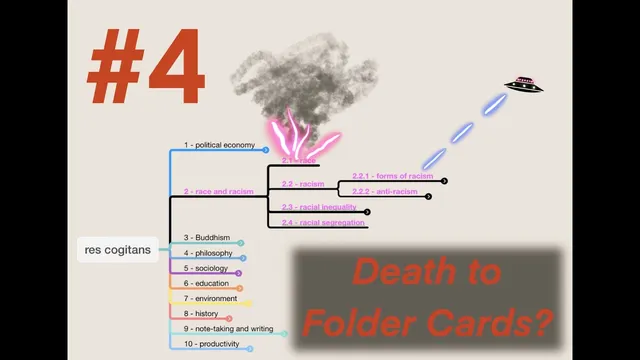
Stop creating new folder cards after reaching about two to three levels (or at most the third/fourth level) to avoid rigid placement decisions.
Briefing
Zettelkästen builders should stop expanding “folder cards” beyond a shallow depth—typically two to three levels—because deeper folder hierarchies push note-taking toward rigid filing instead of the method’s core goal: developing connected lines of thought. Folder cards can be useful early on to seed a structure, but once they multiply, they tend to create decision fatigue (“where does this new card go?”) and discourage the kind of associative thinking that makes the system useful.
The guidance starts with how folder cards fit into the Zettelkasten Costa method. The method recommends choosing a handful of main subject areas, then breaking them into subcategories and creating folder cards for each branch—often visualized as columns in a mind-map style layout. In the creator’s “old school” setup, folder card titles and addresses are written in pink (idea cards use blue), with occasional color inconsistencies noted as a personal annoyance. The key instruction, however, is not “never use folder cards,” but “don’t keep creating them after they reach about the third or fourth level.”
Three reasons drive the recommendation. First, deeper hierarchies make it harder to place new notes without agonizing over the “one best place” for each card. That mindset conflicts with what the method is designed to do: instead of perfect classification, it favors iterative linking and discovery. Second, too many folder levels reduce the likelihood of using the Zettelkasten for what it’s meant to support—building lines of thinking through relationships among idea cards, not through a deep filing tree. Third, organization should increasingly shift to the index section once idea cards exist. The index becomes the primary navigation tool: for example, an “H” entry for Healthcare can point to the address of the first card in a sequence, letting the system retrieve a chain of related notes later.
The transcript also broadens the argument by pointing out that folder cards are optional. Some practitioners reportedly use none at all; the creator contrasts their approach with Nicholas Luhmann, who allegedly used no folder cards. Others even question whether starting with subject areas is compatible with the system’s spirit, citing Scott Shepherd and a recent discussion attributed to him and Bob Dotto. Still, the creator is skeptical that beginning with a small set of subject areas is inherently harmful, especially when later learning from those ideas proves valuable.
Finally, the creator signals an experiment: using folder cards “a lot less,” potentially not at all, and reporting back on results. Upcoming videos are previewed around two practical problems—where to place a continuation card when it does or doesn’t have a strong relation to existing notes—and around why “old school” Zettelkasten setups can aid digestion of information. There’s also a planned comparison of approaches to building full Zettelkasten sequences, including an “outward in” versus “inward out” method.
Cornell Notes
Folder cards can help seed a Zettelkasten’s early structure, but expanding them beyond about the third or fourth level tends to harm the system’s purpose. Deep folder hierarchies encourage overthinking where each new note “belongs,” and they can interfere with building lines of thinking through links among idea cards. As more idea cards accumulate, organization should shift toward the index section, which uses alphabet entries (e.g., “H” for Healthcare) pointing to the address of the first card in a related sequence. Folder cards are optional—some well-known users reportedly used none—so the method can work even with zero folder cards if the index and linking do the heavy lifting.
Why does creating folder cards beyond the third or fourth level tend to backfire?
How do deep folder hierarchies interfere with the Zettelkasten’s real goal?
What role does the index section play once idea cards exist?
Can a Zettelkasten work with zero folder cards?
What’s the practical compromise suggested for folder cards?
Review Questions
- What specific problems arise when folder cards are extended beyond the third or fourth level, and how do those problems affect thinking?
- How does the index section retrieve a sequence of idea cards, and what information must be written on the relevant index card?
- What tradeoff does the transcript propose between early folder-based structure and later index-based navigation?
Key Points
- 1
Stop creating new folder cards after reaching about two to three levels (or at most the third/fourth level) to avoid rigid placement decisions.
- 2
Deep folder trees increase decision fatigue by pushing the “one best location” mindset, which conflicts with the method’s linking-first approach.
- 3
Too many folder levels can reduce the system’s effectiveness for building lines of thinking among idea cards.
- 4
Shift organization of idea cards toward the index section once idea cards exist, using alphabet entries that point to the first card in a sequence.
- 5
The index can organize without deep folders: for example, an “H” index entry labeled “Healthcare” can store the address of the first Healthcare-related card.
- 6
Folder cards are optional; some practitioners reportedly used none, and the system can still function with index navigation and linking.