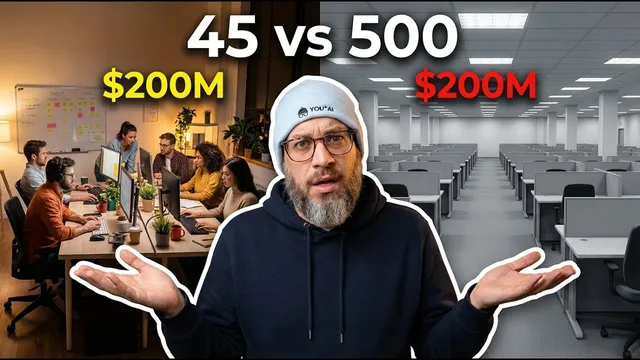
45 People, $200M Revenue. The Question Nobody's Asking About AI and Your Team Size.
Based on AI News & Strategy Daily | Nate B Jones's video on YouTube. If you like this content, support the original creators by watching, liking and subscribing to their content.
AI amplifies per-person output, so coordination costs rise faster than capacity when teams get too large, turning meetings into a symptom of oversized teams.
Briefing
AI didn’t fix the meeting problem because the real bottleneck isn’t meeting volume—it’s team size. As AI boosts output per person, the coordination math breaks: adding people becomes dramatically more expensive, so organizations end up multiplying meetings to synchronize work that should have been structured differently. The result is a “teamsize problem” masquerading as a “meetings problem,” with many teams now spending far more time coordinating than producing.
The core claim is grounded in communication theory and human cognitive limits. The number of communication pathways in a group rises sharply with headcount: five people create 10 pathways, ten people create 45, and twenty people create 190. That explosion matters because humans have layered limits on relationship complexity—research associated with Robin Dunbar’s work suggests effective coordination peaks around small group sizes (often cited as about five for deep coordination, with additional layers for broader trust and stable connections). Military organization mirrors this logic, from fire teams to larger units, and software engineering history reaches similar conclusions: adding people to a project often slows it down due to coordination overhead overwhelming added capacity.
AI changes the economics, not the biology. Before AI, a five-person team produced some baseline output, and adding a sixth person increased capacity with diminishing returns. After AI, the same five-person team can produce roughly 5 to 10 times more than before, with revenue-per-employee data from AI-native companies cited as evidence (including examples like Midjourney, 11 Labs, Anthropic, and OpenAI). When each person’s output rises from hundreds of thousands of dollars to millions, the coordination cost of person number six stops being a “minor tax” and becomes a catastrophe. Meetings exist because coordination was once worth the cost; with AI-amplified productivity, many coordination-heavy structures become net negative.
The transcript reframes what AI makes scarce. Volume is cheap; correctness is scarce. A Harvard Business School field experiment involving 776 professionals at Procter & Gamble found AI-assisted teams were three times more likely to generate ideas in the top 10% of quality—emphasizing accuracy over sheer output. AI also helps break functional silos, letting small teams integrate across domains, but only if humans verify. Verification is the catch: AI output needs human judgment, and that judgment requires a shared mental model. In larger teams, shared context degrades, so organizations compensate with more synchronization—creating an “agentic tarpit” where AI generates work at machine speed while humans struggle to keep plans coherent.
Instead of shrinking companies, the argument pushes restructuring. The proposed organizational unit is the five-person “strike team,” designed for correctness-first execution where AI output is reviewed by other humans with enough shared context to catch meaningful errors. For exploration, a one-person “scout” archetype can work when ambiguity is high and coordination demands are low, but it breaks down for sustained production where multiple perspectives are needed. The transcript also argues that leaders should stop treating AI as a cost-cutting tool and start treating it as a force multiplier: the same people can pursue missions far larger than before.
Finally, it warns that hiring and culture must change. Weak links become more damaging because AI amplifies judgment—and mediocre judgment consumes scarce shared attention, creating an “AI slop tax.” Executives are urged to mandate AI prototyping to build organizational muscle and remove permission barriers. The practical takeaway: fewer meetings won’t come from better note-taking; it will come from reorganizing team size so correctness can scale without drowning in coordination overhead.
Cornell Notes
AI makes output per person jump, but it does not reduce the coordination burden created by large teams. As a result, organizations experience a “teamsize problem” that looks like a “meetings problem”: more people and more teams force more synchronization, which multiplies meetings and verification work. Communication pathways grow sharply with headcount, and human cognitive limits make small groups the natural unit for high-context coordination. The transcript argues that correctness—not volume—is the scarce resource in an AI era, so teams should be reorganized into five-person “strike teams” optimized for shared context and peer verification, plus one-person “scouts” for exploration. The strategic shift is to keep talent and expand ambition, not to cut headcount to preserve old margins.
Why does the transcript claim meetings are a symptom rather than the root cause?
How does communication-pathway math support the “team size” argument?
What evidence is used to argue that AI increases per-person output enough to change the economics of coordination?
What does “correctness is scarce” mean in practice for team design?
Why does the transcript distinguish “scouts” from “strike teams”?
What is the “AI slop tax,” and how does it change hiring priorities?
Review Questions
- How do communication pathways and human cognitive limits jointly motivate a five-person team as an optimal coordination unit?
- What changes in the AI era make “volume” less valuable than “correctness,” and how does that affect meeting-heavy organizational structures?
- Design a strike team for a mission: what shared context and verification steps would be necessary to prevent the “agentic tarpit” effect?
Key Points
- 1
AI amplifies per-person output, so coordination costs rise faster than capacity when teams get too large, turning meetings into a symptom of oversized teams.
- 2
Communication pathways grow sharply with headcount (e.g., 10 pathways at five people, 190 at twenty), making coordination overhead structurally predictable.
- 3
AI makes volume cheap, but correctness remains scarce, so human verification and shared mental models become the limiting factors.
- 4
The transcript proposes five-person “strike teams” for correctness-first execution and one-person “scouts” for exploration under high ambiguity.
- 5
Large teams degrade shared context, which increases verification burden and drives more synchronization work, including meeting multiplication.
- 6
The strategic response is not headcount reduction by default; it’s reorganizing talent into smaller, higher-correctness units to pursue larger missions.
- 7
Hiring and culture must change because weak links become more damaging under AI amplification, creating an “AI slop tax.”