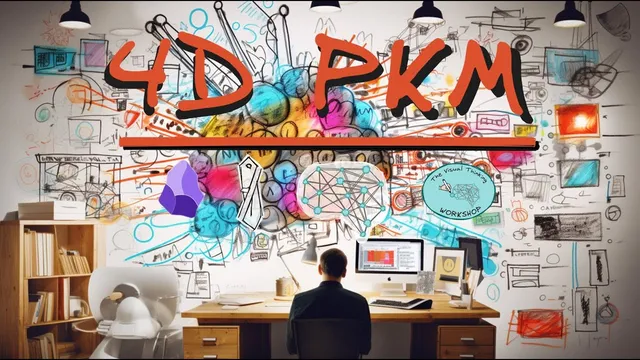
4D Visual Thinking: Effective PKM & the Visual Thinking Workshop Journey
Based on Zsolt's Visual Personal Knowledge Management's video on YouTube. If you like this content, support the original creators by watching, liking and subscribing to their content.
The framework argues that effective PKM must reflect non-linear, image-based human thinking rather than relying on linear, text-only storage.
Briefing
A four-dimensional approach to personal knowledge management is the through-line connecting a tool-building push, a YouTube channel, and a structured “visual thinking workshop.” The core claim is that effective PKM can’t rely on linear, text-only note-taking because human thinking is inherently non-linear and image-driven. Instead of storing disconnected documents, the goal is to build a system that supports connections, context, and visual processing—so people can solve problems, make better decisions, and communicate ideas more clearly.
The framework starts with a contrast: two-dimensional PKM is “notebooks that are disconnected,” where information sits as linear text read top-to-bottom. Three-dimensional PKM adds structure for relationships—links and tags, index pages, content maps, and even dynamic pages powered by queries and ontology—making it easier to connect ideas. The next step, four-dimensional PKM, is motivated by how minds actually work: people capture information in a single view and process pages more effectively when they can see relationships at once, rather than wading through dense text.
That vision drives the creator’s decision to build on Obsidian as an operating environment for PKM tools, including Excalidraw-style diagramming and custom workflows described as “excalib terrain” and “excalib brain” (alongside an “Obsidian Excalidraw” plugin effort). The emphasis isn’t limited to note-taking. The practical payoff is problem-solving: drawing can help people connect the dots when decisions feel stuck; visual play can improve focus and creativity when text-only work becomes draining; visual problem solving can help extract signal from noise and convey insights to others; and visual summaries can slow down a constant stream of new ideas long enough to make sense of incoming information.
The workshop is positioned as a distinctive learning experience rather than a generic course. It’s framed as “home-cooked” learning—hands-on, iterative, and community-based—built around the idea that visuals plus interconnectivity matter more than passive consumption. At the center of the curriculum is “close reading,” described as translating an author’s layered intent—purpose, questions, inferences, assumptions, implications—into the reader’s own point of view. Visual thinking becomes the mechanism for that translation.
Operationally, the workshop follows Thiago Forte’s Progressive Summarization, adapted for creating “book on a page” summaries that feed into permanent notes inside a Zettelkasten-style system. The format runs over six sessions (six weeks) plus five office hours, culminating in a book-on-a-page artifact and stored permanent notes. To ground the method, one cohort reads James B. Carson’s Finite and Infinite Games, a book characterized as both philosophical and business-relevant—cited as influential to frameworks used by leaders and organizations. The broader message is that four-dimensional visual PKM is a way to understand complex environments and turn reading into durable, usable thinking.
Cornell Notes
The workshop and tool-building effort aim to make personal knowledge management match how people actually think: non-linearly, through images and relationships. The approach moves from disconnected, linear notes (2D PKM) to linked and contextual structures (3D PKM), then to a “four-dimensional” model that supports visual processing and one-view understanding. Visual thinking is framed as a practical problem-solving tool—helping with decision-making, focus, creativity, communication, and turning information into durable understanding. The learning method centers on close reading and Progressive Summarization, adapted into “book on a page” summaries that become permanent notes in a Zettelkasten-style system. A cohort example uses James B. Carson’s Finite and Infinite Games to produce visual summaries and reinforce the workflow.
What’s the difference between 2D, 3D, and “4D” personal knowledge management in this framework?
Why does visual thinking matter beyond note-taking?
What makes the “visual thinking workshop” distinct from other learning offerings?
How does close reading connect to visual outputs like “book on a page”?
What structure does the workshop follow, and what is the end product?
Why is Finite and Infinite Games used as a cohort reading example?
Review Questions
- How do links, tags, and dynamic pages change the usefulness of PKM compared with disconnected linear notes?
- What specific steps in close reading are described as layers that must be translated into the reader’s own point of view?
- In what ways do “book on a page” summaries function as permanent notes rather than temporary study aids?
Key Points
- 1
The framework argues that effective PKM must reflect non-linear, image-based human thinking rather than relying on linear, text-only storage.
- 2
2D PKM is characterized as disconnected linear documents; 3D PKM adds links, tags, and contextual structure like index pages and dynamic query-driven views.
- 3
“4D” PKM is motivated by processing information in a single view, using visuals to make relationships easier to perceive and act on.
- 4
Visual thinking is positioned as a practical problem-solving method for decisions, focus, creativity, communication, and turning input into understanding.
- 5
The workshop centers on close reading and translating an author’s layered intent into a reader’s own point of view using visual outputs.
- 6
Progressive Summarization is adapted to produce “book on a page” summaries that feed into permanent notes in a Zettelkasten-style system.
- 7
A six-week workshop format plus office hours culminates in a visual summary artifact stored for ongoing personal use.