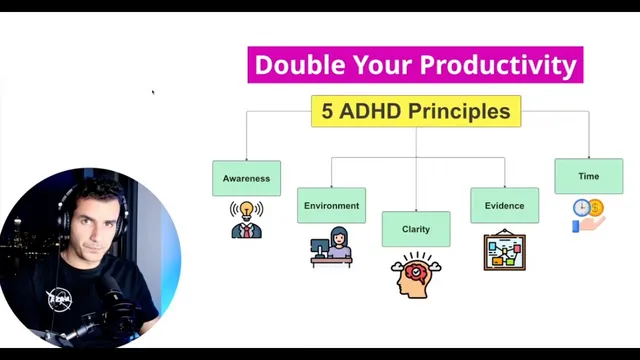
5 ADHD Principles I Learned That Actually Work
Based on Ali Alqaraghuli, PhD's video on YouTube. If you like this content, support the original creators by watching, liking and subscribing to their content.
Treat ADHD productivity as a systems problem by understanding dopamine dysregulation and executive dysfunction rather than relying on discipline narratives.
Briefing
Productivity for people with ADHD hinges less on willpower and more on five practical “principles” built around how the ADHD brain works: awareness, environment, clarity, evidence, and time. The core message is that performance improves when daily systems match dopamine-driven motivation, executive-function limits, and time-blindness—so tasks become easier to start, easier to understand, and easier to trust.
The first principle, awareness, starts with knowing where someone sits on the ADHD spectrum and why. ADHD is framed as more than “attention deficit and hyperactivity disorder,” since the underlying drivers are described as dopamine dysregulation (affecting the ability to initiate actions based on interest and curiosity) and executive dysfunction (affecting the frontal-brain “wiring” needed to initiate, finish, plan, visualize, and sense time). Hyperactivity is clarified as not only physical restlessness in children, but also jitteriness—an outward sign of internal regulation challenges. The payoff of awareness is emotional: when people understand the mechanism, they stop beating themselves up for “discipline” failures and instead treat productivity as a systems problem.
Environment comes next because ADHD is portrayed as more externally oriented than internally oriented. When working memory and internal processing feel “fried,” external cues become essential for identity, mood, and action. A personal example illustrates this: seeing a subtle change in appearance in a mirror can trigger sadness and depression because the person briefly “doesn’t recognize who I am,” while shaving or styling restores a familiar self-image. The practical prescription is to simplify surroundings around goals. The method is a desk “filtration” routine: write the goal, then go item-by-item asking whether each object helps take action toward that goal—if not, delete it (remove, hide, subtract). The speaker’s own desk is intentionally minimal—keyboard, mouse, pen, paper, screen—so visual clutter doesn’t translate into mental clutter.
Clarity is treated as an output of action, not a prerequisite. Waiting to feel certain about what to do is described as a trap; initiating a task generates information that reveals the next step. This creates a “clarity-action loop,” reinforced by the idea that external feedback helps ADHD brains generate ideas. Evidence then becomes the bridge between identity and behavior. Instead of relying on affirmations without proof (which can create cognitive dissonance) or relying on action without an identity (which can break congruence), the solution is to design an “identity of a doer” and then produce daily, small evidence that confirms it.
Finally, time is presented as the most limiting factor: ADHD is described as “time blindness,” where internal timing and task-duration estimation fail, leading to procrastination and vague scheduling (“later,” “someday,” “tomorrow”). The fix is external time scaffolding—clocks in view and a calendar-based productivity system. The strongest recommendation is to use Google Calendar with Google Tasks as the to-do list, and to make the calendar the only productivity system so trust doesn’t fracture across multiple tools. The overall takeaway is straightforward: align daily structure with ADHD’s biology and constraints, and productivity becomes repeatable rather than dependent on motivation.
Cornell Notes
The productivity strategy centers on five ADHD-aligned principles: awareness, environment, clarity, evidence, and time. Awareness means understanding ADHD as dopamine dysregulation and executive dysfunction, which reduces self-blame and guides better system design. Environment should be simplified and goal-filtered because ADHD is described as more externally cue-driven when internal working memory is unreliable. Clarity is framed as something that emerges from action, while evidence is the daily proof that builds a consistent “doer” identity and prevents cognitive dissonance. Time blindness is treated as the biggest constraint, so clocks and a calendar-based system (specifically Google Calendar plus Google Tasks) are used to replace vague scheduling with timeliness.
Why does “awareness” matter for productivity in ADHD, beyond simply knowing the label?
How does environment influence behavior for someone with ADHD?
What does “clarity comes from action” mean in practice?
Why does the transcript emphasize “evidence” and not just affirmations or effort?
What is “time blindness,” and why does it drive procrastination?
What scheduling system is recommended to manage time blindness?
Review Questions
- Which two biological mechanisms are named as root causes behind ADHD in the transcript, and how do they relate to starting tasks?
- How does the transcript justify that clarity should be treated as a result of action rather than a prerequisite?
- What features of a productivity system are said to fail when they are not tied to a calendar, and what tools are recommended instead?
Key Points
- 1
Treat ADHD productivity as a systems problem by understanding dopamine dysregulation and executive dysfunction rather than relying on discipline narratives.
- 2
Simplify and “goal-filter” your environment so external cues support action instead of adding visual and mental clutter.
- 3
Start tasks to generate information; use a clarity-action loop instead of waiting for certainty.
- 4
Build a doer identity through daily evidence—small real-world proof that reduces cognitive dissonance.
- 5
Use external time supports because time blindness undermines task-duration estimation and makes procrastination feel inevitable.
- 6
Adopt a calendar-based system (recommended: Google Calendar plus Google Tasks) and make it the only to-do system to preserve trust.
- 7
Add friction to unwanted actions and remove friction from desired ones to make the next step easier to take.