5 Dimensions of Learning Every Student MUST Master
Based on Justin Sung's video on YouTube. If you like this content, support the original creators by watching, liking and subscribing to their content.
Treat learning as a bottleneck problem: overall results are capped by the weakest learning dimension, not by strengths elsewhere.
Briefing
Learning improvement doesn’t come from chasing a single “best” study trick—it comes from fixing the specific weak link that caps performance. The core claim behind the Broken Barrel approach is that a learner’s results are limited by their most broken “plank,” not by how strong their other skills are. That framing matters because it turns studying from a trial-and-error guessing game into a targeted process: identify weaknesses across core learning dimensions, strengthen the weakest first, then reassess every few months.
Most people, the transcript says, fall into the “Silver Bullet” trap: searching for a universal technique that magically works for everyone. Flash cards, for example, can be excellent for memorizing isolated facts, but they’re less useful for complex problem solving. Even when two students use the same method, outcomes can diverge because learning is not one-size-fits-all. The result is wasted time—especially when someone keeps switching techniques without diagnosing what’s actually holding them back.
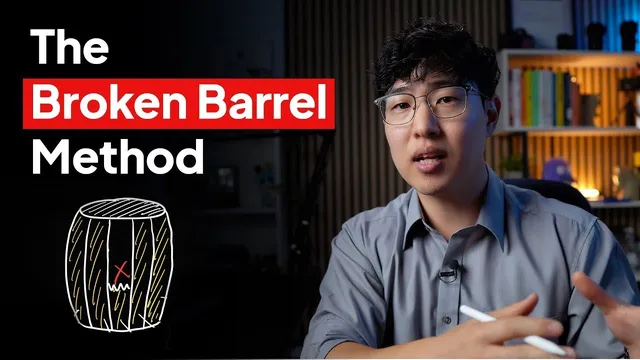
Instead of starting with strengths, the Broken Barrel approach starts with weaknesses. The transcript uses a barrel metaphor: even if most planks are strong, the barrel’s water level is capped by the broken one. In learning terms, that means deep processing, self-regulation, retrieval practice, mindset, and self-management all matter—but a limitation in just one dimension can dominate the overall outcome. The method is straightforward in principle: figure out which dimension is weakest, improve it until it’s no longer the bottleneck, re-evaluate, and repeat. The recommended cadence for reassessment is every three or four months.
A major obstacle is that learners often can’t accurately identify their own learning weaknesses. The transcript points to a “black box of learning,” describing how people know effort matters but struggle to see which internal processes convert effort into results. Research is cited to support the idea that people are poor at pinpointing their true learning weaknesses, which can lead to weeks of experimenting with techniques that don’t target the real bottleneck—and can even make improvement harder by adding mental overhead.
To make diagnosis practical, the transcript promotes a free quiz designed to assess learning strengths and weaknesses and generate a personalized report. It draws on coaching experience with nearly 20,000 learners and includes a validity study conducted with Monash University. The quiz focuses on the five dimensions, but the report emphasizes the most important ones for most learners and may assign a “learner type” to guide which dimension to work on first.
The five dimensions are: deep processing (understanding and extracting meaning), self-regulation (awareness and adjustment of study methods), mindset (comfort with uncertainty and mistakes during trial-and-error), retrieval (recalling and testing previously learned material, often via spaced practice), and self-management (time, prioritization, focus, and procrastination control). The transcript argues that many students overestimate retrieval because they’ve heard about spaced retrieval and flash cards—yet retrieval may not be the limiting weakness for them. By contrast, mindset and self-management are described as especially common bottlenecks when learners avoid uncertainty or struggle to sustain focus. The overall promise is that once the right weakness is targeted, progress can become visible week to week—an indicator that the improvement effort is hitting the actual constraint.
Cornell Notes
The Broken Barrel approach reframes studying as a bottleneck problem: overall learning performance is capped by the most underdeveloped “plank,” not by how strong other skills are. Instead of hunting for a universal “best technique” (the Silver Bullet mindset), learners should identify their weakest dimension, improve it, then reassess periodically. The transcript lays out five dimensions—deep processing, self-regulation, mindset, retrieval, and self-management—and argues that a limitation in just one can dominate results. Because people often misdiagnose their own weaknesses, a free quiz is offered to generate a personalized report and learner type to guide which dimension to fix first. The payoff is faster, more targeted improvement rather than endless trial-and-error.
Why does the transcript reject the “Silver Bullet” approach to studying?
How does the Broken Barrel metaphor determine what to work on first?
What are the five dimensions of learning, and what does each one mean in practice?
Why might a student who uses spaced retrieval still fail to improve?
What problem does the “black box of learning” describe, and how does the quiz address it?
What does “progress week after week” signal in this framework?
Review Questions
- Which learning dimension is most likely to limit a student who understands concepts deeply but rarely revises what they learn?
- How would the Broken Barrel approach change a student’s plan compared with repeatedly trying new study techniques?
- In what situations would self-management become the most urgent dimension to address?
Key Points
- 1
Treat learning as a bottleneck problem: overall results are capped by the weakest learning dimension, not by strengths elsewhere.
- 2
Avoid the “Silver Bullet” mindset; no single study technique reliably solves every learning challenge across people and contexts.
- 3
Use the Broken Barrel cycle: identify the weakest dimension, improve it until it’s no longer the bottleneck, then reassess every 3–4 months.
- 4
Diagnose weaknesses carefully because people often misidentify their own learning constraints, leading to wasted experimentation.
- 5
Understand the five dimensions—deep processing, self-regulation, mindset, retrieval, and self-management—and remember that a limitation in one can dominate outcomes.
- 6
Don’t assume retrieval is the bottleneck just because spaced practice is popular; many students need to fix other dimensions first.
- 7
Use feedback from consistent progress (e.g., week-to-week improvement) to confirm whether the targeted weakness is the real constraint.