5 easy ways to create rich notes (Heptabase Tutorial)
Based on Greg Wheeler's video on YouTube. If you like this content, support the original creators by watching, liking and subscribing to their content.
Use nature and well-chosen stories as raw material, then extract a concrete lesson you can apply to daily life.
Briefing
A Yellowstone wolf story becomes a practical note-taking framework: turn what’s learned from nature and reading into “futureproof” questions, then organize the supporting details with bullet points and clear, specific titles. The core insight is that stories—whether about ecosystems or scripture—carry usable lessons, and the best way to keep those lessons alive in a personal knowledge system is to convert them into prompts that can guide decisions later.
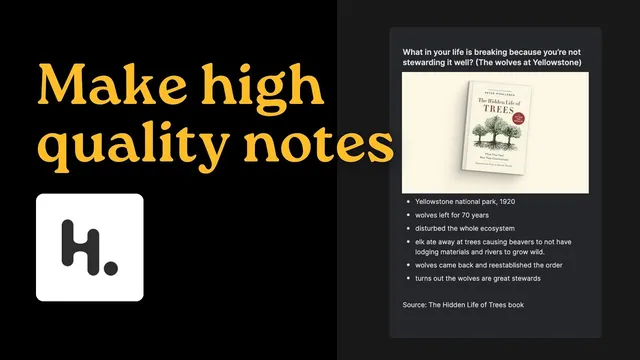
The narrative starts with a chain reaction in Yellowstone around 1920, when wolves were absent for about 70 years. Without wolves, elk multiplied and overbrowsed trees, which in turn disrupted beavers’ access to lodging materials and sent rivers into a more chaotic state. When wolves returned, they reestablished balance: elk pressure eased enough for trees to recover, beavers regained the materials they needed, and rivers stabilized. Wolves are framed as “great stewards,” and that ecological cause-and-effect becomes a mirror for personal life.
From there, the method shifts from inspiration to action. The lesson isn’t just “read more” but “extract meaning”: after encountering a story, write down the takeaway as a question that can be revisited in the future. One example card asks, “What in your life is breaking because you’re not stewarding it well (Wolves at Yellowstone).” The title functions as the first thing to see during scanning, while the note body holds the context and bullet-pointed reflections. Questions are treated as durable prompts because they remain relevant as circumstances change—there’s always some area of life to manage better, whether relationships, health, or parenting.
The transcript also lays out why bullet points are the default structure for these notes. Bullet points visually separate ideas, making them easier to scan than paragraphs. They encourage “small chunks” that are faster to capture and review, since each line can be read quickly and revisited later. Scanning matters because the system is meant for retrieval, not just storage.
Several additional question-title examples show how the approach generalizes beyond wolves: “How many loaves do you have?” ties to the biblical feeding of thousands (five loaves and two fish) and becomes a prompt about time and resources in everyday conversations; “When was the last time you had a great conversation?” connects to the emotional payoff of deep connection; and “When was the last time you did something for the first time?” is a reminder to seek novelty to spark creativity.
Finally, the framework emphasizes “information scent”—making titles clear and specific so they match what’s inside the note. Vague or misleading labels create the same frustration as clickbait links; precise titles help the reader trust that opening the note will deliver the expected context and support further discovery. The result is a five-part checklist: spend time in nature, read stories for lessons, turn note titles into questions, write clear/specific titles using information scent, and use bullet points to capture and retrieve the details.
Cornell Notes
The Yellowstone wolf story is used to build a note-taking system that keeps insights usable over time. Wolves returning to Yellowstone restored balance in the ecosystem, and that cause-and-effect becomes a personal prompt about stewardship in one’s own life. The method turns story takeaways into question-based note titles—prompts that stay relevant as circumstances change—and stores the supporting context in bullet points for fast scanning and review. Clear, specific titles are treated as “information scent,” so opening a note reliably matches the expectation set by its label. Together, these practices aim to make notes more retrievable, reflective, and futureproof.
How does the Yellowstone wolf story translate into a personal note prompt?
Why are bullet points positioned as the best structure for these notes?
What makes question-based note titles “futureproof” in this system?
How do the examples show questions can come from both scripture and everyday life?
What is “information scent,” and how does it affect note titles?
Review Questions
- When you encounter a story that contains a lesson, what exact step turns that lesson into something you can use later?
- Why does the transcript treat bullet points as better for review than paragraphs?
- Give one example of a question-based note title and explain what context the title preserves (including any parenthetical reference).
Key Points
- 1
Use nature and well-chosen stories as raw material, then extract a concrete lesson you can apply to daily life.
- 2
Convert story takeaways into question-based note titles so future review automatically triggers reflection.
- 3
Write supporting details in bullet points to improve visual separation, faster capture, and easy scanning later.
- 4
Make note titles specific and aligned with the note’s contents to create strong “information scent” and avoid misleading labels.
- 5
Attach context to titles when helpful (such as parenthetical references) so the reason for the question is obvious at a glance.
- 6
Treat questions as durable prompts that remain relevant because there’s always something to improve or steward better.