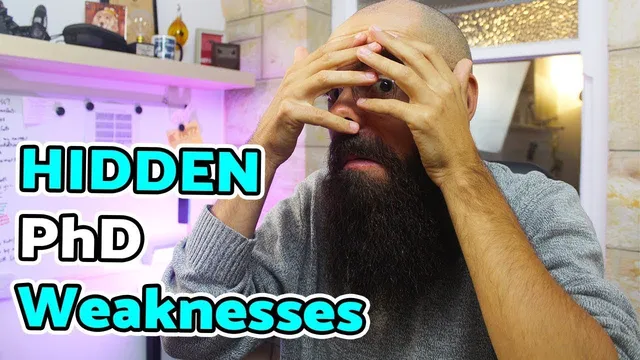
5 Hidden weak points in your PhD and Research
Based on Andy Stapleton's video on YouTube. If you like this content, support the original creators by watching, liking and subscribing to their content.
Bias can be inherited from lab culture and reinforced by a supervisor’s past success, so it requires deliberate self-auditing and outside input.
Briefing
PhD work often fails to progress not because of a lack of effort, but because of “hidden weak points” that quietly skew decisions, communication, and time use. The most consequential is bias—especially the bias shared by a lab culture and reinforced by a supervisor’s past success. When a research group has a preferred method, it can become the default even when better alternatives exist. Breaking that pattern requires stepping back from day-to-day experiments and asking blunt questions: Is this truly the best approach, or is it simply what has been rewarded before? The practical antidote is to challenge assumptions along the way, then seek outside perspectives—both from other academics within the same field and from experts in unrelated areas—so the work is stress-tested against different ways of thinking. A single conversation with a different researcher can expose “cracks and crevices” and lead to a more impartial, more exploratory research direction.
Another major weak point is the pressure to sound clever. Overreliance on long words, intricate phrasing, and heavy acronym use can make research harder to understand and harder to collaborate on. The transcript ties this to identity and background: coming from a working-class family without elite “posh” training can make “academic performance” feel unnatural, and trying to imitate it can reduce clarity. The payoff from dropping that expectation is straightforward—communication becomes more accessible, more people engage, and collaborations follow. A conference example with roughly 200 attendees illustrates the contrast: while others went “too hard” trying to impress, the more direct, story-driven explanation led to many questions and increased interest in the research.
Time management shows up as another vulnerability, but not in the usual productivity sense. The transcript argues that researchers need deliberate thinking time—uninterrupted mental space where ideas can surface without phone, computer, or other distractions. Running is used as the model: several one-hour runs per week with no music or digital input create long stretches of focused thought, producing ideas for videos, businesses, and research. The key is not meditation, but genuine cognitive freedom.
A further weakness is stubbornly investing energy in what “should” work, even when evidence suggests it won’t. The transcript describes chasing a specific solar cell because it felt cool and promised recognition from a supervisor—only to later realize that time and effort should have been redirected toward areas already producing results. That matters because PhD timelines are constrained by funding and the need for timely outputs; the rational strategy is to identify what is working early and double down, since it generates papers, collaborations, and momentum.
Finally, an ego trap can block learning. The internal reflex—“they don’t know anything,” or dismissing criticism as stupid—prevents constructive synthesis of feedback into actionable changes. The transcript’s guidance is to take criticism seriously enough to extract any value, discard what doesn’t fit, and avoid arguing defensively. When feedback causes discomfort, that discomfort may signal something true worth investigating. Together, these weak points—bias, performance pressure, insufficient thinking time, misallocated effort, and ego—shape whether a PhD becomes a steady build of credible results or a prolonged struggle against avoidable friction.
Cornell Notes
The transcript identifies five “hidden weak points” that can quietly derail PhD progress: bias, the need to sound clever, insufficient thinking time, over-investing in experiments that won’t work, and ego-driven resistance to criticism. Bias often comes from lab culture and a supervisor’s rewarded habits, so it requires deliberate self-auditing and outside input from other academics and even unrelated fields. Communication improves when researchers drop the expectation to sound fancy and instead explain clearly in a way others can understand. Creativity and insight need protected thinking time without distractions, illustrated through long runs. Finally, PhD success depends on redirecting effort toward what is working and using criticism constructively rather than dismissing it.
How does lab culture create bias in PhD research, and what’s a concrete way to counter it?
Why does trying to “sound clever” undermine research outcomes?
What does “thinking time” mean in this context, and how is it protected?
How should a PhD student decide whether to keep investing in an approach that isn’t working?
What is the ego trap, and how can feedback be handled without becoming defensive?
Review Questions
- Which sources of bias are most likely in your own lab environment, and what outside perspectives could you seek to test your assumptions?
- What communication habits (word choice, acronym density, level of detail) might be unintentionally reducing clarity for collaborators or examiners?
- How could you schedule protected thinking time in your week without turning it into another task to optimize?
Key Points
- 1
Bias can be inherited from lab culture and reinforced by a supervisor’s past success, so it requires deliberate self-auditing and outside input.
- 2
Improving research communication often means dropping the expectation to sound clever and instead explaining ideas clearly enough for broad understanding.
- 3
Protected, distraction-free thinking time is a practical driver of creativity and research ideas, not a luxury.
- 4
PhD timelines are constrained, so effort should shift toward approaches that are already producing results rather than chasing what “should” work.
- 5
Over-investing in experiments for kudos or excitement can burn time and energy; redirecting earlier can increase papers and collaborations.
- 6
Ego-driven dismissal of criticism blocks learning; extract value from feedback, discard what doesn’t fit, and avoid defensive argumentation.