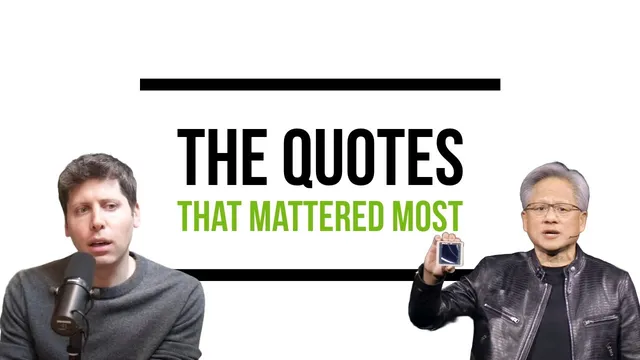
5 Key Quotes: Altman, Huang and 'The Most Interesting Year'
Based on AI Explained's video on YouTube. If you like this content, support the original creators by watching, liking and subscribing to their content.
OpenAI leadership frames GPT-5 rollout as staged and incremental to avoid abrupt, high-impact capability jumps rather than a single “shock” release.
Briefing
AI timelines and deployment strategies are tightening fast: OpenAI leaders and other major AI researchers are signaling that “AGI-like” systems could arrive within the decade—possibly even before 2028—while companies prepare for incremental releases rather than abrupt capability jumps. That matters because the moment AI can function as a “drop-in” substitute for human work, economic incentives and governance choices will collide, raising both labor-market disruption risks and alignment concerns.
Sam Altman’s comments center on avoiding “shock updates” to the world. The practical implication is a release strategy built around staged improvements—rolling out better model checkpoints over time rather than a single, discontinuous leap. Greg Brockman added detail by describing safety planning that involves deploying GPT-5 in stages, effectively creating a continuum of incrementally better systems. The framing suggests a world where capabilities rise in steps, while marketing names may lag behind the underlying technical cadence (with speculation about intermediate releases such as something “equivalent to GPT 4.5” before GPT 5).
Beyond release mechanics, the transcript highlights a second, more destabilizing theme: social and governance fallout. Altman’s circle includes worries about AI going “theatrically wrong,” and Demis Hassabis—discussing governance and AGI definitions—points to how definitions themselves can reshape incentives. One definition treats AGI as systems technically capable of performing economically important tasks, even if they aren’t deployed due to legal, ethical, or social constraints. Under that broader lens, AGI could already be “here” in capability terms while still being withheld in practice—raising the question of whether companies would actually restrain deployment if doing so costs them economically.
Hassabis also ties AGI to a timeline that feels unusually close for a long-range goal: he suggests progress is on track for a “within the next decade” outcome. Other estimates are sharper. An OpenAI alignment researcher is quoted as putting the odds of AGI before 2028 at roughly two-thirds, using public information as the basis for the forecast. Another quote from Daniel Kokotajlo adds urgency: once AGI arrives, artificial superintelligence could follow quickly—“give or take a year”—depending on how the capability curve compounds.
As timelines compress, researchers describe changing personal risk tolerance—helmet use while cycling, and talk of giving up skiing—framed as a human response to the possibility that the “singularity” could arrive in the 2020s. Meanwhile, the transcript pivots to a lighter but telling institutional effect: peer review may increasingly rely on ChatGPT. A cited paper reports that peer reviewers used LLM-generated text more often when deadlines were near and when reviewers were less likely to respond to rebuttals, suggesting that academic quality control could become “LLM-mediated” by default.
The final section shifts from models to hardware and robotics, arguing that compute growth and chip manufacturing are accelerating the whole stack. Nvidia’s Blackwell GPU and related systems are described as delivering large inference and token-generation performance gains, while model sizes continue to scale—from GPT-3’s 175B parameters to GPT-4’s ~1.8T, and Nvidia’s claims about deploying even larger models. The transcript also emphasizes a recursive loop: better chips enable better generative AI, which then helps design better chips, including computational lithography where generative AI can help generate masks. Nvidia’s Project Groot is presented as a general-purpose foundation model for humanoid robot learning, trained in simulation and transferred to real robots, reinforcing the idea that capability gains may soon extend beyond text and into physical action.
Cornell Notes
The transcript links faster AI capability growth to both release strategy and real-world deployment pressures. OpenAI leadership emphasizes avoiding “shock updates” by rolling out GPT-5 in stages, creating a continuum of incremental improvements rather than a single abrupt leap. At the same time, multiple researchers give AGI timelines that cluster within the next decade, with some odds estimates placing AGI before 2028 and others suggesting artificial superintelligence could follow quickly after AGI. Definitions of AGI also matter: some frameworks count capability even if companies hold back deployment for legal or ethical reasons. The piece also points to second-order effects—peer review increasingly using ChatGPT—and to hardware acceleration (Nvidia Blackwell) and robotics learning (Project Groot) that could make these timelines feel less theoretical.
What does “avoid shock updates” imply for how GPT-5 might be released?
How do AGI definitions change the incentives for deployment?
What timeline estimates are offered for AGI, and how do they differ?
Why does the transcript treat peer review automation as a meaningful “AGI-adjacent” effect?
How do Nvidia’s hardware announcements connect to AI capability growth?
What is Project Groot, and how does it extend beyond text-based AI?
Review Questions
- How do staged deployments (incremental checkpoints) attempt to reduce “shock updates,” and what tradeoffs might that create for safety and transparency?
- Compare the different AGI definitions mentioned: capability-only vs. capability-plus-deployment. How could each definition affect governance decisions?
- What evidence does the transcript cite that peer review is becoming LLM-mediated, and what incentives (deadlines, rebuttal behavior) appear to drive it?
Key Points
- 1
OpenAI leadership frames GPT-5 rollout as staged and incremental to avoid abrupt, high-impact capability jumps rather than a single “shock” release.
- 2
AGI definitions that count technical capability—even without workforce deployment—could accelerate competitive pressure to deploy systems sooner than governance would prefer.
- 3
Multiple researchers give AGI timelines that cluster within the next decade, including a two-thirds chance estimate before 2028 and claims that artificial superintelligence could follow quickly after AGI.
- 4
Institutional workflows may already be shifting: peer review is increasingly using ChatGPT-generated text, especially when deadlines are near and when reviewers are less likely to engage with rebuttals.
- 5
Hardware scaling is presented as a key driver: Nvidia’s Blackwell platform is described as boosting inference/token performance while reducing cost and energy per output.
- 6
Compute and chip design are forming a feedback loop, where generative AI can assist in lithography mask ideation while traditional methods verify the final masks.
- 7
Robotics progress is framed as moving from imitation of text to imitation of actions, with Nvidia’s Project Groot trained in simulation and transferred to real humanoid tasks.