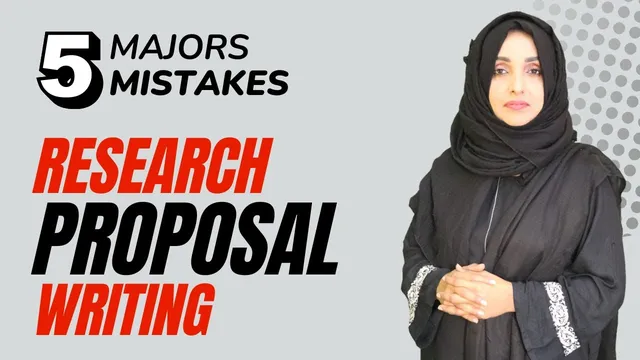
5 Majors Mistakes While Research Proposal Writing | Dr Rizwana
Based on Dr Rizwana Mustafa's video on YouTube. If you like this content, support the original creators by watching, liking and subscribing to their content.
Use a specific, targeted research title that reflects the exact problem, not a broad area that hides the study’s boundaries.
Briefing
A research proposal gets rejected most often when its title, framing, and evidence don’t match the specific problem a funder or committee is trying to solve. Dr Rizwana Mustafa highlights five recurring mistakes made by early-career researchers—starting with overly broad titles that fail to signal a clear, targeted study. Broad wording may feel like it creates more “options,” but grant panels and PhD admissions teams typically look for a precise research concern. If the title doesn’t reflect the exact focus, the proposal can land on a rejection pile before reviewers even reach the methodology.
The first major misstep is selecting a title that’s too general and doesn’t name the specific terms and boundaries of the intended work. A strong title should mirror the depth of the literature review and the researcher’s command of the subject area. Mustafa gives an example: “investigate the application of ionic liquids in organic synthesis” is too wide because it doesn’t specify which ionic liquids, what role they play, or what exact synthesis context is targeted. A more competitive direction is to narrow to a defined subset—such as a particular class of ionic liquids and a specific synthesis system—while also clarifying what will be tested (for instance, whether the ionic liquid is used as a catalyst, and what outcomes will be measured).
The second major mistake is misalignment between the research objectives and the research questions. Objectives, questions, and the proposed solution must all point to the same problem. If the study claims it will examine the role of an azole-based ionic liquid as a catalyst, then the objectives and research question must revolve around that catalytic role—not around unrelated variables like reaction rate or molecular interactions that drift away from the central claim. Mustafa emphasizes that early-stage research should be tightly scoped so the proposal’s logic remains coherent.
Third, many proposals fail because they don’t justify originality and importance. Even if a topic is different, it still must address a problem that matters to society or the field. Mustafa contrasts well-studied uses of azole-based ionic liquids with a gap in N,S-based synthesis, arguing that the proposal should clearly explain why investigating that gap is valuable. She also frames impact in practical terms: replacing volatile organic solvents that pollute the environment with greener ionic liquids can reduce harm, and replacing harmful catalysts can be better for both bodies and ecosystems.
Fourth, researchers often omit the “roadmap” elements that make the work feasible: the method, required resources, nearby infrastructure, and the next strategy if key equipment or cases aren’t available. Committees look for whether the researcher can realistically execute the plan—through lab instruments, collaborations, and interpretation support for results.
Fifth, weak writing and presentation undermine strong science. Mustafa stresses story-driven structure: proposals should move from the problem to prior research to the proposed solution, with clear connections between sections rather than abrupt jumps. She warns against copying and rephrasing sentences from papers; instead, researchers should write in their own words, using confident, understandable language. Strong evidence from literature—showing what impact similar work created—helps tighten the narrative and improves the odds of approval and funding.
Cornell Notes
The proposal’s biggest rejection risk comes from mismatches: vague titles, unclear alignment, weak justification, missing feasibility details, and poor presentation. A competitive title must be specific enough to reflect the exact research concern funders and admissions panels target, not just a broad area. Objectives and research questions must align with the same central problem; if the study claims to examine a catalyst role, the objectives and questions must stay focused on that role. Proposals also need a clear case for originality and importance, including real-world impact such as greener alternatives to volatile organic solvents. Finally, feasibility (methods, resources, collaborations) and story-driven writing determine whether reviewers trust the plan and remember the contribution.
Why does a broad research title increase the chance of rejection even when the topic is “important”?
How should objectives and research questions be aligned to avoid a logical mismatch?
What does “justifying originality and importance” require beyond claiming the topic is new?
What feasibility details strengthen a proposal when reviewers ask, “Can this be done?”
How does story-driven writing improve funding and approval odds?
Review Questions
- What specific elements should a research title include to signal a targeted problem rather than a broad area?
- Give an example of how objectives and research questions could drift away from the central research claim, and how to correct it.
- Which feasibility components (methods, resources, collaborations, contingencies) most directly address reviewer concerns about whether the work can be executed?
Key Points
- 1
Use a specific, targeted research title that reflects the exact problem, not a broad area that hides the study’s boundaries.
- 2
Ensure research objectives, research questions, and the proposed solution all align around the same central issue.
- 3
Build a clear case for originality and importance by identifying a real gap and explaining the practical impact of the work.
- 4
Include feasibility details: methods, required resources, available infrastructure, and a contingency plan plus collaborations if needed.
- 5
Strengthen writing with story-driven structure that connects problem → gap → solution, avoiding abrupt section jumps.
- 6
Write in clear own words and support claims with strong literature evidence showing prior impact, not just citations.
- 7
Follow the required university format and repeatedly review the proposal with supervisors, seniors, and colleagues to catch editing and alignment mistakes.