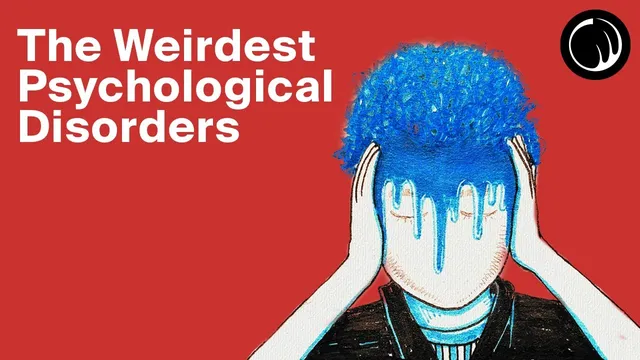
5 of the Weirdest Psychological Disorders (That Will Make You Question Your Own Self)
Based on Pursuit of Wonder's video on YouTube. If you like this content, support the original creators by watching, liking and subscribing to their content.
Psychological disorders are defined as deviant patterns of thought, feelings, or behaviors that cause distress and dysfunction, but “normal” is culturally constructed and hard to measure from the outside.
Briefing
Psychological disorders are often defined as patterns of thoughts, feelings, or behaviors that deviate from cultural ideas of “normal,” while also causing distress and disrupting day-to-day life. Yet the boundaries are blurry: mental illness is common, rarely “extreme” in everyday cases, and still poorly understood—especially because consciousness makes it hard to verify what a person’s inner experience is actually like. That uncertainty becomes the point of focus when five unusual disorders are presented as windows into how fragile and variable “reality” can feel from inside the mind.
The first condition, alien hand syndrome, centers on a hand that behaves as if it has its own intentions. People can watch their hand carry out goal-directed actions—opening windows, unzipping clothing, or retrieving items—without intending to do so. In some cases, the hand even performs the opposite action of what the person is trying to accomplish with the other hand. The disorder is linked to brain trauma, stroke, or tumors, and it can appear alongside serious neurological issues such as aneurysms or after brain surgery. No cure is known, and the mechanism behind the “separate will” feeling remains incomplete.
Derealization is described as a state where surroundings seem unreal, distant, or distorted—like the world has faded behind a pane of glass. It can be temporary and is reported as common, with up to 75% of people experiencing it at least occasionally. A related condition, depersonalization, adds a sense of disconnection from one’s own self, body, or mental processes. When these experiences become chronic and intense, they are often tied to other psychological disorders or medical conditions, frequently with severe trauma or stress in the background.
Disassociative identity disorder is presented as a fragmentation of identity: a person may experience and act through two or more distinct identities, each with different personalities, memories, preferences, and ways of influencing outward behavior. Prevalence is estimated between 0.01% and 1.5%. Trauma is emphasized as a major driver, with 90%+ of cases involving childhood abuse, neglect, or other intensely distressing events. The disorder is framed as a coping response in which the mind attempts to manage overwhelming memories by splitting off aspects of experience; treatment options exist but no single universal approach has won broad consensus, and some methods remain controversial.
Two rarer syndromes push the idea of reality-testing further. Capgras syndrome involves a firm belief that a loved one has been replaced by an imposter or duplicate—so convincing that reasoning often fails to change it. It is associated with brain damage and conditions such as schizophrenia, Alzheimer’s dementia, epilepsy, tumors, and Parkinson’s disease. Cotard (often spelled “Cotard”) syndrome involves believing oneself to be dead, dying, or nonexistent, sometimes extending to the belief that parts of the body are missing; self-neglect and self-harm can follow from the logic that nothing matters if one is already dead. Reported cases often co-occur with depression, anxiety, schizophrenia, substance abuse, or brain damage from stroke, tumors, blood clots, toxins, or head injury.
Taken together, these disorders are used to highlight a central tension: “normal” reality is a shared social definition, while these conditions show how easily perception can diverge from what others recognize. The result is a portrait of the mind as powerful—but also capable of producing competing realities that are difficult to reconcile from the outside.
Cornell Notes
The core message is that psychological disorders can distort how people experience reality, selfhood, and agency—sometimes in ways that look impossible from the outside. Five conditions illustrate this: alien hand syndrome (a hand acts with its own “intent”), derealization (surroundings feel unreal), depersonalization (disconnection from self), disassociative identity disorder (distinct identities with separate memories and preferences), and two rare syndromes—Capgras (loved ones seem replaced) and Cotard (belief that one is dead or nonexistent). These disorders are linked to factors ranging from trauma to neurological damage, but causes and treatments are often incomplete or contested. The stakes are practical: stigma and misunderstanding persist, while the lived experience of “reality” can vary dramatically between individuals.
How does alien hand syndrome challenge the idea that actions always match a person’s intentions?
What distinguishes derealization from depersonalization, and how common is derealization?
What are the key features of disassociative identity disorder, and what role does trauma play?
Why is Capgras syndrome so resistant to “proof,” according to the description?
What does Cotard syndrome involve, and what behaviors can follow from it?
Review Questions
- Which disorders in the list directly involve a mismatch between intention and action, and what neurological or psychological factors are linked to each?
- How do derealization and depersonalization differ in what feels unreal or disconnected, and what patterns suggest chronic versus temporary experiences?
- What common theme connects disassociative identity disorder, Capgras syndrome, and Cotard syndrome, even though their symptoms differ?
Key Points
- 1
Psychological disorders are defined as deviant patterns of thought, feelings, or behaviors that cause distress and dysfunction, but “normal” is culturally constructed and hard to measure from the outside.
- 2
Alien hand syndrome features goal-directed actions by a hand that the person does not intend, sometimes even contradicting the person’s other hand.
- 3
Derealization makes the environment feel unreal or distorted, and depersonalization adds disconnection from one’s own self, with chronic forms often tied to trauma or other conditions.
- 4
Disassociative identity disorder involves distinct identities with separate memories and preferences, and trauma—especially childhood abuse or neglect—is reported in most cases.
- 5
Capgras syndrome is the belief that a loved one has been replaced by an imposter, and it can persist despite evidence because the conviction feels absolute.
- 6
Cotard syndrome involves believing oneself is dead, dying, or nonexistent, which can lead to self-neglect or self-harm.
- 7
Across these conditions, “reality” is shown to be fragile and variable, shaped by brain function, trauma, and how consciousness organizes experience.