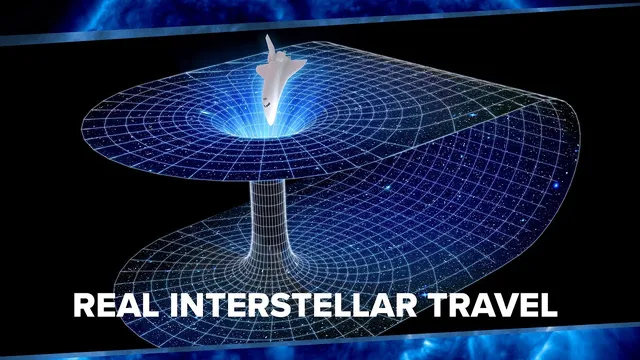
5 REAL Possibilities for Interstellar Travel
Based on PBS Space Time's video on YouTube. If you like this content, support the original creators by watching, liking and subscribing to their content.
Interstellar mission planning depends on the Wait Calculation: development time and travel time must be optimized together, not separately.
Briefing
Interstellar travel is most likely to arrive first through technologies that can be built and scaled within human timelines—meaning the deciding factor isn’t just propulsion physics, but the “Wait Calculation,” a tradeoff between how fast a starship could go and how long it would take to develop and assemble it. The fastest options tend to demand extreme energy sources or exotic fuels, while near-term feasibility points toward light-driven systems that avoid carrying vast propellant masses.
The baseline problem is propellant. Even the fastest historical rocket speeds—like Apollo 10’s nearly 25,000 miles per hour—would take roughly 120,000 years to reach Alpha Centauri. The rocket equation makes that outcome hard to escape: achieving a human-lifetime trip requires speeds around 10% of light speed, but with conventional liquid fuels the needed fuel mass becomes absurdly large. That pushes the search toward either expelling more mass at higher velocities or, more realistically, using fuels with far higher energy density.
Fusion is presented as the most achievable high-energy step. One scenario borrows the logic of the Orion project: detonate large thermonuclear devices behind a spacecraft and “surf” the resulting blasts. With a ship mass dominated by hundreds of thousands of 1-megaton hydrogen bombs, acceleration could reach about 1G and approach 0.1c. The catch is slowing down at the destination—an unavoidable cost that effectively halves the achievable cruise speed—turning a one-way trip from about 44 years into roughly 90 years. That implies multiple generations aboard, plus the political and safety hurdles of using nuclear explosives in space.
Antimatter drives take the efficiency idea further. Matter–antimatter annihilation releases energy with very high efficiency, so only tiny amounts of antimatter would be needed in principle. The barrier is practical: producing and storing enough antimatter—especially antiprotons—for interstellar travel is currently far beyond capability, with production rates limited by expensive particle accelerator processes. If production could scale dramatically, a pion-based concept using antiproton–proton annihilation products could plausibly reach around 0.5c, cutting an Alpha Centauri trip to about nine years, and potentially higher speeds (with strong time-dilation effects) if even more antimatter becomes available.
Light sails shift the focus again: instead of carrying fuel, a spacecraft rides a beam of energy. A kilometer-scale sail—potentially sapphire-coated for heat resistance—could be pushed by a gigantic laser, with power levels comparable to many nuclear plants. For early unmanned missions, speeds around 0.1c are framed as within reach using microwave-beam concepts; for humans, the required laser scale and sail materials become the main engineering bottlenecks. Slowing down remains a major issue, but beam range and destination interactions could allow even higher speeds.
At the far end sits the “Blackhole Drive,” specifically a Schwarzschild Kugelblitz: an artificial black hole created by focusing extreme laser energy into a tiny region. A carefully chosen black hole mass would radiate Hawking radiation intensely enough to power acceleration, potentially reaching 0.1c in days and higher fractions of light speed before evaporation. The limiting drawback is that the lasers required to create the black hole must be vastly more powerful than the black hole itself—making it a distant, speculative option.
In the end, the “fastest” path under extreme assumptions is nuclear propulsion (Orion-like), while the most realistic near-term bet is light sails for unmanned probes—about 45 years to reach Alpha Centauri, with additional time for signals to return. The far-future exploration toolkit then becomes fusion, antimatter, and black-hole concepts, assuming warp drives don’t deliver.
Cornell Notes
Interstellar travel hinges on a development-and-speed tradeoff captured by the “Wait Calculation”: a ship that takes decades to build must still beat slower ships launched later. Conventional rockets fail because the rocket equation demands impossible fuel masses to reach ~10% of light speed. Fusion propulsion is the most near-term high-energy option, but slowing down at the destination roughly doubles the trip time, pushing Alpha Centauri missions toward ~90 years and multi-generation crews. Antimatter drives could be far faster if antimatter production and storage scale up dramatically, potentially enabling ~0.5c travel. Light sails avoid carrying propellant by using massive laser or microwave beams to push a large, heat-resistant sail, making them the leading near-term candidate for unmanned probes and a plausible stepping stone toward manned missions.
Why does conventional rocket fuel struggle to reach Alpha Centauri within a human lifetime?
How does the “Wait Calculation” change which propulsion concept looks best?
What makes Orion-style nuclear propulsion fast, and what makes it difficult?
What is the main obstacle for antimatter drives, despite their high theoretical efficiency?
Why are light sails considered a near-term path, and what remains the biggest operational challenge?
What is a Schwarzschild Kugelblitz, and why is it both powerful and speculative?
Review Questions
- Which part of the Wait Calculation most strongly favors near-term technologies over theoretically faster ones?
- How does the need to slow down at the destination change the trip-time estimates for fusion-based propulsion?
- What practical constraint prevents antimatter drives from being a near-term option even though annihilation is highly efficient?
Key Points
- 1
Interstellar mission planning depends on the Wait Calculation: development time and travel time must be optimized together, not separately.
- 2
Conventional rockets fail for Alpha Centauri because the rocket equation makes the required propellant mass unworkable at ~0.1c.
- 3
Fusion propulsion is among the most achievable high-energy concepts, but destination deceleration roughly doubles the effective one-way travel time.
- 4
Antimatter drives could enable near-light-speed travel if antimatter production and storage scale up by many orders of magnitude beyond current capabilities.
- 5
Light sails are the leading near-term candidate for unmanned interstellar probes because they trade propellant for beam power and sail engineering.
- 6
Artificial black-hole propulsion (Schwarzschild Kugelblitz) could be extremely fast, but it requires laser powers far beyond what would be needed to merely sustain the black hole.
- 7
The “fastest” path under extreme assumptions is nuclear propulsion (Orion-like), while the most realistic first steps likely involve light-sail probes.