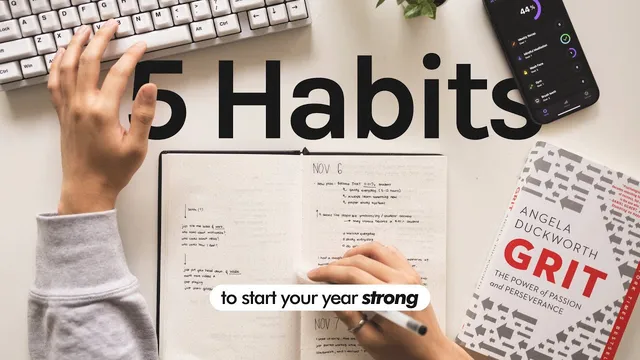
5 unique habits to start the year STRONG for 2025 (that ACTUALLY helps)
Based on Kai Notebook's video on YouTube. If you like this content, support the original creators by watching, liking and subscribing to their content.
Start the day with a protein-forward breakfast early to support mood and sleep through tryptophan and to help align meal timing with circadian rhythm.
Briefing
A strong start to 2025 doesn’t come from generic advice like “work out” or “eat healthy.” Instead, the focus is on five practical habits—some tied to mood and sleep science, others built for mental clarity and follow-through—that can make daily productivity feel easier and more consistent.
The first habit is eating a substantial breakfast with decent protein early in the morning. The reasoning is twofold: protein supports mood and sleep through an essential amino acid called tryptophan, and it helps stabilize the body clock by aligning meal timing with the body’s internal rhythm. The creator links this to personal experience with long-running anxiety—describing chest discomfort that improved after waking earlier, eating a protein-heavy meal, and pairing it with morning sunlight. The takeaway is not “bulk up,” but “front-load protein” to support both mental state and circadian timing.
Next comes morning meditation, framed less as spiritual performance and more as a short mental setup. Even five minutes is presented as enough to prime attention for the day: sitting quietly, picturing upcoming tasks, and mentally choosing the person someone wants to be. The emphasis is on simplicity—no long sessions, no candles or elaborate rituals—just a quick routine that creates a “snowball effect” for productivity.
The third habit is day or weekly reviews. Rather than chasing perfect tracking, the goal is honest evaluation: identifying mistakes, recognizing small wins, and using that information to adjust. The argument is that awareness prevents drifting through life without knowing whether progress is happening. The review ritual can be done at night or at week’s end, and the key requirement is self-honesty rather than self-congratulation.
Journaling is the fourth habit, positioned as a tool for overthinkers and anyone who struggles to mentally “shut off.” Writing down thoughts in a physical notebook is described as therapeutic and calming, because it clears mental space and organizes worries that don’t belong in the present moment. The practical advice is straightforward: use a quality journal and a pen that feels good to write with. A bonus tactic turns the journal into a “distraction notebook,” where anything that pulls attention off-task gets recorded immediately—helping reveal patterns and break the loop.
The final habit is avoiding phone use before lunch. The rationale is that early-day behavior sets the tone for everything that follows. Scrolling or opening the phone can reward dopamine-driven engagement and undermine motivation later. The suggested method is to keep the phone far from the bed so the morning requires getting up to turn off alarms, reducing the chance of doomscrolling and making it easier to start work before distractions take over.
Taken together, the habits aim at a single outcome: a calmer, more intentional start that improves mood, sleep timing, focus, and accountability—so 2025 becomes something built day by day rather than hoped for.
Cornell Notes
Five habits are proposed to make 2025 feel more productive by improving mood, attention, and self-accountability. Eating a protein-forward breakfast early supports anxiety and sleep via tryptophan, and it helps reset the body clock by aligning meal timing with the body’s internal rhythm. A short morning meditation (as little as five minutes) is used to mentally rehearse goals and the person someone wants to be. Day or weekly reviews build honesty about progress by capturing mistakes and small wins, preventing blind drifting. Journaling—plus a “distraction notebook” for interruptions—and avoiding phone use before lunch reduce mental clutter and protect early motivation.
Why does eating protein early in the morning get framed as more than a fitness tip?
What kind of “meditation” is recommended, and how is it supposed to improve productivity?
How do day or weekly reviews differ from strict tracking or perfectionism?
Why is journaling described as especially helpful for overthinking?
What’s the argument for avoiding phone use before lunch, and what’s the concrete strategy?
Review Questions
- Which habit in the list most directly targets sleep and circadian rhythm, and what mechanism is given for why it works?
- What does an effective day/week review require—accuracy, or honesty—and how does that change what gets written down?
- How does the “distraction notebook” approach in journaling differ from simply trying to ignore distractions?
Key Points
- 1
Start the day with a protein-forward breakfast early to support mood and sleep through tryptophan and to help align meal timing with circadian rhythm.
- 2
Use a short morning meditation (around five minutes) to mentally rehearse goals and the person you want to be before starting tasks.
- 3
Do day or weekly reviews that prioritize honest evaluation of mistakes and small wins over perfect tracking.
- 4
Journal to offload overthinking into a physical record, and use a distraction notebook to capture interruptions immediately.
- 5
Avoid phone use before lunch to protect early motivation; keep the phone far from the bed to prevent morning doomscrolling.
- 6
Pair morning routines with sunlight and consistent wake times when trying to fix a disrupted sleep schedule.