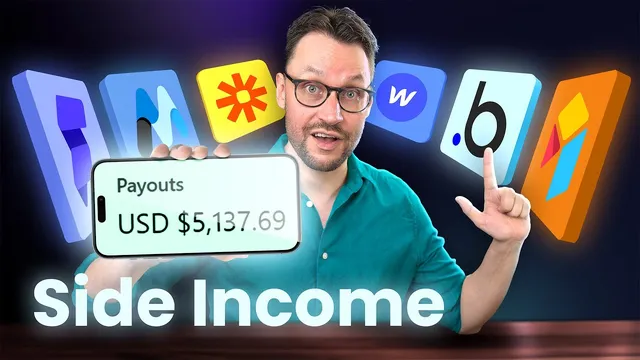
5 Ways to Create a No Code Side Hustle
Based on Simon Høiberg's video on YouTube. If you like this content, support the original creators by watching, liking and subscribing to their content.
Webflow template designers can list templates in Webflow’s Marketplace, typically pricing them $50–$150 and keeping about 80% per sale after Webflow’s cut.
Briefing
No-code entrepreneurship can produce real side income even before someone is ready to build full products from scratch, and five practical paths stand out: sell templates, monetize no-code content, offer citizen-developer training, build no-code MVPs for startups, and create niche micro-SaaS apps. The common thread is using no-code tools to deliver value faster and with less technical overhead—then charging for distribution, expertise, or outcomes.
The most straightforward option is creating and selling templates. Webflow template designers can list templates in Webflow’s Marketplace, typically pricing them around $50 to $150. Webflow keeps a cut, but creators retain about 80% of each sale. Because templates can be sold repeatedly after one build, even modest daily sales—two to three templates per day at an average of $75—can translate into roughly $5,000 per month after Webflow’s share. The tradeoff is meeting Webflow’s requirements and standards, which is easier if someone already has web design and development skills.
A second template route targets Notion. Notion template sellers can offer advanced templates for project management, data capture, organization, and finances, selling through their own websites rather than an application process. Unlike Webflow’s marketplace model, this approach shifts effort toward marketing and authority-building. Successful template sellers—such as Thomas Frank and “SLOW” (as referenced in the transcript)—benefit from large, active audiences and consistent social media presence. The template itself is only part of the product; it often rests on established models and frameworks, packaged with a clear philosophy and use case.
If building templates feels too narrow, monetizing no-code education can tap into a fast-growing market. No-code is framed as a broader movement aimed at democratizing tech entrepreneurship for non-technical founders and creators. That demand supports YouTube channels or podcasts focused on no-code tools and workflows. Higher advertiser competition in this niche can lift revenue per thousand views (RPM). The transcript includes a personal example: early no-code content led to sponsorship offers and a spike in RPM reaching about 14–16, with an explanation of how YouTube ad auctions and advertiser bidding affect RPM.
For people who prefer services over content, a consulting business can train “citizen developers”—technical employees who build internal apps and workflows using no-code tools instead of writing code. The target customers are non-tech companies (law firms, accounting firms, retail chains, healthcare providers) that need automation and data workflows but find hiring full software engineers too expensive or overkill. The consulting offer centers on coaching employees in no-code/low-code tooling and bridging gaps with lightweight software engineering concepts.
Finally, startups and niche operators create two additional service and product opportunities. A no-code MVP agency helps founders validate ideas without the time and cost of traditional development, translating vision into a market-ready early product using no-code stacks. And micro-SaaS creation focuses on small, specific software services that solve narrow problems for a limited audience. With platforms like Bubble, Wized, Webflow, FlutterFlow, Zapier, Memberstack, Airtable, and Pabbly, founders can build functional apps without writing code, aiming for realistic monthly revenue ranges (about $5,000–$10,000) by targeting repetitive niche needs rather than trying to scale broadly.
Cornell Notes
No-code side hustles can generate income through templates, content, consulting, MVP services, and micro-SaaS. Template sales work because creators can build once and sell repeatedly—Webflow templates are sold in Webflow’s Marketplace (with creators keeping about 80%), while Notion templates are typically sold via a seller’s own website and require stronger marketing. No-code content can monetize via ad revenue and sponsorships, with RPM rising in competitive niches. Consulting can train “citizen developers” inside non-tech companies that need internal automation but can’t justify hiring full software engineers. For startups, a no-code MVP agency can turn early vision into market-ready prototypes faster, and micro-SaaS targets small, niche problems using no-code platforms.
How do template sales create a scalable side income without ongoing work?
Why does marketing and audience-building matter more for Notion templates than Webflow templates?
What is RPM, and why does it matter for no-code YouTube or podcast monetization?
What problem does “citizen developer” consulting solve, and who pays for it?
Why do no-code MVP agencies appeal to startup founders early on?
What makes micro-SaaS a good no-code side hustle strategy?
Review Questions
- Which side-hustle path depends most on distribution through an existing marketplace, and which depends most on the creator’s own marketing?
- How does advertiser competition influence RPM, and why would that matter specifically for no-code content?
- What training outcomes define a “citizen developer,” and how does that reduce costs for non-tech companies?
Key Points
- 1
Webflow template designers can list templates in Webflow’s Marketplace, typically pricing them $50–$150 and keeping about 80% per sale after Webflow’s cut.
- 2
Notion template sales often require stronger marketing because templates are sold via the creator’s own website rather than an established marketplace.
- 3
No-code content can monetize through ads and sponsorships, and RPM can rise in competitive niches due to advertiser bidding.
- 4
Citizen-developer consulting targets non-tech companies that need internal automation but can’t justify hiring full software engineers.
- 5
A no-code MVP agency helps founders validate ideas faster by translating vision into a market-ready early product without traditional development bottlenecks.
- 6
Micro-SaaS works best when it solves a narrow, repetitive niche problem for a small audience rather than trying to scale broadly.
- 7
No-code side hustles tend to succeed when the offer combines a clear use case (often built on known frameworks) with a distribution plan—marketplace, audience, or client acquisition.