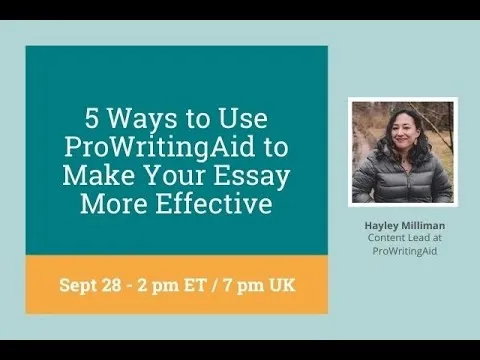
5 Ways to Use ProWritingAid to Improve Your Essay, with Hayley Milliman
Based on ProWritingAid's video on YouTube. If you like this content, support the original creators by watching, liking and subscribing to their content.
Prioritize clarity and thesis visibility over impressive-sounding vocabulary and complicated phrasing.
Briefing
Clarity beats vocabulary flexing in essays: stuffing writing with “fantasy vocabulary” and convoluted sentence structures tends to bury the thesis, distract readers, and make the work look amateur. The core goal is to let ideas do the heavy lifting—using language that’s precise, readable, and purposeful—so professors can quickly grasp the argument and stay engaged.
Hayley Milliman, content lead at ProWritingAid, frames essay writing as an editing problem rather than a drafting problem. Professors read many papers, so language that’s overly complex, vague, repetitive, or padded with extra words forces readers to work harder than necessary. When that happens, the main thesis gets lost, readers get bored or annoyed, and the writing can appear unfocused—even if the writer knows the subject. Milliman distinguishes “rich words” from “complicated words”: strong, descriptive language (like “enormous” instead of “very big”) can add meaning without making sentences harder to follow. Likewise, varying sentence structure and avoiding wordiness help maintain momentum and readability.
From there, the session lays out five practical improvement targets that align with recommendations from the Harvard College Writing Center. First is eliminating unnecessary words by reducing “glue words”—the connective filler that makes sentences clunky without adding essential information. Milliman introduces a “glue index” concept, recommending an average target around 40% glue words, and demonstrates how a long, padded sentence can be rewritten into a shorter one that says the same thing with fewer words.
Second is replacing vague or wishy-washy language. Terms like “some improvements,” “worth more,” or “existing structures” don’t specify what changed or by how much. The fix is to swap in concrete details and stronger verbs, and to remove indefinite hedges such as “could,” “might,” or “whenever possible” when the claim can be stated more firmly. Milliman emphasizes that meeting word counts shouldn’t mean stuffing; it should mean adding analysis and specificity.
Third is improving readability by reducing jargon, pompous language, clichés, and overly complex structures. She offers a “chips” metaphor for domain-specific vocabulary: use challenging technical terms when needed, but keep the surrounding verbs and explanations simple. She also recommends active voice when possible, warns against nominalizations (turning verbs into nouns), and suggests keeping most sentences in a practical range—often cited as 11–18 words—while breaking up sentences that run too long.
Fourth is avoiding repetitive sentence structure by varying sentence length, sentence starters, and rhythm so the prose doesn’t become monotonous. Fifth is ensuring every word does important work by cutting crutches and superfluous phrases that inflate length without adding meaning.
Throughout, Milliman connects each editing goal to ProWritingAid features—especially tools like Sticky Sentences, Style reports, Clichés checks, Sentence Length reports, and readability diagnostics—while stressing that the software flags issues but doesn’t rewrite in a way that preserves the writer’s voice. The takeaway is straightforward: edit for clarity, precision, and reader experience, and use word count as a byproduct of stronger ideas rather than a target that drives padding.
Cornell Notes
The session argues that essays improve most when clarity and idea strength come first, not when writers try to impress with complex vocabulary. Overly complicated language, vague claims, hedging, clichés, and repetitive sentence patterns can hide the thesis and make professors work harder than they should. Five editing priorities are emphasized: cut unnecessary “glue words,” replace vague and wishy-washy wording with specific details, boost readability by reducing jargon and pomp, vary sentence structure to avoid monotony, and remove crutches that add length without meaning. ProWritingAid is presented as a set of checks that highlight these problems (e.g., Sticky Sentences, Clichés, Sentence Length, Style/Readability reports) so writers can revise while keeping their own voice.
Why does “fancy vocabulary” often hurt an essay instead of helping it?
What are “glue words,” and how does the glue index help with wordiness?
How can writers meet word counts without padding?
What does “readability” mean here, and how should writers handle necessary technical terms?
How do repetition and sentence rhythm affect reader engagement?
What kinds of phrases are “crutches,” and how does ProWritingAid help remove them?
Review Questions
- Pick one sentence from your own essay and label which words are “working” versus “glue.” What would a ~40% glue target change in that sentence?
- Rewrite a vague claim you’ve made using specific details and measurable outcomes. What hedging words (“could,” “might,” “maybe”) did you remove or replace?
- Identify one place where your sentence length or sentence starters become repetitive. How would you vary rhythm without losing clarity?
Key Points
- 1
Prioritize clarity and thesis visibility over impressive-sounding vocabulary and complicated phrasing.
- 2
Reduce wordiness by cutting “glue words” and aiming for an average glue index around 40% (about 60% working words).
- 3
Replace vague and wishy-washy language with specific details and firmer claims; meeting word counts should come from stronger analysis, not padding.
- 4
Improve readability by removing jargon you don’t need, cutting clichés, using active voice when possible, and avoiding nominalizations.
- 5
Avoid monotony by varying sentence length and sentence starters so pacing and emphasis don’t feel repetitive.
- 6
Remove crutches and superfluous phrases that add length without meaning (e.g., “whenever possible,” “currently,” “needless to say”).
- 7
Use ProWritingAid checks to flag issues, then revise manually to preserve the writer’s voice.