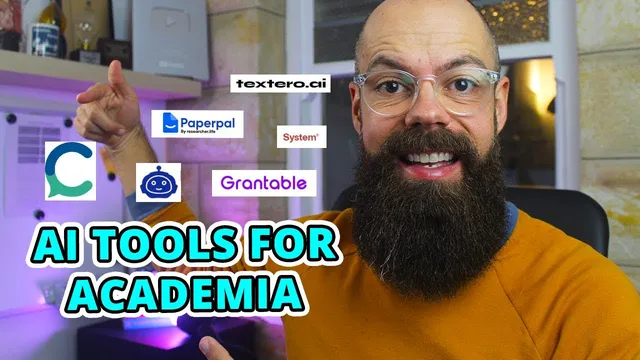
6 Academic AI Tools You Just *HAVE* to Know About
Based on Andy Stapleton's video on YouTube. If you like this content, support the original creators by watching, liking and subscribing to their content.
Consensus (beta) is positioned as a consensus-from-papers tool that can synthesize across studies to support early literature reviews.
Briefing
Academic work is getting a new workflow: instead of spending most of the time on literature hunting, drafting, editing, and grant admin, researchers can now lean on specialized AI tools that pull from peer-reviewed sources, organize findings into themes, and generate first drafts—while still requiring human verification.
Consensus (in beta) is positioned as a research “consensus finder.” Users ask a question and get conclusions grounded in research papers, with an option to turn on “synthesize” to produce both summaries and a consensus across multiple studies. The pitch is that this helps early-stage literature reviews by showing where the research is heading and what the majority of papers agree on. It’s also framed as a way to reduce reliance on any single AI system, since cross-checking across tools can help surface biases. The interface is described as intuitive, with outputs meant to support broad literature discovery and an overall sense of the field.
System Pro targets the same early-stage problem—finding and summarizing evidence—but with a narrower scope at the moment, limited to health and life sciences. It synthesizes statistical results from millions of peer-reviewed studies and provides citations and links back to the underlying sources. It also recommends and visualizes topics that relate statistically to a query. In the example around cannabis use, the tool returns a structured literature review with a count of peer-reviewed studies (198 in the example) and organizes evidence into themes, such as cannabis use increasing with psychosis, supported by a specific number of studies (25). The emphasis is on quickly grabbing a first set of papers and then expanding the search.
Research Buddy focuses on producing a literature review draft and organizing the resulting papers by theme. After a subject query (example: “organic photovoltaic devices”), it generates a one-page literature review and breaks the literature into categories like materials and design, interface engineering and device physics characterization, and device architecture and performance. The output can be emailed when ready and downloaded as a Word file, with a short summary at the bottom.
For writing assistance, TextaRota AI is presented as a way to break writer’s block by generating an essay or literature-review-style text in a chosen format (example: MLA) with user-controlled constraints like number of sources. The transcript notes a limitation: outputs are constrained by the number of sources provided. Paper Pal then shifts from generation to editing—uploading academic text and offering targeted fixes such as redundancy, word choice, capitalization, punctuation, and article usage—aimed at improving academic English before submission.
Finally, Grantable is described as a grant-writing assistant that guides users through drafting responses to prompts, including proposal summaries and other sections. It can auto-search for relevant material and produce first drafts for administrative and summary components, though the details still require the user’s input.
Taken together, the tools are pitched as a practical pipeline for academia: discover evidence, synthesize and theme it, generate initial drafts, and polish language—while maintaining the responsibility to verify AI outputs and citations.
Cornell Notes
The transcript lays out an AI-assisted academic workflow built around five core tasks: literature discovery, evidence synthesis, literature-review drafting, writing/editing, and grant drafting. Consensus (beta) and System Pro both aim to answer questions using research papers, with System Pro emphasizing statistical synthesis plus citations and theme-based organization (health and life sciences for now). Research Buddy generates a short literature review and groups papers into thematic categories, while TextaRota AI helps generate initial text for formats like MLA using a limited number of sources. Paper Pal focuses on editing for academic English quality, and Grantable guides users through first-draft grant responses and proposal summaries. The practical takeaway: automate the early heavy lifting, then verify everything before submission.
How does Consensus help with early literature reviews, and what does “synthesize” add?
What makes System Pro different from a basic search tool?
What output does Research Buddy generate, and how is the literature organized?
How does TextaRota AI try to reduce writer’s block, and what constraint limits its usefulness?
What does Paper Pal do differently from generation tools?
What role does Grantable play in grant writing?
Review Questions
- Which tools are primarily designed for literature discovery versus writing/editing, and what evidence-based features does each one provide?
- In the transcript’s examples, how do theme-based outputs (Consensus/System Pro/Research Buddy) help a researcher decide what to read next?
- What verification steps are implied as necessary even when AI generates drafts or edits?
Key Points
- 1
Consensus (beta) is positioned as a consensus-from-papers tool that can synthesize across studies to support early literature reviews.
- 2
System Pro synthesizes statistical results from peer-reviewed research and provides citations/links plus theme-based organization, though it’s currently limited to health and life sciences.
- 3
Research Buddy generates a short literature review and organizes referenced papers into thematic categories, with outputs that can be emailed and downloaded as a Word file.
- 4
TextaRota AI can generate MLA-style text using user-specified subjects and a limited number of sources, making it useful for breaking writer’s block rather than producing large documents.
- 5
Paper Pal focuses on editing academic text—targeting redundancy, word choice, capitalization, punctuation, and article issues—to improve submission-ready English.
- 6
Grantable guides users through drafting grant responses and proposal summaries, using prompts and optional auto-search for first drafts, while leaving detailed content to the applicant.
- 7
Across the workflow, AI output should be checked and verified, especially for citations and factual claims.