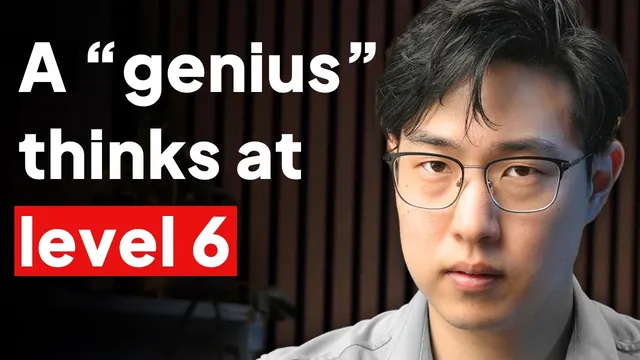
6 Levels of Thinking Every Student MUST Master
Based on Justin Sung's video on YouTube. If you like this content, support the original creators by watching, liking and subscribing to their content.
Most learners underperform because they think at the wrong cognitive level, not because they lack effort or talent.
Briefing
Top results in school and professional life hinge less on “working harder” and more on thinking at the right cognitive level. Six levels of thinking—ranging from rote recall to creating new hypotheses—map directly to different kinds of questions and different outcomes. Most learners get stuck early, where studying feels familiar but produces fragile knowledge, leading to stress, wasted time, and the false belief that they simply aren’t cut out for high performance.
The first level, “remember,” is built on repetition: rereading, rewriting, and heavy flash-card use. It can unlock the ability to regurgitate facts—listing, defining, and stating information—but it’s a weak foundation for long-term retention and real-world usefulness. The second level, “understand,” shifts the mental goal from storing text to comprehending meaning. Two people can use the same outward technique (like reading a textbook), yet think differently: one reads to re-encode the material, while the other reads to wrap their head around what it means. That difference determines whether the “explain” level result becomes available—answering questions that require explaining concepts or processes.
From there, the framework aligns with Bloom’s revised taxonomy (published in 1956 and revised in 2001), which many curricula and exam writers implicitly follow. Level three, “apply,” is about using knowledge to solve problems. The transcript distinguishes simple “one-to-one” problems—where one learned concept directly solves the task—from more advanced problems that require selecting and sequencing multiple concepts. Level four, “analyze,” is the first step that forces comparison: similarities and differences between ideas. Techniques like Venn diagrams, tables, summaries, and mind maps work when they compel real contrast, not when they become decorative grouping.
Level five, “evaluate,” is where top performance typically separates from competent performance. After analyzing similarities and differences, learners must decide what matters, justify conclusions, and prioritize. The telltale sign is mental back-and-forth: asking why something is important, how it fits, and why it should be believed—often involving jumping between lecture notes, textbooks, and external references. The transcript also warns that many students avoid level five because it feels harder; this aligns with the “misinterpreted effort hypothesis,” where increased mental effort is mistaken for doing something wrong.
Level six, “create,” involves synthesizing novel hypotheses—filling a gap by generating an answer that isn’t already present in one’s existing knowledge. It’s described as less common and less necessary for most learners, who can reach their best outcomes by consistently operating at level five.
Finally, the most actionable advice flips the usual study ladder. Moving upward from level one is time-consuming and undermined by knowledge decay (a forgetting curve): lower-level material fades while higher-level thinking is attempted. Instead, the transcript recommends aiming at level five first and “moving down” as a side effect—because the brain forms stronger memory when it evaluates and prioritizes. In practice, that means shifting study attention away from “trying to remember or understand” and toward deciding what matters, which naturally strengthens the ability to later explain, solve, and—when needed—regurgitate.
Cornell Notes
The transcript presents six levels of thinking—Remember, Understand, Apply, Analyze, Evaluate, and Create—each tied to different types of questions and results. Rote recall can produce regurgitation but weak retention, while comprehension enables explanation. Applying and analyzing let learners solve problems and compare ideas, but evaluation is the key step for top performance: learners must decide what matters, justify conclusions, and prioritize. Create (hypothesizing new answers) is reserved for the highest levels of education and is less necessary for most people. A major takeaway is strategy: instead of climbing from level one upward, aim at level five first because evaluation strengthens memory and reduces the impact of knowledge decay.
Why does “remember” often fail to produce strong academic results despite lots of studying?
How can two students use the same study technique but think at different levels?
What’s the difference between “apply” and “analyze” in question types?
What does level five (“evaluate”) require that level four (“analyze”) does not?
Why does the transcript recommend aiming at level five first instead of mastering level one upward?
When does “create” (level six) matter, and why is it less emphasized?
Review Questions
- Which specific internal shift turns reading from “remember” into “understand,” and how does that change the kinds of questions you can answer?
- Give an example of a level four task and explain what makes it “comparison” rather than “application.”
- Why does knowledge decay make a bottom-up study ladder inefficient, and what does “aim at level five first” practically mean for study sessions?
Key Points
- 1
Most learners underperform because they think at the wrong cognitive level, not because they lack effort or talent.
- 2
Rote “remember” supports regurgitation but tends to produce fragile retention and limited usefulness.
- 3
“Understand” depends on intention—reading to comprehend meaning enables explanation, not just repetition.
- 4
“Analyze” requires comparing and contrasting ideas; tools like mind maps only work when they force real contrast.
- 5
“Evaluate” is the performance multiplier: learners must prioritize, justify conclusions, and decide what matters.
- 6
Avoid the bottom-up study ladder; knowledge decay makes it inefficient to master levels one through four in order.
- 7
Aim at level five first so evaluation strengthens memory and reduces relearning caused by forgetting.