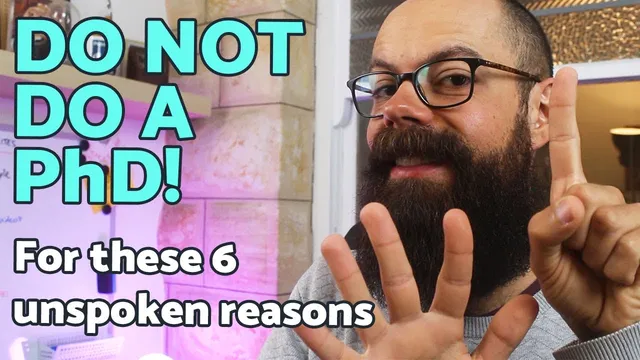
6 reasons why you should not do a PhD | The unspoken truths!
Based on Andy Stapleton's video on YouTube. If you like this content, support the original creators by watching, liking and subscribing to their content.
Treat a PhD as a multi-year life commitment and test whether the payoff matches the time and stress required.
Briefing
A PhD is a multi-year commitment that can carry major financial tradeoffs and mental-health costs—so people should only pursue one if their motivations survive a hard reality check. The central warning is straightforward: a doctorate is not a guaranteed path to higher pay, stable well-being, or an academic career, and it can quietly derail anyone who starts for the wrong reasons.
Money is the first fault line. A PhD typically translates into about a 26% increase over non-PhD baseline earnings, while a master’s degree is closer to a 23% increase. That small gap matters because the doctorate also demands more time—often three to five years—and far more stress. There are exceptions, such as certain government or medical-track roles (the transcript mentions a medical physicist) where a PhD may be required to access higher pay scales. But for most people, the advice is to compare effort versus reward and ask whether the marginal financial gain justifies the years of pressure.
Mental health is the second major risk. A Nature study cited in the transcript reports that anxiety and depression among PhD students and in academia are worsening, with 36% of PhD students reporting anxiety or depression. The message is not just that stress exists, but that universities often do little to reduce it—prioritizing funding and output, while students who aren’t “bringing in money” can feel sidelined. For anyone entering with existing anxiety or depression, the transcript urges getting mental-health support and planning before starting.
The third warning targets career expectations. While a PhD is commonly treated as a prerequisite for academic jobs, the odds of converting that doctorate into a faculty position are described as extremely low—around 1% or less in most fields. The transcript also points to structural oversupply: one university reportedly received 100 to 450 applications for a single 10-year track position, even though many applicants were fully qualified. The takeaway is to treat academia as a goal, not a guarantee, and to build a backup plan that feels as motivating as the PhD topic.
The remaining reasons focus on motivation quality. A PhD can be a bad idea if it’s simply the path of least resistance—when students accept it because it’s the next step after a master’s, often supported by supervisors whose incentives depend on recruiting PhD labor. Ego is another trap: chasing the “doctor” title or social validation can deepen commitment for the wrong reasons. Finally, seeking work-life balance is framed as incompatible with many PhD cultures; the transcript describes expectations of long lab hours and constant mental carryover, including weekends, evenings, and travel for conferences.
Despite the bluntness, the transcript ends with a counterbalance: the PhD can be rewarding when pursued for the right reasons. The practical demand is honesty—identify what truly drives the decision, then stress-test it against money, mental health, career probabilities, and lifestyle realities before committing years of life to the process.
Cornell Notes
The transcript argues that a PhD is a high-cost commitment that often fails to deliver on common assumptions—especially pay, mental well-being, and academic-job outcomes. Financially, the earnings gap between PhDs and master’s degrees is described as small (about 26% vs. 23%), while the doctorate requires more time and stress; exceptions exist for certain regulated roles. Mentally, a Nature-cited figure says 36% of PhD students report anxiety or depression, and institutional support is portrayed as limited. Career-wise, the chance of landing an academic position after a PhD is described as roughly 1% or less in most fields, with heavy applicant oversupply. The transcript also warns against starting for convenience, ego, or a desire for lifestyle balance.
If someone is considering a PhD mainly for higher salary, what comparison should they make?
What mental-health risk does the transcript highlight for PhD students?
How does the transcript frame the odds of turning a PhD into an academic job?
Why does the transcript warn against choosing a PhD as the “path of least resistance”?
What role does ego play in the transcript’s “reasons not to do a PhD”?
Why does the transcript say balance seekers may struggle during a PhD?
Review Questions
- What specific earnings comparison does the transcript use to question the “PhD = higher salary” assumption?
- How does the transcript connect institutional incentives to student mental health outcomes in academia?
- What evidence does the transcript give for why academia is an unlikely outcome for most PhD graduates?
Key Points
- 1
Treat a PhD as a multi-year life commitment and test whether the payoff matches the time and stress required.
- 2
Don’t assume a PhD automatically increases earnings enough to justify the extra years; compare outcomes against a master’s degree.
- 3
If anxiety or depression is already present, prioritize mental-health support and planning before starting a doctorate.
- 4
Plan for a low probability of landing an academic job by building a backup career path that still feels meaningful.
- 5
Avoid choosing a PhD simply because it’s the easiest next step after a master’s; ask whether the goal is truly yours.
- 6
Be cautious of ego-driven motivations like chasing the “doctor” title or social validation.
- 7
Expect that many PhD cultures limit work-life balance through long hours, weekends, and travel.