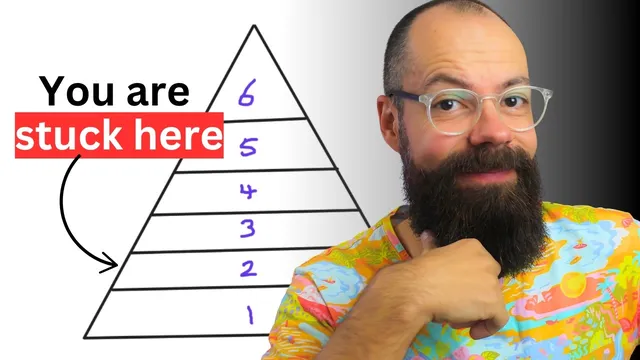
6 Research Levels Every Academic Must Master - You're Stuck at Level 2
Based on Andy Stapleton's video on YouTube. If you like this content, support the original creators by watching, liking and subscribing to their content.
Academic research success is framed as a six-skill progression: doing, directing, designing, collaborating, leading, and convincing.
Briefing
Academic success in research depends on mastering a ladder of six skills—yet many people stall early, especially at “doing” and “directing.” The core message is that progress up the research pyramid requires deliberate practice of each level, because later abilities build directly on earlier ones. Those who stay only in hands-on execution may earn results, but they often struggle when it’s time to shape a research agenda, coordinate others, and win resources.
At the base is “doing,” the technician work of producing results: running experiments, analyzing data, and learning instruments. This is where most researchers begin—during undergraduate projects, honors years, or master’s work—and it can take years to become competent. The next step, “directing,” shifts attention from personal execution to leading others through the work. Directing means explaining expected outcomes, training students or lab members on techniques and instruments, and troubleshooting when their approach differs from how the director would do it. It’s a first taste of stepping back from daily lab tasks and understanding research well enough to guide someone else.
The level where many careers stall is “designing.” After directing others, researchers must zoom out from individual experiments and build experiments that serve a larger goal—often tied to a personal career niche. Designing requires choosing what area to become known for (the “active layer,” “transparent electrode,” or similar focus points in OPV research were used as an example), then iterating through trial and error over years. The challenge is psychological as well as technical: people who enjoy the nuts-and-bolts of doing may find the broader, long-horizon planning less engaging, even though it’s essential for progression.
“Collaborating” comes next and is more than teamwork. It involves understanding another group’s research niche, identifying overlap, and managing conflicts between different aims. Collaboration is slower and logistically heavy—sharing samples and data back and forth, coordinating emails, and aligning complementary skill sets. Still, it’s framed as a necessity for going further, even though early-career academics often lack the “luxury” of time and connections needed to build collaborations.
“Leading” then reframes research as something that must be sustained through networks and administration. Real leadership includes building collaborators across departments and regions, and handling the practical burdens of grants: finances, reporting, and communication with universities, governments, and funding bodies. It’s described as looking upward to secure resources, then translating that vision downward into coordinated action.
The final level, “convincing,” is portrayed as the hardest skill: persuading people that a researcher’s work deserves funding and attention. This includes convincing funders and authorities, but also motivating those under one’s direction by communicating purpose and confidence. Persuasion is not treated as salesmanship; it’s about conveying belief and creating momentum so others leave meetings ready to act. Together, the six levels—doing, directing, designing, collaborating, leading, convincing—form a cumulative pathway; skipping a step makes later work far more difficult.
Cornell Notes
Research mastery in academia is organized into six escalating skills: doing, directing, designing, collaborating, leading, and convincing. Most people get stuck in the first two because they focus on executing experiments and training others to do tasks, but they fail to zoom out to build a long-term research niche. Designing is the common career bottleneck: it requires stepping away from daily lab work and planning experiments that serve a broader goal over years. Collaboration adds speed limits and logistical complexity by requiring niche alignment and data/sample exchange. Leading and convincing shift the work toward securing resources, managing administration, building networks, and persuading funders and teams that the research matters.
What distinguishes “doing” from “directing,” and why does the transition matter?
Why is “designing” described as the point where many researchers stall?
What makes “collaborating” harder than the usual advice to “collaborate more”?
How does “leading” change what research work looks like day to day?
What does “convincing” require beyond technical competence?
Review Questions
- Which skill in the pyramid is most associated with choosing and refining a personal research niche, and what makes it difficult?
- How do collaboration and leading differ in terms of time demands and the kind of work involved?
- Why does the transcript claim that skipping one level creates problems later in an academic career?
Key Points
- 1
Academic research success is framed as a six-skill progression: doing, directing, designing, collaborating, leading, and convincing.
- 2
Most researchers become competent at “doing,” but career growth requires moving into “directing,” where others execute under guidance.
- 3
“Designing” is a common bottleneck because it demands long-horizon planning and choosing a career niche rather than focusing on daily experiments.
- 4
“Collaborating” requires niche alignment and managing overlap and conflicts, and it is slower due to heavy coordination and data/sample exchange.
- 5
“Leading” involves securing resources through grants and networks, including administration, reporting, and communication with funding bodies.
- 6
“Convincing” is the hardest skill because it requires persuading funders and motivating teams by communicating purpose and confidence.
- 7
Each level builds on the previous one, so skipping steps makes later responsibilities harder to handle.