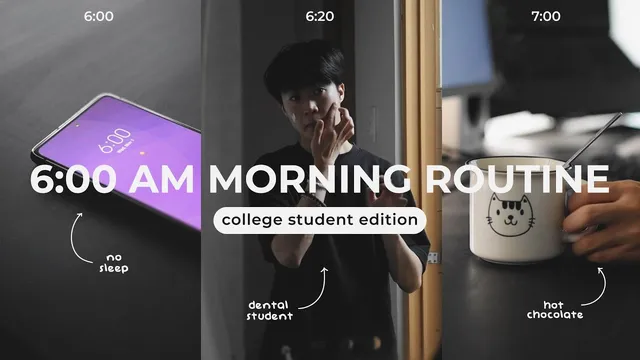
6am college morning routine | peaceful & productive habits (college edition)
Based on Kai Notebook's video on YouTube. If you like this content, support the original creators by watching, liking and subscribing to their content.
Wake up around 6:00 a.m. most days, then delay full phone use until checking only urgent notifications.
Briefing
A dental student’s weekday morning routine centers on one practical goal: protect the first hour from phone-driven distraction, then stack small, repeatable habits—air, order, skincare, and light fuel—to make classes feel more manageable. On most Wednesdays and similar days, wake-up lands around 6:00 a.m. (with Fridays as an exception), and the schedule is built around an on-site class at 10:00 a.m. while online coursework starts earlier at 8:00 a.m. That timing shapes everything from how long the morning lasts to when the day’s work begins.
The routine starts with getting up for real after snooze—often after the second alarm—then immediately checking the lock screen only when something urgent might be waiting (like a sudden assignment submission). When nothing pressing shows up, the phone is set aside to keep the morning “purely for myself,” because early scrolling and notifications tend to eat time and attention. Fresh air follows: windows open first to clear the stuffiness that builds overnight. From there, the room gets reset in quick, visible ways—making the bed and tidying the desk—so the day begins in a cleaner environment rather than carrying last night’s clutter into class prep.
Skincare becomes the next anchor. After realizing showering in the morning is unnecessary because a shower happened the night before, the student opts for a morning skincare routine instead: cleanse the face, then layer products from The Ordinary. The hydration step uses hyaluronic acid 2% + B5, followed by niacinamide 10% + 1% for acne treatment. A thick moisturizer is applied to seal in moisture, with sunscreen as the final layer—specifically Sun Multi Sun Cream SPF 50. The student also notes personal experimentation: another moisturizer (Natural Moisturizing Factors + HA) didn’t feel as effective on their skin, but it could work differently for others.
By about 6:40 a.m., the routine shifts to logistics—changing into a dental-school uniform (convenient but tight), preparing a bag (keys, wallet, school ID, phone, plus an iPad and other items, with alcohol sometimes forgotten), and keeping stationery accessible in a chest pocket. Breakfast is usually skipped, but when it’s included, the day feels noticeably better: simple cereal helps, and the student plans to add boiled eggs for protein, citing improved energy and less hunger during class.
For online days, mornings include a calmer “quiet moment” instead of background media. Hot chocolate replaces commuting-time rituals, and the drink is enjoyed on a balcony or upstairs area for breeze and coolness. After that, the phone returns briefly for messaging and social tasks—typically 15 to 20 minutes—before work begins on a computer: flashcards, emails, assignments, and reading ahead. The day then moves into classes, with a 9:00 a.m. public-transport commute for the 10:00 a.m. on-site session.
Even with this structure, the student admits the routine isn’t perfect—sleep can run late, breakfast can be skipped, and priorities sometimes shift toward exam prep. The takeaway is less about flawless execution and more about recovery: if the morning goes off track, it’s “fine” to reset the next day rather than spiral into shame.
Cornell Notes
The routine is built to make early mornings productive by reducing phone distraction, resetting the physical space, and using a consistent skincare and prep sequence. After waking around 6:00 a.m., the student checks notifications only if something urgent is likely, then puts the phone away to avoid time loss. Fresh air, making the bed, and tidying the desk create a calmer start, followed by a skincare stack: cleanser, The Ordinary hyaluronic acid 2% + B5, The Ordinary niacinamide 10% + 1%, a thick moisturizer, and Sun Multi Sun Cream SPF 50. Breakfast is often skipped, but when eaten it improves energy and mood; boiled eggs are planned for added protein. The morning ends with a short phone window for messaging, then computer work and classes.
Why does the routine treat the phone as a problem early in the day?
What physical reset steps happen before skincare, and what’s the purpose?
What exact skincare sequence is used, and what skin goals does it target?
How does breakfast fit into the routine, and what changes when it’s included?
What replaces background entertainment during online mornings?
How is the morning work period structured after the phone is put away?
Review Questions
- Which specific moments in the morning are designed to minimize phone distraction, and what triggers justify checking the phone?
- Match each skincare product to its stated purpose in the routine (hydration, acne treatment, sealing moisture, sun protection).
- What changes in energy and class experience does the student associate with eating breakfast versus skipping it?
Key Points
- 1
Wake up around 6:00 a.m. most days, then delay full phone use until checking only urgent notifications.
- 2
Open windows, make the bed, and tidy the desk to start the day with a cleaner environment.
- 3
Use a consistent skincare stack: cleanser, hyaluronic acid 2% + B5, niacinamide 10% + 1%, thick moisturizer, then Sun Multi Sun Cream SPF 50.
- 4
Breakfast is usually skipped, but when eaten (cereal or planned boiled eggs), the student reports better energy and less hunger during class.
- 5
Create phone-free quiet time on online days using hot chocolate and a calm spot with fresh air.
- 6
Keep bag prep simple and repeatable—keys, wallet, school ID, phone, plus essentials like an iPad—while accepting that some items (like alcohol) may be forgotten.
- 7
After a short messaging block, shift into computer-based study tasks (flashcards, emails, assignments, reading ahead).