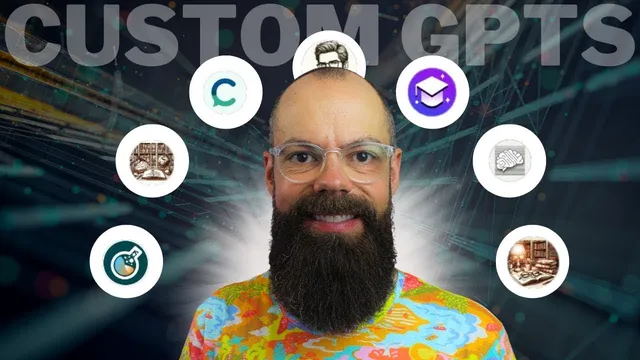
7 Custom ChatGPT GPTs That'll Change How You Do Research
Based on Andy Stapleton's video on YouTube. If you like this content, support the original creators by watching, liking and subscribing to their content.
Consensus combines large-scale academic search (200 million papers) with citation-backed drafting, making it useful for literature review scaffolding.
Briefing
Custom GPTs are moving research workflows from “ask a question” toward “run a specialized research task,” and the strongest academic examples in this roundup focus on three jobs: finding relevant papers, turning papers into structured summaries, and helping draft or polish academic writing. The most practical value comes from tools that can search or interpret scholarly sources quickly—especially when they produce citations or a consistent paper “snapshot” (abstract, methods, results, limitations) rather than a generic explanation.
Consensus is positioned as an academic research assistant that can search 200 million papers and generate science-based answers with citations. The standout detail isn’t only the paper search—it’s the pricing model the creator scrutinizes: the GPT appears to offer unlimited GP4 summaries for $6.99, while the underlying Consensus site limits GP4 summaries. In a test prompt about science-backed benefits of mindfulness, the GPT produced a blog-style draft with references spanning multiple years (including 2018 and 2015). That makes it useful for literature review work where fast semantic retrieval and citation scaffolding matter, even if the output is more “draft-ready” than deeply novel.
Scholarly Assistant targets academic advising and resource discovery, with an emphasis on recent literature. In one test about nanocomposite transparent electrodes, it returned multiple recent research items and flagged recency (including a 2024 framing), though one returned result dated to 2019—highlighting that “recent” can vary by field and may require more specific constraints. The Paper Interpreter takes a different approach: paste a URL or upload a PDF and receive a structured breakdown of the paper—title, abstract, background, methods, results, discussion, limitations, and applications. It worked well for producing a readable snapshot. When the creator tried to use it with sites associated with unauthorized access (e.g., Sci-Hub and “Anna’s Archive”), it refused due to copyright and legal restrictions.
Scholar AI (described as “AI scientist”) focuses on hypothesis generation and analysis of text, figures, and tables. After signing into its plugin, it could parse an uploaded/linked paper and then provide a detailed methodology rundown plus a figure relevant to the request—an outcome the creator found especially compelling because it goes beyond summarizing into extracting visual evidence.
Scholar GPT emphasizes “built-in critical reading skills.” It offers a command-style way to list those skills and then uses them to read an uploaded PDF. In the creator’s comparison, it was less detailed than the best-performing paper-interpreting tool, but it still delivered a structured breakdown and correctly identified the uploaded paper.
For writing support, Academic Assistant Pro offered thesis abstract polishing with multiple rewrite options (versioned outputs) and next-step suggestions. The final tool, Academic Research Reviewer, promised comprehensive reviews and scoring, but the creator reported a major mismatch: it reviewed an unrelated paper after an upload, plus a network error—leading to a “don’t use it” conclusion.
Overall, the most reliable wins are paper-to-structure tools (especially those that produce consistent sections and citations) and recency-aware discovery assistants. The weaker performers either lacked depth, produced less useful detail, or failed basic correctness like retrieving the right document.
Cornell Notes
Academic-focused custom GPTs are most useful when they do three things well: locate relevant papers, convert papers into structured summaries, and support writing tasks like polishing abstracts. Consensus stands out for semantic paper search at scale with citations, while Scholarly Assistant emphasizes finding newer research (though “recent” can be inconsistent). Paper Interpreter and Scholar AI focus on turning a paper into a readable methodology/results snapshot; Paper Interpreter also refuses to retrieve content from copyright-restricted sources. Scholar GPT adds “critical reading skills,” and Academic Assistant Pro helps with thesis abstract rewrites. One reviewer-style GPT failed a basic test by reviewing the wrong paper, showing that correctness still varies.
What makes Consensus particularly attractive for research work compared with using the Consensus website alone?
How does Scholarly Assistant handle the “recent research” requirement, and what limitation shows up in testing?
Why is Paper Interpreter considered valuable even without deep writing or hypothesis features?
What did Scholar AI add beyond text summarization in the creator’s test?
How did Scholar GPT’s “critical reading skills” feature affect usability?
What went wrong with Academic Research Reviewer, and why does that matter?
Review Questions
- Which academic GPTs in the roundup are primarily optimized for paper discovery, and which are optimized for turning a paper into a structured summary?
- What evidence from the tests suggests that recency handling (“recent research”) may require user constraints rather than relying on the tool’s default interpretation?
- Why is basic document retrieval accuracy (reviewing the correct uploaded paper) a make-or-break feature for research reviewer tools?
Key Points
- 1
Consensus combines large-scale academic search (200 million papers) with citation-backed drafting, making it useful for literature review scaffolding.
- 2
The creator’s pricing comparison suggests the Consensus custom GPT may offer more GP4 summary capacity than the Consensus website’s plan limits.
- 3
Scholarly Assistant can surface newer papers, but “recent” can still return older results (e.g., 2019), so users may need tighter date constraints.
- 4
Paper Interpreter’s main strength is structured paper snapshots (background, methods, results, limitations, applications) from a URL or uploaded PDF.
- 5
Scholar AI goes beyond text by extracting or presenting relevant figures alongside a methodology breakdown, after plugin sign-in.
- 6
Scholar GPT’s “critical reading skills” improves discoverability of what the tool can do, though depth may lag behind the best paper-interpreting options.
- 7
Academic Research Reviewer failed a correctness test by reviewing an unrelated paper, demonstrating that reliability varies across GPTs.