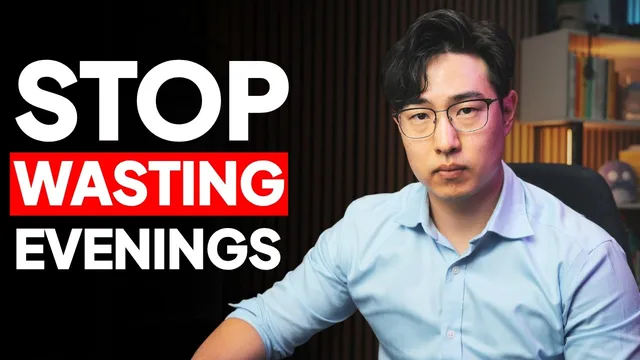
7 Things I Did To Stop Wasting My Evenings After Work
Based on Justin Sung's video on YouTube. If you like this content, support the original creators by watching, liking and subscribing to their content.
Calibrate your natural energy by experimenting with sleep and recovery; long-term tiredness can reflect a compromised baseline that takes months to fully recover from.
Briefing
The core message is that “wasted evenings” usually aren’t a time-management problem—they’re an energy-management problem. After years of feeling drained after work, the coach realized the baseline tiredness wasn’t normal; it was the result of long-term under-recovery. Once recovery finally caught up, evenings became sharper, faster, happier, and more stable—proof that evenings can be both productive and fulfilling when the body and mind are operating near their natural optimum.
The first strategy is to calibrate natural energy levels by tracking what “enough rest” actually looks like. The coach describes a long stretch—late high school through medical training and years of work—where daily fatigue and the urge to nap felt constant. Only after leaving medical practice and controlling the schedule did the pattern become clear: with sufficient sleep and recovery, energy returned. The key insight is that people often normalize a “compromised baseline” and then assume they’re already at optimum. Recovery from that deeper deficit can take months; the coach reports three to four months of sleeping without alarms and waking only when rested. Even a two-week leave didn’t restore energy, but sustained recovery did—so the practical warning is to avoid drifting into the “danger zone” where bounce-back takes far longer.
Second, energy should be treated like a generator, not a battery. Resting can help, but doing nothing can trap people in a cycle: they rest because they feel too tired, then spend the regained energy on daily obligations, and end the day too depleted to do what they actually enjoy. The alternative is to choose evening activities that reliably generate energy—especially ones that are physically engaging (like going to the gym right after work or taking a walk) and at least somewhat cognitively active (puzzles, painting, learning, or a project). The coach’s own example is learning and building a business in the evenings, arguing that fulfillment—not sheer workload—was the real driver.
Third, cut the tiredness cycle by shifting from “more work” to “better alignment.” Constant busyness can still feel unproductive if the work quality and mental clarity don’t improve. The coach recounts a period of full-time entrepreneurship where output rose but returns disappointed, partly because decision quality suffered—sleeping on an air mattress in an office and losing mental freedom for big-picture thinking. The fix: each evening should have one main goal (plus an optional stretch goal). If energy is low, prioritize re-energizing activities; if still depleted, allow chilling and reflection without guilt.
Fourth, use an “or/not” framework to say no without feeling like time is missing. People expect to complete an ideal list of evening tasks, but reality usually means only a few items happen. Writing priorities and buffer time clarifies what can be safely skipped on a given day.
Fifth, “win the week, not the day” with a nightly wind-down routine. A 30-minute routine improved sleep efficiency and next-day freshness; the rules include no screen time (using blockers and do-not-disturb scheduling) and doing something that slows thoughts, like writing or calm reading.
Sixth, create procrastination space to prevent revenge bedtime procrastination. Instead of fighting scrolling at night, schedule short “freedom windows” (e.g., five 5-minute blocks) so control doesn’t get reclaimed through doom scrolling.
Seventh, avoid energy dead spots by identifying when energy reliably drops due to specific activities—often the commute home. The coach suggests bypassing or transforming those blocks (work extra to beat traffic, exercise immediately after work, or—if commuting is the issue—change the commute method so the time becomes productive rather than draining). Together, the strategies aim to make evenings intentional, aligned, and sustainable rather than automatically depleted.
Cornell Notes
Evenings feel “wasted” when recovery is chronically insufficient and when energy is managed like a battery that only drains. The coach argues that tiredness often reflects a long-term baseline deficit, and recovery can take months—so the priority is staying out of the “danger zone” and calibrating how much sleep truly restores performance. Energy should also be treated as a generator: choose evening activities that genuinely energize (physical and cognitively engaging) rather than defaulting to doing nothing. To prevent busy-but-unfulfilling nights, set one main goal, use an “or/not” priority method with buffer time, and protect sleep with a no-screens wind-down routine. Finally, schedule short “freedom windows” for procrastination and avoid “energy dead spots” like draining commutes by changing or transforming those blocks.
How can someone tell whether their tiredness is “normal” or a sign of long-term under-recovery?
Why can “resting” in the evening still lead to feeling like the evening was wasted?
What does “cut the tiredness cycle” mean in practice when someone is busy every evening?
How does the “or/not” method reduce the guilt of not finishing an ideal evening?
What makes a wind-down routine effective, according to the coach’s rules?
How does “procrastination space” prevent revenge bedtime procrastination?
What are “energy dead spots,” and how can they be redesigned?
Review Questions
- What signs suggest your tiredness is a long-term recovery deficit rather than a normal daily state?
- How would you design an evening plan using the “one main goal + stretch goal” rule when your energy is low?
- Which part of your routine is most likely an “energy dead spot,” and what specific change could turn it into an energizing activity?
Key Points
- 1
Calibrate your natural energy by experimenting with sleep and recovery; long-term tiredness can reflect a compromised baseline that takes months to fully recover from.
- 2
Avoid drifting into a “danger zone” of chronic under-recovery; staying in an optimum band makes recovery possible after a single night.
- 3
Treat energy like a generator: choose evening activities that genuinely energize you, especially physical and cognitively engaging options.
- 4
Prevent busy-but-unfulfilling evenings by setting one main goal (plus an optional stretch goal) and allowing low-energy nights to include reflection or chilling without guilt.
- 5
Use an “or/not” priority method with buffer time to reduce guilt and make tradeoffs explicit when you can’t complete an ideal list.
- 6
Protect sleep with a nightly wind-down routine (at least 30 minutes), no screens, and a thought-slowing activity like writing or calm reading.
- 7
Create scheduled “freedom windows” for procrastination and identify energy dead spots (often commutes) so evenings don’t start with an energy crash.