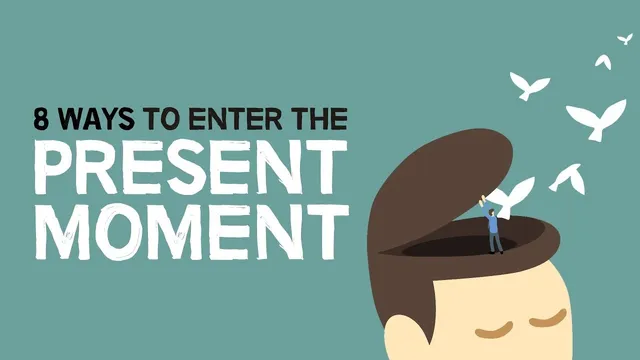
8 Ways To Enter The Present Moment
Based on Einzelgänger's video on YouTube. If you like this content, support the original creators by watching, liking and subscribing to their content.
A Harvard University finding is used to highlight that people spend nearly half their waking hours not thinking about what they’re doing, often drifting into past rumination or future worry.
Briefing
A Harvard University study is used to frame the central problem: people spend nearly half their waking hours not thinking about what they’re doing, drifting instead into rumination about the past or worry about what’s coming next. That mental time travel doesn’t just waste attention—it tends to stir emotions that can amplify unnecessary pain. The practical question becomes urgent: how can someone interrupt that cycle and actually inhabit the present moment?
The answer offered is eight discipline-friendly techniques, many drawn from Buddhist and Stoic traditions, that redirect attention away from mental chatter and back to immediate experience. Breath meditation is the first method: rather than controlling breathing like a relaxation exercise, practitioners watch the breath and how it affects body and mind. The approach is broken into stages—observing the body and sensations, noticing feelings such as anger as they arise and linger, and then tracking thoughts as they come and go.
Several methods then target bodily awareness as an “escape hatch” from thinking. Focusing on the inner body—tight muscles, digestion, or other sensations—turns autopilot processes into a live stream of present-moment data, calming the mind by keeping attention anchored inside. Touching offers another route: feel contact points (like sitting on a chair and noticing where the buttocks meet the seat), hold a small object such as a marble, or bring full attention to routine tasks like washing hands or brushing teeth.
Repetition and timing are used to quiet the mind as well. Reciting mantras—ranging from “ohmm” in Hinduism to Buddhist recitation of the Buddha’s name, and even Islamic phrases like “La ilaha illallah”—gives attention a steady object in the present. Another tactic is “waiting for the next thought,” popularized through Eckhart Tolle’s work: become conscious of thoughts, then anticipate what the next one will be, using that moment of anticipation to disrupt automatic mental flow.
Other practices sharpen perception rather than concentration. Awareness of silence trains attention to notice subtle environmental sounds, since complete silence is impossible while breathing and living. Listening closely to words shifts focus outward—useful for social anxiety—by concentrating on what someone else is saying instead of rehearsing what to say next or judging past remarks. Finally, focusing on movement treats everyday actions—walking, cleaning, sitting, standing, shaking hands—as opportunities to pull attention out of planning and worry and into the physical reality of what the body is doing right now.
Taken together, the methods share a single mechanism: attention becomes present when it is repeatedly redirected to immediate sensory experience, whether through breath, touch, sound, inner sensations, or the timing of thoughts. The techniques are framed as simple but requiring discipline, especially for chronic overthinkers, and they aim to make “now” not a concept but a practiced state.
Cornell Notes
The transcript argues that people often spend close to half their waking hours not thinking about what they’re doing, instead cycling between past rumination and future worry. To break that loop, it offers eight ways to enter the present moment by redirecting attention away from mental chatter and toward immediate experience. Techniques include breath meditation (Ānāpānasati), sensing the inner body, mindful touch, mantra recitation, and “waiting for the next thought.” It also recommends training perception through awareness of subtle silence, close listening to words, and focusing on everyday movements. The practical value is clear: these methods aim to reduce unnecessary emotional pain by anchoring attention in what’s happening right now.
Why does the transcript treat past rumination and future worry as the core obstacle to being present?
How does Ānāpānasati differ from typical breathing exercises?
What makes “feeling the inner body” useful as a standalone practice?
How can touching practices turn ordinary life into present-moment training?
What is the mechanism behind “waiting for the next thought”?
How does close listening help with social anxiety?
Review Questions
- Which present-moment technique most directly anchors attention in internal bodily sensations, and what specific sensations are suggested?
- Compare breath meditation and mantra meditation: what does each practice give the mind to focus on?
- How do the transcript’s listening and movement practices differ in where attention is redirected (outward to speech vs. inward to physical action)?
Key Points
- 1
A Harvard University finding is used to highlight that people spend nearly half their waking hours not thinking about what they’re doing, often drifting into past rumination or future worry.
- 2
Breath meditation (Ānāpānasati) is framed as mindfulness of breathing rather than breath control, with attention moving through body sensations, feelings, and thoughts.
- 3
Focusing on the inner body—such as muscle tightness or digestion—turns autopilot processes into a present-moment anchor that can calm the mind.
- 4
Mindful touch can be practiced through contact points (like sitting) or through fully feeling everyday tasks such as washing hands and brushing teeth.
- 5
Mantra recitation uses repetition to give attention a stable present object, with examples drawn from Hindu, Buddhist, and Islamic traditions.
- 6
“Waiting for the next thought” interrupts automatic thinking by making thought anticipation itself the focus of awareness.
- 7
Close listening and focusing on movement reduce self-referential mental loops by shifting attention to the other person’s words or to the physical reality of ordinary actions.