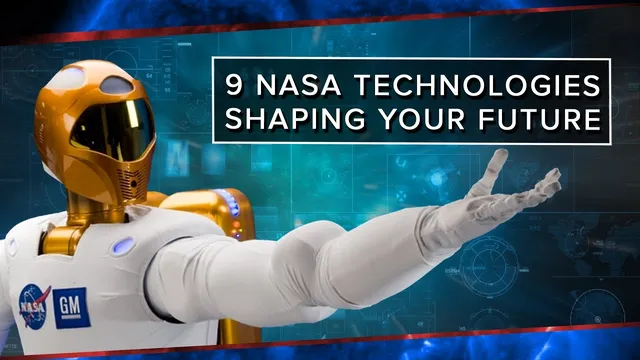
9 NASA Technologies Shaping YOUR Future
Based on PBS Space Time's video on YouTube. If you like this content, support the original creators by watching, liking and subscribing to their content.
A robo glove prototype amplifies grip to reduce hand fatigue and repetitive-motion stress during ISS spacewalks, drawing inspiration from Robonaut’s robotic hand.
Briefing
NASA-developed technologies have quietly migrated into everyday life—especially for Americans born after the mid-1990s—through a steady stream of “spinoffs” that solve real problems in space and then get repackaged for Earth. The through-line is practical: NASA’s constraints in orbit and during launches force engineering breakthroughs, and many of those breakthroughs translate into consumer products, medical tools, and industrial safety systems.
One of the clearest examples is a prototype “robo glove” designed for astronauts working outside the ISS. Long spacewalk tasks can cause hand fatigue and grip-strength loss, so the glove amplifies human grip and aims to improve dexterity while reducing repetitive-motion stress. It draws inspiration from the robotic hand used in the Robonaut system already tested on the ISS.
Sleep is another target. Because the ISS cycles through sunrise and darkness roughly every 90 minutes, astronauts can struggle with circadian rhythms. Researchers at Stony Brook University studied how vibration patterns can synchronize brain signals from both the auditory system and the vestibular system (which helps regulate balance). After extensive testing on hamsters—chosen for similarities in vestibular function—scientists identified vibration regimes that can induce either wakefulness or sleep. That work is tied to a downloadable insomnia app called Sleep Genius, which pairs the vibration approach with classical music.
For nutrition and closed-loop life support, NASA’s microalgae research has had a major downstream impact. NASA’s earlier experiments explored algae as a way to convert waste into oxygen and food. Later, researchers found certain algae species can produce DHA, a compound also found in human breast milk and important for infant brain development. Today, this microalgae-derived DHA is used in more than 90% of baby formula sold in the US and in nearly two-thirds of baby formula worldwide.
Other spinoffs address mechanical shocks, human physiology, and safety. Shock absorbers developed to protect rocket-fueling gantries from launch vibrations were adapted for earthquake-prone buildings in places like Tokyo and San Francisco; installations reportedly show no even minor damage across hundreds of buildings. Memory foam—used to distribute pressure and improve comfort—traces back to NASA work aimed at designing seating that supports astronauts during high-G launch phases without creating painful pressure points.
NASA’s medical and monitoring innovations also extend beyond space. In microgravity, astronauts lose bone density about 10 times faster than people with osteoporosis on Earth, alongside major muscle loss. NASA-funded research produced a chair that uses targeted high-frequency vibrations to “trick” bones into maintaining strength and also triggers muscle contractions without voluntary effort, currently in prototype physical therapy use. For temperature monitoring inside bulky suits, ingestible thermometers provide core-body readings via sensors and transmitters. And for visibility in low-contrast environments, infrared laser strobe lights paired with video processing help create an infrared “sonar” effect for fog—an approach that can translate into firefighter goggles able to see through smoke and flames.
Finally, agriculture tech is getting a space makeover. Sensors that monitor leaf thickness can trigger automatic irrigation based on plant health, reducing water waste on space stations; farm prototypes can even send status updates via text message. Taken together, these spinoffs show how solving extreme constraints in space can produce tangible benefits on Earth, from sleep aids and infant nutrition to earthquake protection and medical rehabilitation.
Cornell Notes
NASA spinoffs translate spaceflight engineering into widely used Earth applications by solving specific constraints—fatigue, sleep disruption, closed-loop life support, vibration shocks, and human health risks in microgravity. Examples include a robo glove that amplifies grip for spacewalks, vibration-based sleep technology that led to Sleep Genius, and microalgae-derived DHA now present in most US baby formula. Launch and structural shock research produced earthquake-dampening systems, while NASA work on pressure distribution helped seed memory foam. Medical and monitoring advances include vibration-based exercise chairs for bone and muscle maintenance, ingestible core-temperature pills, and infrared laser systems that improve vision in fog and smoke. These transfers matter because they turn costly, high-stakes space problems into scalable tools for everyday life.
How does the robo glove aim to solve a spacewalk problem, and what earlier system influenced its design?
What research linked vibrations to sleep or wakefulness, and how did it become a consumer product?
Why did microalgae research become a major ingredient in baby formula?
What is the connection between NASA shock-absorber work and earthquake protection on Earth?
How do NASA-linked vibration technologies address both bones and muscles in microgravity?
How does the infrared laser approach help pilots see through fog, and what Earth use does it suggest?
Review Questions
- Which NASA spinoff examples in the transcript directly target circadian rhythm, and what biological systems were involved?
- What chain of reasoning connects rocket-launch vibration problems to earthquake-resistant building design?
- How do the vibration-based chair and the robo glove each use amplification or stimulation, but for different human limitations?
Key Points
- 1
A robo glove prototype amplifies grip to reduce hand fatigue and repetitive-motion stress during ISS spacewalks, drawing inspiration from Robonaut’s robotic hand.
- 2
Vibration research at Stony Brook University linked auditory and vestibular signal synchronization to induced wakefulness or sleep, leading to the Sleep Genius insomnia app paired with classical music.
- 3
Microalgae research evolved into a DHA supply chain for infant formula, with microalgae-derived DHA now used in most US baby formula and a large share worldwide.
- 4
Shock absorbers developed for rocket gantry stability were adapted into earthquake-dampening building systems, with reported zero even-minor quake damage across hundreds of installations.
- 5
Memory foam’s pressure-distribution concept traces back to NASA seating design needs during high-G shuttle takeoffs.
- 6
NASA-funded vibration-based therapy aims to counter microgravity bone loss and muscle deterioration by using high-frequency vibrations that trigger bone “weight-bearing” responses and involuntary muscle contractions.
- 7
Ingestible thermometers and infrared laser imaging show how NASA monitoring and sensing solutions can become practical tools for space safety and emergency response on Earth.