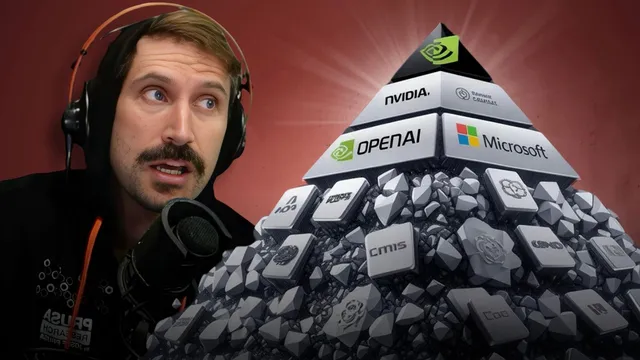
99% of AI start ups will be Dead by 2026
Based on The PrimeTime's video on YouTube. If you like this content, support the original creators by watching, liking and subscribing to their content.
Many AI startups are essentially “LLM wrappers”—prompt pipelines wrapped in a UI—so they often lack a defensible moat.
Briefing
AI startups face a brutal selection process: many “LLM wrapper” companies—marketed as AI products but built mostly as thin interfaces over OpenAI or similar model APIs—are likely to burn out as funding tightens and competitors get embedded into existing platforms. The core warning is that “prompt rappers” can be copied quickly, lack durable moats, and often survive only by converting heavy usage into short-term revenue while relying on a rented intelligence layer.
A long detour through past tech bubbles frames the present moment as familiar. In the late 1990s and early 2000s, internet-era valuations soared on hype and investor attention, then collapsed when business models failed to match the money. The transcript draws a parallel to today’s AI boom: investment and product launches look explosive, but many companies may not have a sustainable purpose beyond packaging model calls into a UI. The “rapper” metaphor is used to describe tools that are essentially prompt pipelines stapled to a front end—sometimes with little more than API calls, templated instructions, and basic integrations.
The economics of these wrappers are portrayed as fragile. Because the underlying model capability is widely accessible, differentiation often comes down to distribution and convenience rather than unique technology. That creates a dependency chain: wrappers drive API usage for model providers, but if wrappers fail, the distribution layer they provide can shrink. At the same time, the transcript pushes back on a simplistic claim that model providers are doomed if wrappers die; it argues that the real exposure is more tangled—wrappers may be loss-making and interchangeable, yet they can also be the growth engine that brings users into the ecosystem.
Nvidia is positioned as the “silent kingmaker,” not because it sells the apps, but because it controls the compute supply chain. Training and inference depend on constrained GPU manufacturing and logistics, so any disruption—export controls, geopolitical tensions, supply shortages, or manufacturing delays—can stall the entire stack from model training to real-time responses. The transcript emphasizes that the AI industry’s bottleneck is increasingly hardware access, not just software ingenuity.
The discussion then shifts to what might actually survive. The most durable winners are expected to be companies that integrate AI closer to where work happens—inside developer tools, communication workflows, or domain-specific platforms—so switching costs and user dependency grow. “Just being a rapper” is treated as insufficient; the wrapper needs to become part of a larger product people already rely on. Examples mentioned include tools that generate templated responses or workflow outputs inside existing systems, creating stickiness through usefulness rather than novelty.
Finally, the transcript argues that many AI startups are chasing optics—fake demos, inflated headcount, and investor-deck hockey sticks—rather than building enduring infrastructure, memory layers, workflow engines, or defensible distribution. In that environment, the likely outcome is not that AI disappears, but that a large fraction of wrapper-heavy startups fade into irrelevance as the market demands real differentiation, tighter unit economics, and deeper integration.
Cornell Notes
The transcript warns that many AI startups are “LLM rappers”: thin UIs and prompt pipelines built on top of OpenAI (and similar providers). Because the underlying intelligence is rented and easy to replicate, these companies often lack a durable moat and can’t withstand funding pressure or fast-follow competitors. Compute access—especially Nvidia’s GPU supply chain—acts as a systemic bottleneck that can stall the whole ecosystem when disrupted. Survival, the discussion suggests, depends less on clever wrappers and more on integration into existing workflows and products that create switching costs and real user dependence.
Why does the transcript call many AI startups “LLM rappers,” and what does that imply for their business durability?
How does the transcript connect wrapper startups to model providers’ economics?
What role does Nvidia play in the AI startup survival story?
What kinds of AI products are described as more likely to last than thin wrappers?
What is the “gold rush” critique, and how does it relate to the predicted startup failures?
Review Questions
- What specific characteristics make an AI startup vulnerable if it relies mainly on UI + prompt pipelines over rented model capability?
- How does compute supply chain risk (e.g., GPU shortages or export controls) change the way you evaluate AI company resilience?
- Which integration strategies (inside existing workflows vs standalone tools) are presented as most likely to create switching costs?
Key Points
- 1
Many AI startups are essentially “LLM wrappers”—prompt pipelines wrapped in a UI—so they often lack a defensible moat.
- 2
Thin wrappers can be copied quickly, making differentiation depend on convenience and distribution rather than unique technology.
- 3
Nvidia’s GPU supply chain is treated as a systemic bottleneck; disruptions can stall training, inference, and product development across the ecosystem.
- 4
Model providers benefit from wrapper-driven API usage, but wrapper fragility can still threaten distribution and reach.
- 5
The transcript argues that durable winners integrate AI into where work already happens, creating stickiness and switching costs.
- 6
A large share of AI startups may chase optics and short-term fundraising rather than building infrastructure, memory/workflow layers, or defensible distribution.
- 7
The predicted “startup deaths” are framed as a market correction: AI continues, but wrapper-heavy businesses fade when unit economics and differentiation fail.