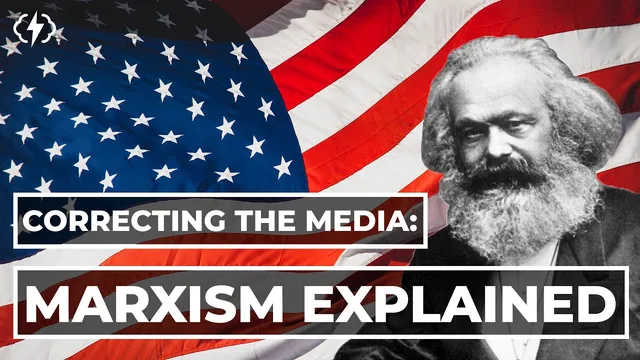
A Future Beyond Capitalism? Socialism Explained.
Based on Second Thought's video on YouTube. If you like this content, support the original creators by watching, liking and subscribing to their content.
Capitalism is portrayed as a profit-driven system that keeps wages low through unemployment and worker replaceability.
Briefing
The central claim is that capitalism is structurally unstable and systematically prioritizes profit over human well-being—so socialism is presented as the necessary next step to end recurring crises, mass precarity, and preventable suffering. The argument ties everyday economic life (wages, unemployment, housing, healthcare) to global power politics, arguing that the same profit logic drives both domestic inequality and foreign interventions.
The case begins with a historical framing: capitalism replaced feudalism and raised global production, but like feudalism it became outdated. A shift in public perception—capitalism increasingly seen as worsening lives even in wealthy countries—is treated as an inflection point signaling a broader societal transition. From there, capitalism is described less as an identity than as a tool for organizing monetary relations, meaning criticism of it should not be treated as an attack on a nation.
The transcript then lays out why capitalism supposedly fails in practice. Worker pay is portrayed as constrained by power imbalances: executives and owners control hiring and firing, profits are extracted from labor, and unemployment is described as a “reserve” that keeps workers fearful and wages low. That wage pressure is linked to a market problem: if workers can’t afford what they produce, consumer demand collapses, leading to depressions. The recurring “boom and bust” business cycle is offered as evidence that crises are not accidents but built-in features.
Financial crises are used as concrete illustrations, especially the 2008 housing crash. Predatory lending is described as feeding a speculative real-estate bubble that burst, triggering mass job losses, foreclosures, and long-term harm—while executives and capital owners allegedly avoided comparable consequences. The same profit logic is extended to the pandemic era, where wealth rose for the richest while many others lost livelihoods and healthcare. Because healthcare is tied to employment through insurance incentives, losing a job is framed as losing access to care.
Housing and homelessness are used to argue that scarcity is artificial. The transcript cites the coexistence of large homeless populations and millions of vacant homes, arguing that housing is withheld not because it can’t be built or funded, but because it isn’t profitable enough. It also claims that automation and labor markets under capitalism intensify job insecurity, while benefits and rights remain conditional.
Internationally, capitalism is portrayed as exporting its logic through imperial behavior—oil, regime change, and corporate-friendly environments—arguing that U.S. interventions often serve capital interests. The Iraq War is highlighted as an example of propaganda and false intelligence enabling an unjustifiable conflict.
Finally, socialism is presented as an alternative that flips capitalism’s priorities: scaled pay based on work, elimination of homelessness, universal healthcare, and democratic workplace control through worker co-ops. The transcript argues that capitalism’s requirement for endless growth on a finite planet guarantees worsening outcomes, while socialism would treat human needs as primary. It also addresses common objections: “free market” reforms are said to have failed in many developing contexts; the “American dream” is described as having eroded since the Reagan era; and “socialism has never worked” is countered with examples like Bolivia under Evo Morales and Burkina Faso under Thomas Sankara—followed by the claim that capitalist powers and allied forces repeatedly block such experiments.
The closing message is that wealthy countries could fund universal healthcare, education, climate mitigation, infrastructure, and fair compensation, but resources are instead directed toward militarism, corporate tax breaks, and bailouts. Marxism, socialism, and communism are framed as rejecting a dystopian status quo and expanding universal rights and care for the less fortunate.
Cornell Notes
The transcript argues that capitalism is not just unfair but structurally unstable: it keeps wages low through unemployment, produces artificial scarcity, and generates recurring crises through boom-and-bust dynamics. It links domestic precarity—low pay, homelessness, and job-tied healthcare—to global behavior, claiming profit incentives drive foreign interventions. Socialism is presented as the corrective system: pay aligned with work, democratic workplace control, universal access to essentials like healthcare, and the ability to eliminate homelessness and reduce the harms of automation. The transcript also tackles objections by claiming “free market” policies often fail, the American dream has declined, and socialist-leaning governments have improved lives before being undermined by external capitalist power.
Why does the transcript claim unemployment benefits capitalists rather than workers?
How does the transcript connect low wages to economic depressions?
What role does the 2008 housing crash play in the argument?
Why does the transcript say homelessness persists despite many vacant homes?
What is the transcript’s response to “socialism has never worked”?
What does the transcript propose as socialism’s practical differences from capitalism?
Review Questions
- Which mechanisms in the transcript are used to argue that capitalism produces both low wages and recurring crises?
- How does the transcript use housing and healthcare to claim that scarcity and access are shaped by profit incentives rather than necessity?
- What evidence does the transcript offer to rebut the claim that socialism “has never worked,” and how does it explain the outcomes of those cases?
Key Points
- 1
Capitalism is portrayed as a profit-driven system that keeps wages low through unemployment and worker replaceability.
- 2
The transcript links low wages to weak consumer demand, arguing this contributes to boom-and-bust cycles and periodic depressions.
- 3
Financial crises like 2008 are presented as predictable outcomes of greed and speculative bubbles rather than isolated failures.
- 4
Homelessness is framed as artificial scarcity: the transcript cites vacant homes alongside large homeless populations to argue housing is withheld when it isn’t profitable.
- 5
Healthcare is described as tied to employment under capitalism, so job loss becomes a pathway to losing access to care.
- 6
Foreign interventions are argued to follow capital interests, with the Iraq War offered as an example of propaganda enabling unjustified conflict.
- 7
Socialism is presented as a system that prioritizes human needs through democratic workplace control, universal essentials, and pay aligned with work rather than profit growth.