A Simple Proof of Conservation of Energy
Based on minutephysics's video on YouTube. If you like this content, support the original creators by watching, liking and subscribing to their content.
Total energy conservation follows when a force has no explicit time dependence, meaning energy cannot drift as time passes.
Briefing
A force that doesn’t explicitly depend on time automatically leads to conservation of energy: the system’s total energy stays constant even as objects move. The reasoning hinges on a basic symmetry—physics has no “absolute” starting time. If the laws of motion work the same no matter where you place the clock’s zero, then there’s no built-in time reference for the force, and energy cannot systematically drift as time passes.
The proof starts by defining total energy as the sum of kinetic energy and potential energy. Kinetic energy depends on motion: for an object of mass m moving at speed v, it is (1/2)mv². To track whether energy changes, the derivation looks at how kinetic energy changes over time. Algebra turns the time change of (1/2)mv² into a form involving velocity times acceleration. Since acceleration relates to force through Newton’s second law (m·a = F), the rate of change of kinetic energy becomes v·F.
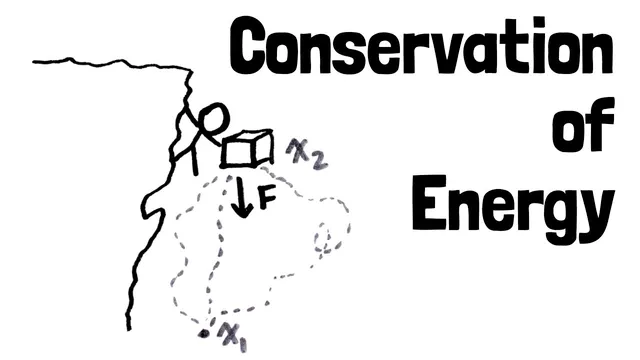
Potential energy is introduced through work. For forces that are time-independent in the required sense, the potential energy change between two positions depends only on the displacement, not on the path taken. That lets the derivation write the change in potential energy as the negative of the work done by the force: ΔU = −F·Δx. The negative sign captures the physical convention that when the force pushes in the direction of motion, potential energy decreases; when motion goes against the force, potential energy increases. Converting displacement change over time into velocity (Δx/Δt = v) yields a potential-energy rate of change of −v·F.
Add the two contributions—the kinetic-energy change v·F and the potential-energy change −v·F—and the result is zero. With no net change in kinetic plus potential energy, the total energy E remains constant over time, which is exactly what conservation of energy means.
The transcript also clarifies a subtlety: “no explicit time dependence” does not mean the force is identical everywhere along the path. The force may vary from place to place, but at any given position it must not change with time. For a more formal treatment, the same result can be expressed with calculus as dE/dt = F·v − F·v = 0. Finally, the most general and rigorous framework behind this kind of conservation law is Noether’s theorem, tied to Emmy Noether’s 1915 work: time-translation symmetry corresponds to energy conservation across all of physics.
Cornell Notes
When a force has no explicit time dependence, the system’s total energy stays constant. Kinetic energy is (1/2)mv², and its time change can be rewritten as v·F using Newton’s second law. Potential energy is defined so that its change equals the negative of the work done by the force, giving a time change of −v·F (with displacement change over time equal to velocity). Adding both rates yields dE/dt = v·F − v·F = 0, so energy does not change as time passes. This connects to the broader idea that time-translation symmetry (no absolute starting time) implies conservation of energy, formalized by Noether’s theorem.
Why does “no absolute time” connect to conservation of energy?
How does the change in kinetic energy become v·F?
What assumption about the force is required for potential energy to be well-defined here?
Why does potential energy change come with a minus sign?
How does adding kinetic and potential energy changes prove conservation?
What is the more general principle behind this result?
Review Questions
- In the derivation, what exact cancellation leads to dE/dt = 0, and what physical quantities produce each term?
- What does “force doesn’t depend explicitly on time” allow the force to do as an object moves, and what does it forbid?
- How would the proof’s structure change if the force depended explicitly on time? (Identify which step would fail.)
Key Points
- 1
Total energy conservation follows when a force has no explicit time dependence, meaning energy cannot drift as time passes.
- 2
Kinetic energy is K = (1/2)mv², and its time change can be rewritten as v·F using Newton’s second law.
- 3
Potential energy is defined so that its change equals the negative of work: ΔU = −F·Δx, assuming the force is time-independent in the needed sense.
- 4
Converting displacement change over time to velocity turns the potential-energy rate into −v·F.
- 5
Adding the kinetic and potential energy rates gives dE/dt = v·F − v·F = 0, proving conservation of energy.
- 6
The force may vary with position along a trajectory, but it must not vary with time at a fixed position.
- 7
Noether’s theorem generalizes the connection between time-translation symmetry and energy conservation, rooted in Emmy Noether’s 1915 work.