A Systematic Approach to Instantly Doubling Your Productivity
Based on Ali Alqaraghuli, PhD's video on YouTube. If you like this content, support the original creators by watching, liking and subscribing to their content.
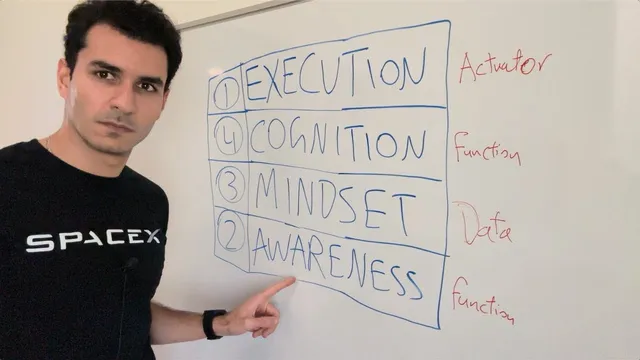
Productivity is modeled as four sequential layers: awareness, mindset, cognition, and execution, which together bridge ideas to real-world action.
Briefing
Productivity doesn’t stall because of one missing “discipline” trait—it breaks down in a specific mental layer. A systematic model lays out four sequential stages that bridge ideas to real-world action: awareness, mindset, cognition, and execution. When someone diagnoses which layer is failing—especially common with ADHD—productivity improvements can come quickly because the fix targets the bottleneck instead of trying to brute-force the whole process.
Awareness is the starting gate: people must be able to notice what they want and what’s happening around them. Without that, planning becomes guesswork. The model emphasizes that many people—often including those with ADHD—can’t answer what they want long-term without pausing and thinking deeply, and they struggle to connect short-term desires to long-term goals. The recommended exercise is straightforward: write down what you want long-term and what you want short-term, then bridge the gap so the plan has a clear destination.
Mindset follows as the belief layer. Beliefs about the self and about the world act like a lens that shapes what a person can perceive and pursue. Limiting beliefs—such as assuming you can’t learn what you need to start a business or that the economy will prevent customers from buying—can “lock in” attention and block forward vision. The model frames mindset as something that can be updated by replacing stored “belief code” with new lines supported by evidence. A first-principles, physics-style test is suggested for challenging whether an obstacle is real: ask whether something violates fundamental constraints (or whether the real barrier is simply missing skills that can be acquired).
Cognition is the “how” layer: it’s the ability to learn, process information, and solve problems—often associated with being able to think quickly and adapt. Even with limited cognitive horsepower, the model argues that strategy matters: build roadmaps and step-by-step paths toward goals. This is where systems thinking becomes central, and where the creator positions a separate, deeper discussion of cognition as necessary for full implementation.
Execution is the final interface with reality—the “actuator” that turns plans into performance. For people with ADHD, execution problems often come from executive dysfunction and time blindness: the ability to translate cognitive intent into action is impaired, and self-criticism doesn’t help because the circuitry isn’t optimized for consistent follow-through. The model recommends practical execution hacks that reduce friction and increase urgency or interest. One approach is to remove distractions and make the work the most compelling option by eliminating stronger dopamine alternatives. Another is to use a calendar as the real to-do list so tasks are visible in time and space. It also points to physiological levers (like avoiding blood-sugar spikes, exercising, and cold showers) and, more broadly, the use of external systems to compensate for memory and time-management weaknesses.
The payoff is diagnostic: productivity can be “doubled” by identifying whether the bottleneck is awareness (journal/meditate), mindset (install new beliefs), cognition (build roadmaps), or execution (use external systems like calendars). The model’s core claim is that targeted fixes outperform generic effort because the brain’s process is modular, and each layer has a different remedy.
Cornell Notes
The model breaks productivity into four ordered layers that move ideas into action: awareness → mindset → cognition → execution. Awareness is the ability to recognize what you want long-term and short-term; without it, planning lacks a target. Mindset is the belief system about yourself and the world, which can either widen or block what you can perceive and pursue. Cognition is the “how” layer—learning, processing, and problem-solving—where roadmaps and strategy matter. Execution is the “actuator” that performs in the real world, and for ADHD it often fails due to executive dysfunction and time blindness, so external systems like calendars and distraction reduction become crucial.
Why does the model treat awareness as the first productivity bottleneck?
How do beliefs function in this framework, and what’s the practical way to change them?
What does cognition mean here, and why are roadmaps emphasized?
What makes execution uniquely hard for ADHD, according to the model?
Which execution hacks does the model recommend, and what problem does each target?
How does the model suggest diagnosing the right fix instead of trying everything at once?
Review Questions
- In what way does the model connect long-term goal clarity to downstream execution, and what exercise is used to build that clarity?
- How does the model distinguish cognition (“how”) from execution (“actuation”), and what are examples of each layer’s interventions?
- If someone can’t follow through on tasks despite understanding what they want, which layer is most likely failing and what specific system would you implement first?
Key Points
- 1
Productivity is modeled as four sequential layers: awareness, mindset, cognition, and execution, which together bridge ideas to real-world action.
- 2
Awareness fails when people can’t clearly identify what they want long-term versus short-term; writing and bridging that gap is the proposed fix.
- 3
Mindset is treated as beliefs about the self and the world that act like a lens; limiting beliefs can block perception and progress.
- 4
Cognition is the “how” layer—learning and problem-solving—where roadmaps and step-by-step paths increase follow-through.
- 5
Execution is the “actuator” that performs in the real world; ADHD-related executive dysfunction and time blindness make self-criticism ineffective.
- 6
External systems (especially calendars as the to-do list) are recommended to compensate for time blindness and memory issues.
- 7
The fastest productivity gains come from diagnosing which layer is the bottleneck and applying the corresponding remedy.