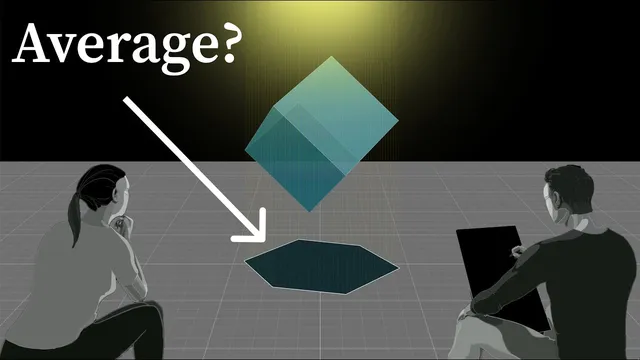
A tale of two problem solvers | Average cube shadow area
Based on 3Blue1Brown's video on YouTube. If you like this content, support the original creators by watching, liking and subscribing to their content.
For vertical, infinitely distant light, the projected area of a tilted square face equals its face area times |cos θ|, where θ is the angle between the face normal and the vertical.
Briefing
The average shadow of a cube—when light comes from directly above and the cube is tossed into every possible orientation—turns out to depend only on the cube’s surface area, not on its detailed geometry. The final result is that the mean shadow area equals one quarter of the cube’s total surface area, giving 1/4 · 6s² = 3s² for a cube of side length s. The striking part isn’t just the number; it’s the route to it, which links a concrete geometry problem to a broad principle about convex solids.
Two contrasting problem-solving styles drive the solution. Bob focuses on computation. He first reduces the shadow of a tilted face to a trigonometric scaling: for a flat face with area s², the projected shadow area equals s² · |cos θ|, where θ is the angle between the face’s outward normal and the vertical direction of the light. Averaging over all orientations then becomes an average of |cos θ| over a uniform distribution of normal directions on a sphere. Carrying out the integral yields a clean constant: the average shadow area of a randomly oriented square face is exactly one half the face’s area.
Alice takes a higher-level route that avoids most of that calculus. She begins with a geometric counting idea: for any fixed orientation of a convex solid, every point in the shadow corresponds to exactly two “face crossings” of a light ray through the solid—entering and exiting. Convexity guarantees this two-to-one relationship (except for edge cases that contribute zero area). From that, she concludes that the shadow area of the whole cube equals one half the sum of the shadow areas of its six faces.
The next step is a clever rearrangement of averaging. Instead of averaging the cube’s shadow over orientations directly, she swaps the order of summation and averaging: the average of the sum of face shadows equals the sum of the average face shadows. Because each face is just a rotated copy, each face has the same universal average projection factor. Once Bob’s constant for a square face is known (1/2 of the face area), Alice’s framework turns it into the cube result: the cube’s average shadow area is (1/2) · 6 · (1/2)s² = 3s², i.e., one quarter of the cube’s surface area.
The argument doesn’t stop at cubes. Alice’s reasoning extends to any convex solid: the average shadow area is proportional to surface area with the same proportionality constant. She pins down that constant using the sphere, whose shadow is always a circle of area πr² while its surface area is 4πr², making the ratio 1/4. For solids with curved surfaces, she justifies the extension by approximating them with polyhedra whose faces hug the sphere more tightly.
Finally, the discussion turns meta: the real unresolved subtlety is what “random orientation” means. Bob effectively assumes a uniform distribution of face normals over the sphere, while Alice’s averaging relies on a specific distribution choice that’s easy to miss—an issue reminiscent of Bertrand’s paradox in probability. The cube-shadow puzzle thus becomes a lesson in both geometry and the hidden assumptions behind “averages.”
Cornell Notes
A cube tossed into all orientations casts shadows whose average area depends only on surface area. For a cube of side s, the mean shadow area is 1/4 of its total surface area: 1/4 · 6s² = 3s². Bob computes the key constant by projecting a tilted square face: a face’s shadow area scales as s²|cos θ|, and averaging |cos θ| over uniformly distributed face normals on a sphere gives an average of (1/2)s². Alice then uses convexity to relate the cube’s shadow to the sum of its face shadows (cube shadow = 1/2 of the total face-shadow sum) and swaps averaging with summation so the same constant applies to every face. The same proportionality principle extends to all convex solids, with the constant fixed using the sphere’s shadow.
Why does the shadow area of a tilted square face scale like |cos θ| times the face area?
How does convexity produce the relation “cube shadow = one half the sum of face shadows” for a fixed orientation?
What does it mean to “swap” averaging and summation in Alice’s method, and why does it help?
How does Bob’s integral lead to the constant that the average shadow area of a square face is half the face area?
Why does the proportionality constant for convex solids match the sphere’s ratio 1/4?
Review Questions
- For a single face, what geometric quantity determines the projected shadow area under vertical, infinitely distant light: the face’s tilt angle, the normal vector, or something else? Explain the role of |cos θ|.
- In Alice’s method, where exactly does convexity enter, and what would fail for a non-convex shape like a donut?
- What hidden assumption about “random orientation” is needed for Bob’s uniform distribution on the sphere of normals, and why might different choices change the average?
Key Points
- 1
For vertical, infinitely distant light, the projected area of a tilted square face equals its face area times |cos θ|, where θ is the angle between the face normal and the vertical.
- 2
Averaging over all orientations can be reduced to averaging |cos θ| over uniformly distributed face normals on the unit sphere.
- 3
Bob’s calculation gives a universal constant: the average shadow area of a square face is exactly one half the face’s area.
- 4
Convexity ensures a two-to-one relationship between cube shadow points and face crossings of light rays, implying cube shadow area equals half the sum of face shadow areas for any fixed orientation.
- 5
Alice’s averaging step swaps “average of a sum” into “sum of averages,” letting the same universal face constant determine the cube’s mean shadow.
- 6
Combining the face constant with the convexity relation yields the cube’s mean shadow area: 1/4 of total surface area, i.e., 3s² for a cube of side s.
- 7
The proportionality principle extends from cubes to all convex solids, with the constant fixed by the sphere’s shadow-to-surface-area ratio of 1/4.