Abstract Linear Algebra 1 | Vector Space
Based on The Bright Side of Mathematics's video on YouTube. If you like this content, support the original creators by watching, liking and subscribing to their content.
A vector space is a nonempty set V with two operations: vector addition (V×V→V) and scalar multiplication (F×V→V) using a field F.
Briefing
Abstract linear algebra starts by stripping vectors of their familiar coordinates and rebuilding them from rules. The core move is defining a vector space as a nonempty set V equipped with two abstract operations: vector addition (taking two vectors in V and returning another vector in V) and scalar multiplication (taking a scalar from a field F and a vector in V, again returning a vector in V). This framework matters because it lets linear algebra work in settings far beyond R^n and C^n—any time objects obey the same algebraic laws, the same geometric and computational ideas can follow.
Once the two operations are in place, the definition becomes precise through a set of eight axioms. First, the vectors under addition must form an abelian group: addition is associative, there is a zero vector that leaves any vector unchanged when added, every vector has an additive inverse (so v + (−v) equals the zero vector), and addition is commutative. These properties ensure that vector addition behaves predictably even when vectors are abstract objects rather than arrows in space.
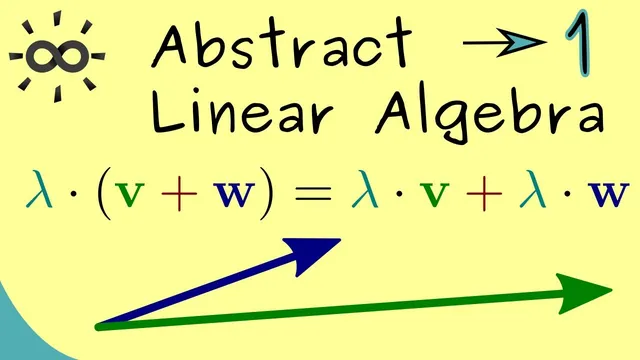
Next come the axioms tying scalar multiplication to the field F and to vector addition. Scalar multiplication must be compatible with multiplication in the field: scaling a vector by two scalars in succession must match scaling by their product in F. It also must respect the multiplicative identity of the field: scaling by 1 leaves vectors unchanged. Finally, two distributive laws connect scalar multiplication with addition. One law says scaling the sum of two vectors equals the sum of the individually scaled vectors. The other says scaling by the sum of two scalars equals adding the two separately scaled vectors. Together, these distributive rules guarantee that the “two different plus signs” (addition in V versus addition in F) interact correctly.
With these axioms satisfied, V becomes an F-vector space, meaning the choice of field is part of the structure. Real and complex vector spaces are highlighted as the most important cases, but the definition allows any field depending on the problem at hand. The practical takeaway is that computations and reasoning can be carried out inside this abstract setting much like in R^n and C^n. Arrow diagrams remain a helpful visualization, but the elements of V are not inherently arrows—those are just a mental model. The payoff is that later topics like linear maps, change of basis, inner products (for angles and orthogonality), and eigenvalues can be generalized to these abstract spaces once the vector-space foundation is secure.
Cornell Notes
A vector space is built from a nonempty set V plus two operations: vector addition (V×V→V) and scalar multiplication (F×V→V), where scalars come from a field F. The definition becomes usable through axioms: addition must form an abelian group (associativity, zero vector, additive inverses, commutativity). Scalar multiplication must be compatible with field multiplication and respect the field’s multiplicative identity. Two distributive laws then connect scalar multiplication with both vector addition and field addition. When all these rules hold, V is an F-vector space, and familiar linear-algebra reasoning from R^n and C^n can be transferred to much more abstract settings.
Why does the definition require a field F for scalars, rather than just any numbers?
What does it mean for vector addition to form an abelian group in an abstract vector space?
How do the scalar-multiplication axioms ensure scaling behaves like ordinary multiplication?
Why are there two distributive laws, and what do they connect?
What is the role of arrow diagrams if vectors are not necessarily arrows?
Review Questions
- List the eight axioms required for a vector space and group them by addition, scalar multiplication, and distributive laws.
- Explain the difference between addition in the vector space V and addition in the field F, and describe how the distributive laws relate them.
- Give an example of what could count as a vector space element even if it is not an arrow, and justify it using the axioms.
Key Points
- 1
A vector space is a nonempty set V with two operations: vector addition (V×V→V) and scalar multiplication (F×V→V) using a field F.
- 2
Vector addition must satisfy associativity, commutativity, a zero vector, and additive inverses, making (V,+) an abelian group.
- 3
Scalar multiplication must be compatible with field multiplication: (ab)·v = a·(b·v).
- 4
Scaling by the field’s multiplicative identity must leave vectors unchanged: 1·v = v.
- 5
Two distributive laws must hold: a·(u+v)=a·u+a·v and (a+b)·v=a·v+b·v.
- 6
The choice of field F is part of the structure, so the same set V can behave differently as an F-vector space under different fields.
- 7
Arrow diagrams are helpful intuition, but vector-space elements can be abstract objects; the axioms define what matters.