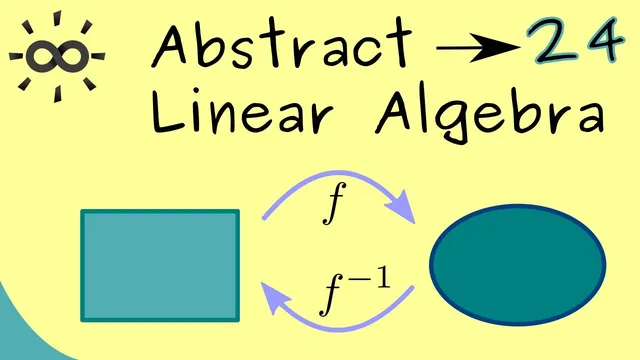
Abstract Linear Algebra 24 | Homomorphisms and Isomorphisms
Based on The Bright Side of Mathematics's video on YouTube. If you like this content, support the original creators by watching, liking and subscribing to their content.
A vector space homomorphism is a linear map that preserves addition and scalar multiplication.
Briefing
Homomorphisms and isomorphisms in linear algebra are just linear maps—distinguished by whether they preserve structure one way or in both directions. A linear map L between vector spaces V and W is defined by preserving the two operations of vector spaces: addition and scalar multiplication. Any map that preserves a given structure is called a homomorphism, so in this setting “homomorphism” and “linear map” are effectively synonyms (more precisely, a linear map is a vector space homomorphism).
An isomorphism tightens the requirement: it is a homomorphism that can be reversed. Concretely, a linear map is an isomorphism when it is invertible—meaning there exists another map G that undoes its action in both directions. On the level of sets, invertibility means F: V → W has a two-sided inverse: G ∘ F equals the identity on V, and F ∘ G equals the identity on W. The inverse is unique when it exists, and it is typically denoted F^{-1}. On sets, “invertible” and “bijective” are equivalent; bijectivity captures exactly the same condition as having a two-sided inverse.
The key linear-algebra payoff is that invertibility automatically respects linear structure. If L: V → W is linear and bijective, then its inverse map L^{-1} is also linear. So once a linear map preserves addition and scalar multiplication and is bijective, the reverse direction preserves the same structure too. This means linear structure is preserved both ways, not just from V to W.
A central example makes the idea concrete: the basis isomorphism. Start with a finite-dimensional abstract vector space V with a chosen basis B = {b_1, …, b_n}. Map V to the concrete space F^n by sending each basis vector b_j to the corresponding standard unit vector e_j in F^n. This map is linear by construction, and it is bijective because every coordinate direction in F^n corresponds to exactly one basis vector in V. Since the map is bijective and linear, its inverse is also linear—so the correspondence works in both directions. That two-way, structure-preserving correspondence is exactly what “isomorphism” means.
The general definition follows the same pattern: an isomorphism is a homomorphism that is invertible, with the inverse also preserving the structure. In practice, for vector spaces this simplifies further: a linear map that is bijective is already enough to guarantee an isomorphism, because the inverse will automatically be linear. One major consequence is that isomorphic vector spaces have the same dimension. If V and W are isomorphic, the number of basis elements cannot change, so dim(V) = dim(W). This “translation” between vector spaces is what later enables representing linear maps by matrices—by moving between abstract spaces and coordinate spaces like F^n.
Cornell Notes
A homomorphism in linear algebra is a linear map: it preserves vector addition and scalar multiplication. An isomorphism is a homomorphism that can be reversed—equivalently, a linear map that is bijective. On the set level, bijectivity matches invertibility, and the inverse is unique. Crucially, if a linear map L: V → W is bijective, then its inverse L^{-1} is automatically linear too, so structure is preserved in both directions. A basis isomorphism illustrates this: sending a chosen basis of a finite-dimensional space V to the standard basis of F^n produces a bijective linear map whose inverse is also linear. Isomorphic vector spaces therefore have equal dimension, setting up the matrix viewpoint for linear maps.
Why does “homomorphism” effectively mean “linear map” in this context?
What does it mean for a linear map to be invertible, and how is that tied to bijectivity?
Why is the inverse of a bijective linear map guaranteed to be linear?
How does the basis isomorphism demonstrate an isomorphism concretely?
What does an isomorphism imply about the dimensions of vector spaces?
Review Questions
- How do homomorphisms, invertibility, and bijectivity relate for maps between vector spaces and for maps between sets?
- What extra property turns a linear map into an isomorphism, and why does that guarantee the inverse is also linear?
- Explain the basis isomorphism construction and state what it implies about the dimensions of the involved vector spaces.
Key Points
- 1
A vector space homomorphism is a linear map that preserves addition and scalar multiplication.
- 2
An isomorphism is a linear map that is reversible, meaning it has a two-sided inverse.
- 3
On sets, invertibility is equivalent to bijectivity, and the inverse is unique when it exists.
- 4
If a linear map L: V → W is bijective, then L^{-1} is automatically linear.
- 5
The basis isomorphism maps an abstract basis of V to the standard basis of F^n and is an isomorphism.
- 6
Isomorphic vector spaces have the same dimension, because basis size cannot change under an isomorphism.